
Profile Perfect Level 667 Answer
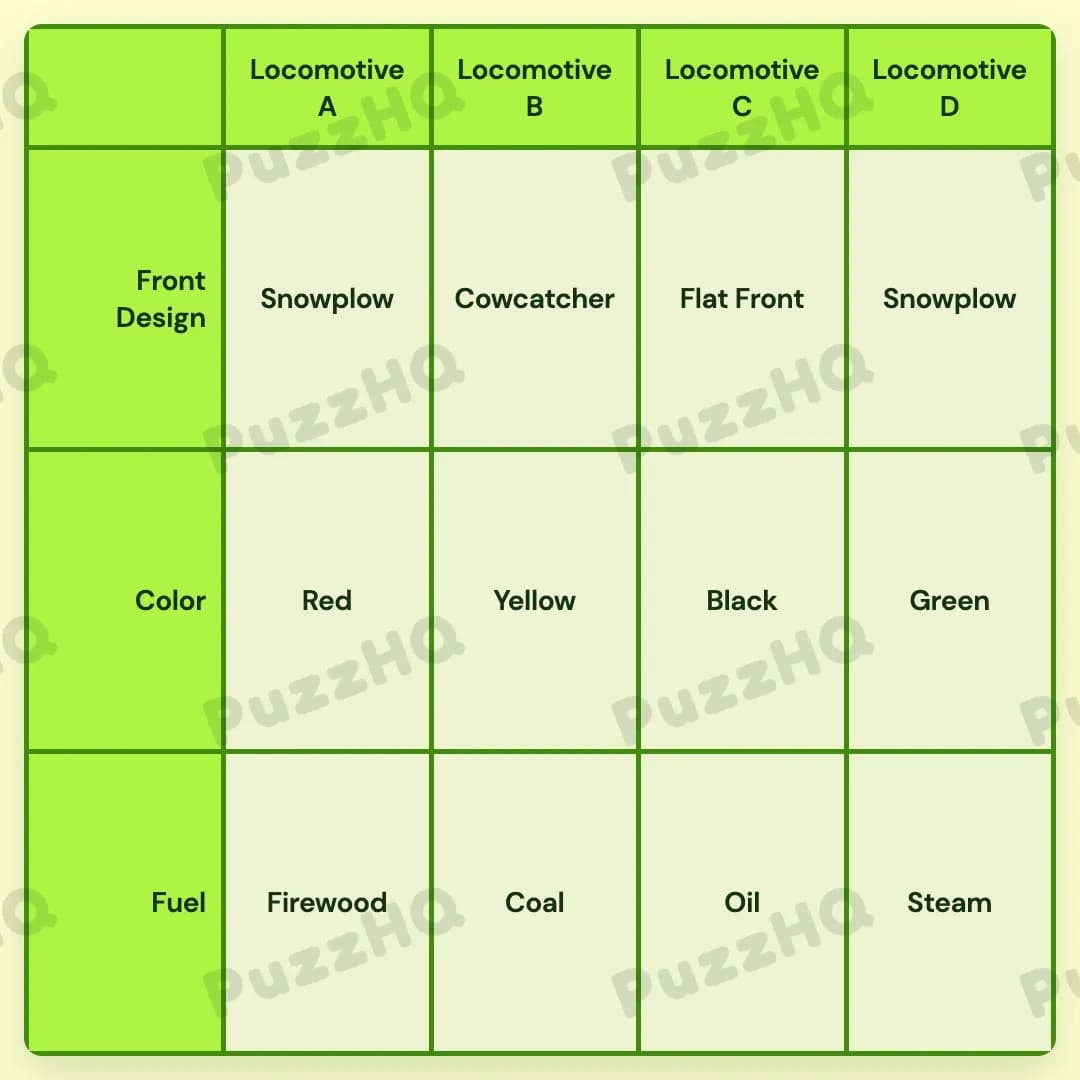
Every locomotive's design, color, and fuel type can be found by securing fixed column anchors before using spatial distance and count comparisons to finish the rest.
| Trait | Locomotive A | Locomotive B | Locomotive C | Locomotive D |
|---|---|---|---|---|
| Front Design | Snowplow | Cowcatcher | Flat Front | Snowplow |
| Color | Red | Yellow | Black | Green |
| Fuel | Firewood | Coal | Oil | Steam |
How To Think Through Profile Perfect Level 667
The key to solving this board smoothly is recognizing how positional constraints divide the grid. When a puzzle gives you boundary conditions, such as items belonging to a specific half or items that must have two neighbors, you can eliminate half the board in a single move. Instead of checking every possible combination, you should first gather the absolute anchors, split the board into halves, and let spacing rules complete the remaining assignments.
Lock In Multi-Trait Anchors First: Locomotive B Takes Cowcatcher And Coal
A clue that connects multiple traits to a single named subject is the fastest way to build an anchor on the board. You are told directly that Locomotive B has a Cowcatcher front and runs on Coal.
Because this clue names the exact locomotive alongside two separate traits, you do not need to guess where those attributes belong. Filling in Locomotive B with Cowcatcher and Coal immediately gives you a reference point in the second column. This step is crucial because future deductions about neighbors, colors, and fuels can now test against a partially completed locomotive rather than an empty grid.
Pin Down The Edges: The Extremes Reveal Green And Firewood
Edge clues are valuable because the board has clear physical boundaries. In a four-column lineup, the leftmost column is Locomotive A and the rightmost column is Locomotive D.
Two separate clues target these exact ends of the line. First, the locomotive on the rightmost edge is Green. You can immediately place Green into Locomotive D's color slot.
Second, the leftmost locomotive needs carpenters for its fuel. Carpenters work with wood, which means the fuel required for Locomotive A is Firewood. By translating this clue and assigning Firewood to Locomotive A, both outer columns now have confirmed information. You have established boundaries on both the far left and the far right, making any further positional clues much easier to measure.
Combine Regional Restrictions With Spacing: Red, Yellow, And Black Fall Into Place
Once the edges are marked, examine clues that restrict items to specific regions of the board. You are told that the Yellow and Red cars are not on the right half of the grid.
In a four-column layout, the right half consists of Locomotive C and Locomotive D, while the left half consists of Locomotive A and Locomotive B. Because Red and Yellow cannot sit on the right half, they must occupy the two slots on the left half. We already know Locomotive D is Green. This means the two rightmost cars must be Green and Black, leaving Black as the only possible color for Locomotive C.
Now look at the spacing clue: the Black locomotive is two columns away from the Red one. Locomotive C sits in column three and is Black. Counting two columns to the left brings you directly to column one, which is Locomotive A. That means Locomotive A must be Red.
With Locomotive A identified as Red, Locomotive B must take the other left-half color, which is Yellow. In just a few structured steps, every single locomotive color is determined: Locomotive A is Red, Locomotive B is Yellow, Locomotive C is Black, and Locomotive D is Green.
Use Neighbor Counts To Solve Interior Slots: Oil Belongs To Locomotive C
Positional clues involving neighbor counts work through simple geometry. A train can only have two neighbors if it is flanked on both sides, which means it must sit in an interior position rather than on an edge.
In this puzzle, the Oil powered locomotive has two neighbors. That restriction instantly rules out Locomotive A on the far left and Locomotive D on the far right, because edge trains only have a single neighbor. The only possible candidates for Oil are Locomotive B and Locomotive C.
Because our very first anchor already assigned Coal to Locomotive B, the second column cannot take Oil. Therefore, Locomotive C must be the locomotive powered by Oil.
With Firewood, Coal, and Oil accounted for, only one fuel type remains open: Steam. Locomotive D is the only locomotive without an assigned fuel, so Steam naturally belongs to Locomotive D. This completes the entire Fuel row across all four subjects.
Resolve Remaining Features With Quantity Comparisons: Balancing Flat Front And Snowplow
The final open trait is Front Design. You already know that Locomotive B uses a Cowcatcher. That leaves three open slots across Locomotive A, Locomotive C, and Locomotive D, waiting for either Flat Front or Snowplow designs.
The clue states that there are fewer trains with a Flat Front than with a Snowplow. Because three slots remain, you cannot split them evenly. Giving two trains a Flat Front and one a Snowplow would violate the clue, because that would mean more Flat Fronts than Snowplows. To satisfy the requirement, there must be fewer Flat Fronts, meaning there can only be one Flat Front alongside two Snowplows.
Locomotive C takes the single Flat Front design, while Locomotive A and Locomotive D each receive a Snowplow. This satisfies the comparison rule and completes the entire board with full logical certainty.
What This Level Teaches You
Regional Restrictions Cut Possibilities In Half
When a clue states that items do not appear on a specific half of the grid, group the subjects by column sets right away. Marking Locomotive A and Locomotive B as the only valid spots for Red and Yellow narrowed the options for four different subjects at once, forcing Black straight into the third column without any guesswork.
Neighbor Counts Separate Edges From The Center
Whenever a clue mentions that an item has two neighbors, you can immediately eliminate the first and last columns. In any straight lineup, edge subjects can only ever touch one neighbor. Using this rule lets you discard the board's perimeter and concentrate exclusively on interior columns.
Relative Comparisons Define Exact Counts
A clue stating that one trait appears less often than another helps you deduce exact quantities when slots are limited. When dividing three remaining spaces between two options, having fewer of one trait forces the split to be one versus two. Recognizing this numerical pattern lets you place repeated traits with complete confidence.
Final Thoughts
The most important solving habit for this level was translating general positional boundaries into exact columns before testing spacing rules. By using the board edges and the half-grid restriction first, you turn relative distance clues into simple, direct placements.
Comments