
Profile Perfect Level 673 Answer
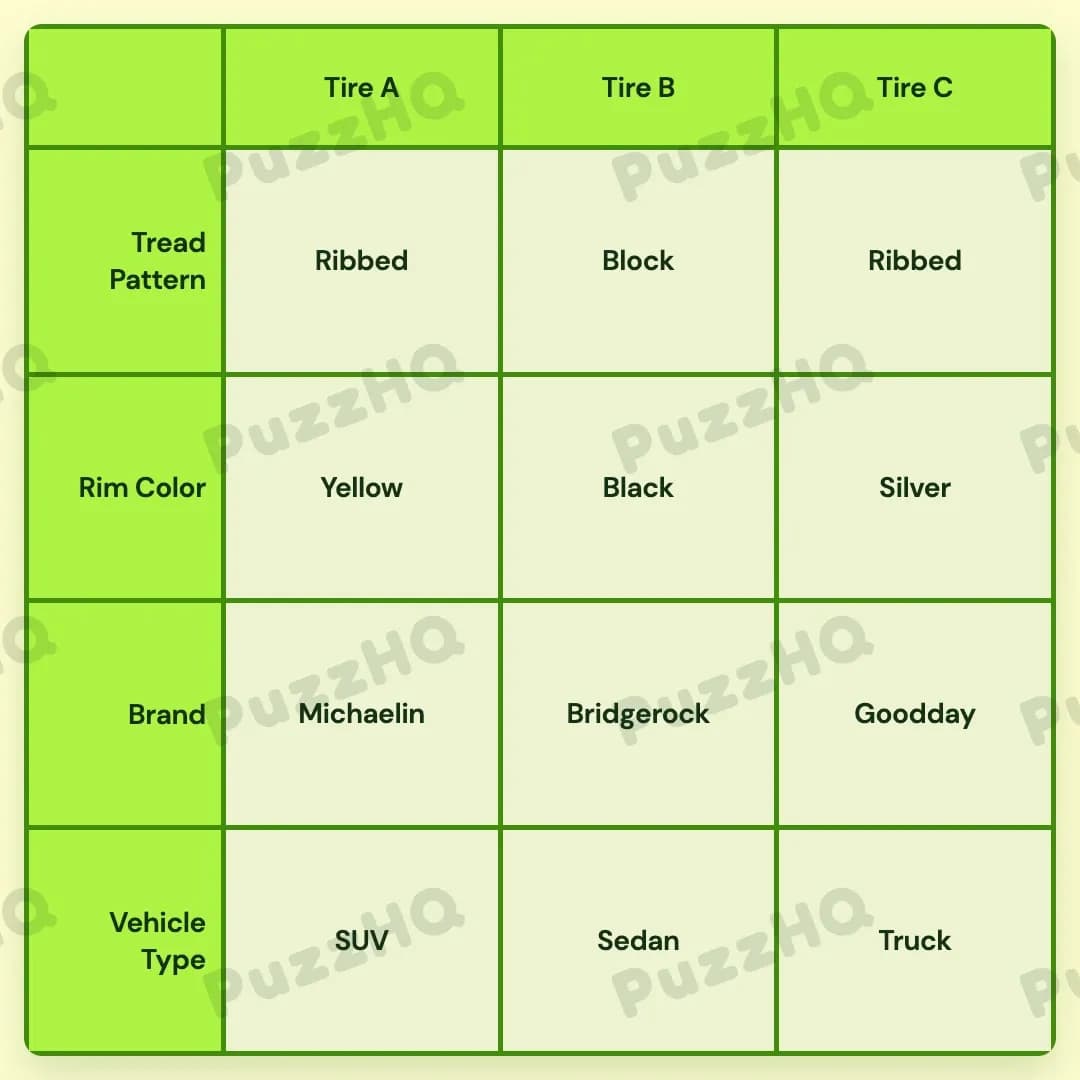
The layout is solved by anchoring the central tire through brand and vehicle clues, then using rim colors and tread availability to separate the outer positions.
| Trait | Tire A | Tire B | Tire C |
|---|---|---|---|
| Tread Pattern | Ribbed | Block | Ribbed |
| Rim Color | Yellow | Black | Silver |
| Brand | Michaelin | Bridgerock | Goodday |
| Vehicle Type | SUV | Sedan | Truck |
Building The Grid By Trait
Starting with brand positioning gives the most stable foundation because it immediately secures the central column and provides an orientation reference for all directional clues. Once the brand row establishes the physical lineup, vehicle classifications and rim finishes fall into place through direct positional dependencies.
Brand Establishes The Spatial Core And Sides
The brand row offers an immediate spatial anchor. One clue states that Bridgerock is placed directly in between the other two brands. Because the puzzle consists of Tire A, Tire B, and Tire C arranged in sequence from left to right, the middle item must belong to Tire B. Bridgerock is therefore confirmed as Tire B's brand without any ambiguity.
This middle placement immediately activates another brand rule regarding the logo. We learn that the brand featuring a humanoid logo is not to the right of Bridgerock. In real world tire manufacturing, Michaelin is famous for its iconic humanoid tire mascot. Since Tire B is Bridgerock, the humanoid brand cannot occupy Tire C on the right. It must be situated on the left side at Tire A.
Assigning Michaelin to Tire A leaves only one remaining brand name in the category, which is Goodday. With Tire A holding Michaelin and Tire B holding Bridgerock, Goodday naturally claims Tire C. This single trait row is now completely populated, creating a reliable coordinate system for the rest of the puzzle.
Vehicle Type Locks The Center And Identifies The Outer Posts
With the three columns anchored, the vehicle type category provides the next breakthrough by isolating non adjacent items. A clue specifies that the tires used for SUV and Truck are not neighbors. In a three tire display, the only two positions that are not neighbors are the far ends, Tire A and Tire C.
Because Tire A and Tire C must divide the SUV and Truck designations between them, Tire B cannot belong to either of those categories. That leaves Sedan as the only possible vehicle type for Tire B. Placing Sedan in the middle column matches the structure established by the brand row, pairing Bridgerock directly with the Sedan.
Determining which outer post receives SUV and which receives Truck requires consulting the rim characteristics, but locking Sedan into Tire B already shrinks the vehicle possibilities down to a binary choice between Tire A and Tire C.
Rim Color Connects Vehicle Assignments To Visual Finishes
The rim color row resolves the vehicle ambiguity through a direct directional relationship. We are told that the Sedan sits to the right of the Yellow rim. Since Sedan is firmly established as Tire B, the Yellow rim must sit to its left. Tire A is the only tire to the left of Tire B, which means Tire A must have the Yellow rim.
Next, a clue mentions that the rim of the Truck's tire looks very shiny after being cleaned. Among the available rim colors, Silver is the shiny metallic option. Because Tire A has already claimed the Yellow rim, Tire A cannot be the Truck. Therefore, Tire A must take the SUV classification, and Tire C must be the Truck.
With Tire C identified as the Truck, its shiny finish assigns Silver to Tire C's rim color. The only rim color left to place is Black, which fills the remaining vacancy at Tire B. The rim color category is now fully resolved alongside the vehicle type category, pairing Yellow with the SUV, Black with the Sedan, and Silver with the Truck.
Tread Pattern Resolves Through Contrast And Rarity
The final trait to complete across all three subjects is tread pattern. The category contains two styles, Ribbed and Block, distributed among the three tires. Two specific clues govern how these patterns behave.
First, we know that the tires with Black and Yellow rims have different tread patterns. From our solved rim color row, Yellow belongs to Tire A and Black belongs to Tire B. Because their tread designs must contrast, Tire A and Tire B cannot share the same pattern. One must be Ribbed and the other must be Block.
Second, a clue notes that currently only one brand has the tread pattern in stock. This tells us that one tread style appears exactly once in the grid while the alternative style appears twice. If the solitary pattern belonged to multiple tires, it could not be unique to a single brand.
Looking at the pairing, Tire B is the unique item between the two distinct rims. Assigning Block to Tire B makes it the solitary in stock pattern for Bridgerock. Tire A and Tire C then share the Ribbed tread pattern. This satisfies the contrast rule because Tire A's Yellow rim has a Ribbed pattern while Tire B's Black rim has a Block pattern. It also satisfies the rarity rule because only one brand carries the Block design.
Where The Trait Rows Intersect
Vehicle Placement Dictates Rim Color
The connection between the vehicle type row and the rim color row is crucial because neither category can solve Tire A and Tire C independently. The clue stating that the Sedan is to the right of the Yellow rim acts as the bridge. Knowing that the Sedan sits in the middle column instantly locks Yellow onto the left column. This discovery instantly rules out the shiny Silver rim for Tire A, which in turn forces Truck into Tire C and SUV into Tire A.
Brand Identification Guides The Flanking Positions
The intersection between brand recognition and column index provides the directional anchor for the entire puzzle. By using the humanoid mascot clue relative to Bridgerock's central spot, the brand row prevents any mirror image confusion. Without knowing that Michaelin sits on the left, subsequent clues involving directional movement to the right of specific traits could not be evaluated with certainty.
Rim Colors Unlock Tread Distribution
The relationship between rim colors and tread patterns proves far more powerful than inspecting the tread patterns in isolation. By establishing that Black and Yellow rims must feature contrasting tread patterns, the solved rim row directly controls the pattern choices for Tire A and Tire B. Pairing this constraint with the single brand inventory clue quickly isolates the unique Block pattern at Tire B, allowing the duplicated Ribbed pattern to fill Tire A and Tire C seamlessly.
Final Grid Check
Every category now aligns cleanly with every other row. Bridgerock sits squarely in the middle with a Sedan classification, a Black rim, and an exclusive Block tread pattern. Michaelin occupies the left post as an SUV with a Yellow rim and Ribbed tread, placing it neatly to the left of the central Sedan. Goodday completes the right post as a Truck with a shiny Silver rim and Ribbed tread, safely separated from the SUV. Every clue is satisfied, and the entire puzzle locks into place with total consistency.
Comments