
Profile Perfect Level 668 Answer
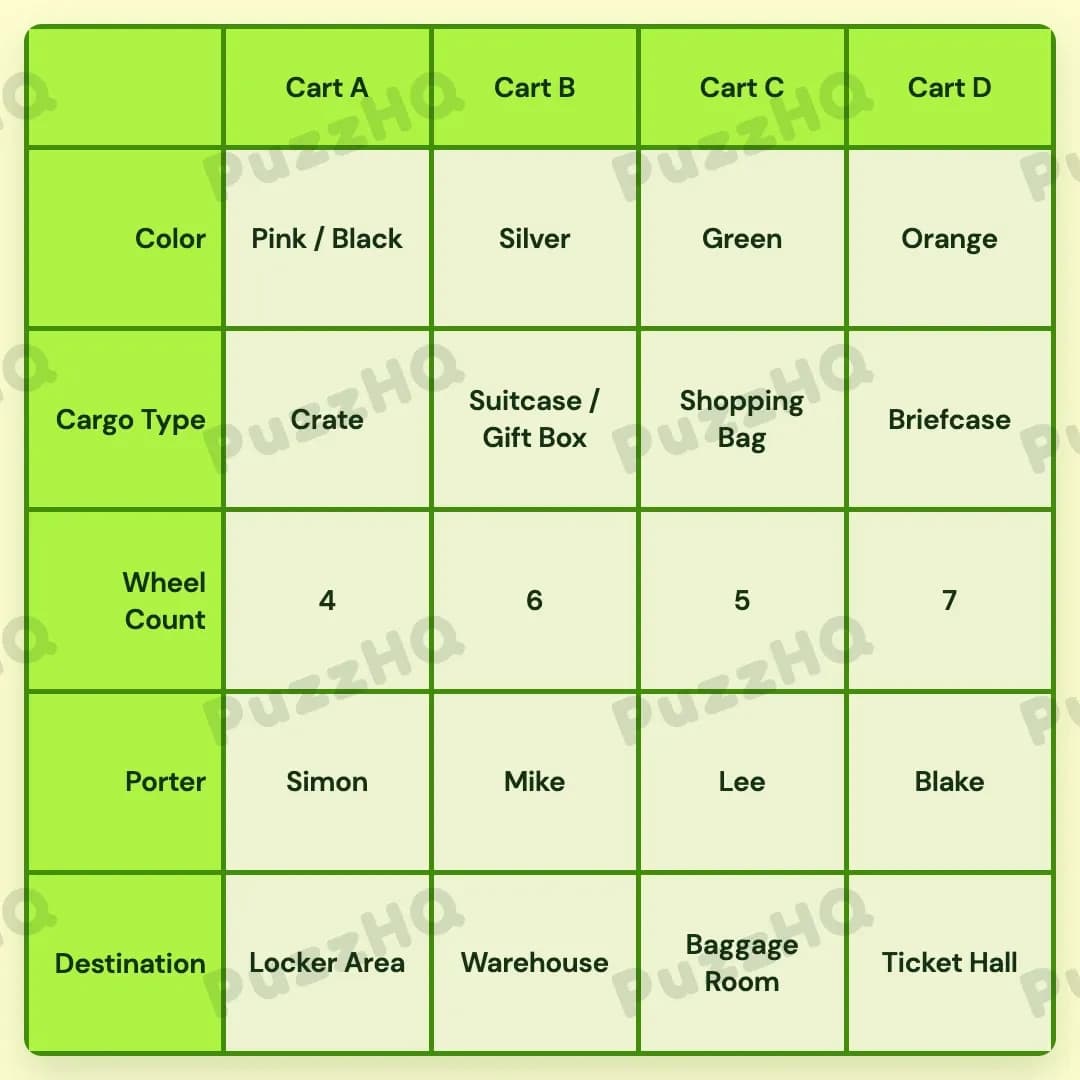
Every cart can be completely deduced by anchoring the wheel counts and colors before tracing cargo destinations across the luggage platform.
| Trait | Cart A | Cart B | Cart C | Cart D |
|---|---|---|---|---|
| Color | Pink / Black | Silver | Green | Orange |
| Cargo Type | Crate | Suitcase / Gift Box | Shopping Bag | Briefcase |
| Wheel Count | 4 | 6 | 5 | 7 |
| Porter | Simon | Mike | Lee | Blake |
| Destination | Locker Area | Warehouse | Baggage Room | Ticket Hall |
Building The Grid By Trait
Starting directly with the Wheel Count row offers the cleanest entry point, because numerical comparisons establish positional structure immediately when paired with cart colors.
Wheel Count And Color Set The Physical Layout
The physical structure of each cart provides the firmest baseline. We know that the cart painted in orange has the most wheels, which means the orange cart carries seven wheels. Alongside this, we learn that the four wheeled cart features a pink handle, which pairs four wheels directly with the pink coloring.
Positional clues quickly tie these values to specific columns. We are told that the cart immediately to the left of the briefcase has five wheels. This requirement forces five wheels into an interior position where a briefcase can sit to its immediate right. Furthermore, we know that Mike pushes the cart with the second most wheels, giving him six wheels. With the available wheel values spanning four, five, six, and seven, placing the five wheeled cart directly to the left of the briefcase aligns Cart C with five wheels and leaves Cart D to hold seven wheels.
Because seven wheels belongs to the orange cart, Cart D must be orange. Cart A takes the four wheeled build with the pink and black finish, while Cart B takes the six wheeled design. The only remaining color options assign silver to Cart B and green to Cart C. This neatly locks both the entire Wheel Count row and the entire Color row across all four subjects.
Cargo Type Takes Shape Along The Line
With the physical cart bodies settled, we can examine the freight resting inside them. We are told that the silver cart moves the suitcase to another location, immediately placing the suitcase in Cart B. Additionally, clues mention a gift box, noting that the cart next to the gift box is full of crates, while the cart with only green is situated to the right of the gift box.
Since Cart C is green, the cart to its immediate left must contain the gift box. That means Cart B holds the gift box alongside the suitcase. Following the neighboring rule, the cart next to the gift box carries crates, which assigns the crates to Cart A.
We also know that the briefcase sits immediately to the right of the five wheeled cart. Since Cart C has five wheels, Cart D must hold the briefcase. That leaves Cart C with the shopping bag. Every position along the Cargo Type row is now locked into place, establishing crate in Cart A, suitcase and gift box in Cart B, shopping bag in Cart C, and briefcase in Cart D.
Destination Resolves The Station Endpoints
The freight types directly dictate where the carts must travel. We are told that stacks of wooden boxes go into the lockers, while crates and their neighbor are sent to the warehouse or locker. Because Cart A carries the wooden crates, Cart A heads straight for the Locker Area.
The neighbor of Cart A is Cart B, meaning Cart B must claim the warehouse route. That satisfies the warehouse or locker condition for Cart A and its neighboring vehicle.
Next, we evaluate the remaining two destinations, which are the Ticket Hall and the Baggage Room. A clue points out that Simon handles the cart farthest from the one destined for the Ticket Hall. Because Cart A sits at the extreme opposite end of the platform, the cart farthest away from it is Cart D. Therefore, Cart D must head to the Ticket Hall, leaving Cart C to proceed toward the Baggage Room. The Destination row now aligns across all four carts without any ambiguity.
Porter Assignments Complete The Roster
Now that destinations and wheel counts are established, the porters can be assigned to their respective carts. The clue regarding Simon states that he handles the cart farthest from the Ticket Hall cart. Since Cart D is heading to the Ticket Hall, Cart A is the farthest cart from it, meaning Simon pushes Cart A. This fits nicely with the blonde porter pushing the four wheeled pink cart.
Next, we look at Mike. An earlier clue stated that Mike pushes the cart with the second most wheels. The six wheeled cart is Cart B, so Mike takes Cart B.
This leaves two porters, Lee and Blake, to fill Cart C and Cart D. We are told that the cart with a total of seven wheels is not handled by Lee. Since Cart D has seven wheels, Lee cannot take Cart D. This assigns Lee to Cart C. Blake takes the remaining post at Cart D. We also see that Lee sits at Cart C, and his neighbor Cart B heads to the warehouse rather than the locker area, which satisfies the restriction that Lee's neighbor does not head to the Locker Area.
Where The Trait Rows Intersect
Wheel Count Anchors The Briefcase Position
Looking at wheels alone gives relative numbers, and looking at cargo alone gives an unordered manifest. The clue stating that the cart to the left of the briefcase has five wheels acts as a vital bridge between these two separate categories. It translates a numeric wheel quantity into a spatial anchor for cargo placement, ensuring that Cart C claims five wheels while Cart D claims the briefcase.
Color Coordinates Cargo Across Adjacent Slots
Color by itself only tells us how the carts look, but matching colors to cargo reveals the entire spatial layout. The green cart being to the right of the gift box links the Color row directly to the Cargo Type row. Once Cart C is recognized as green, Cart B must house the gift box, which instantly helps solve both Cart A's crates and Cart B's dual parcel status.
Destination Directs Porter Geography
The destination path provides the crucial leverage needed to sort the porters. Simon's clue links his identity not to a cart number, but to the cart farthest from the Ticket Hall destination. By solving the destinations first, we uncover that Cart D belongs to the Ticket Hall. That instantly isolates Cart A as Simon's cart, showing how destination geography determines personnel.
Final Grid Check
Every row in this solution confirms the logic of the others. Cart A combines four wheels, pink styling, Simon, crates, and the locker area in complete accordance with each neighbor rule. Cart B links silver paint and six wheels to Mike, the suitcase, and the warehouse. Cart C holds Lee, green paint, five wheels, and the baggage room without violating neighboring locker restrictions. Finally, Cart D holds seven wheels, orange paint, Blake, and the briefcase traveling to the ticket hall. Each trait category interlocks smoothly with the rest to form an airtight solution.
Comments