
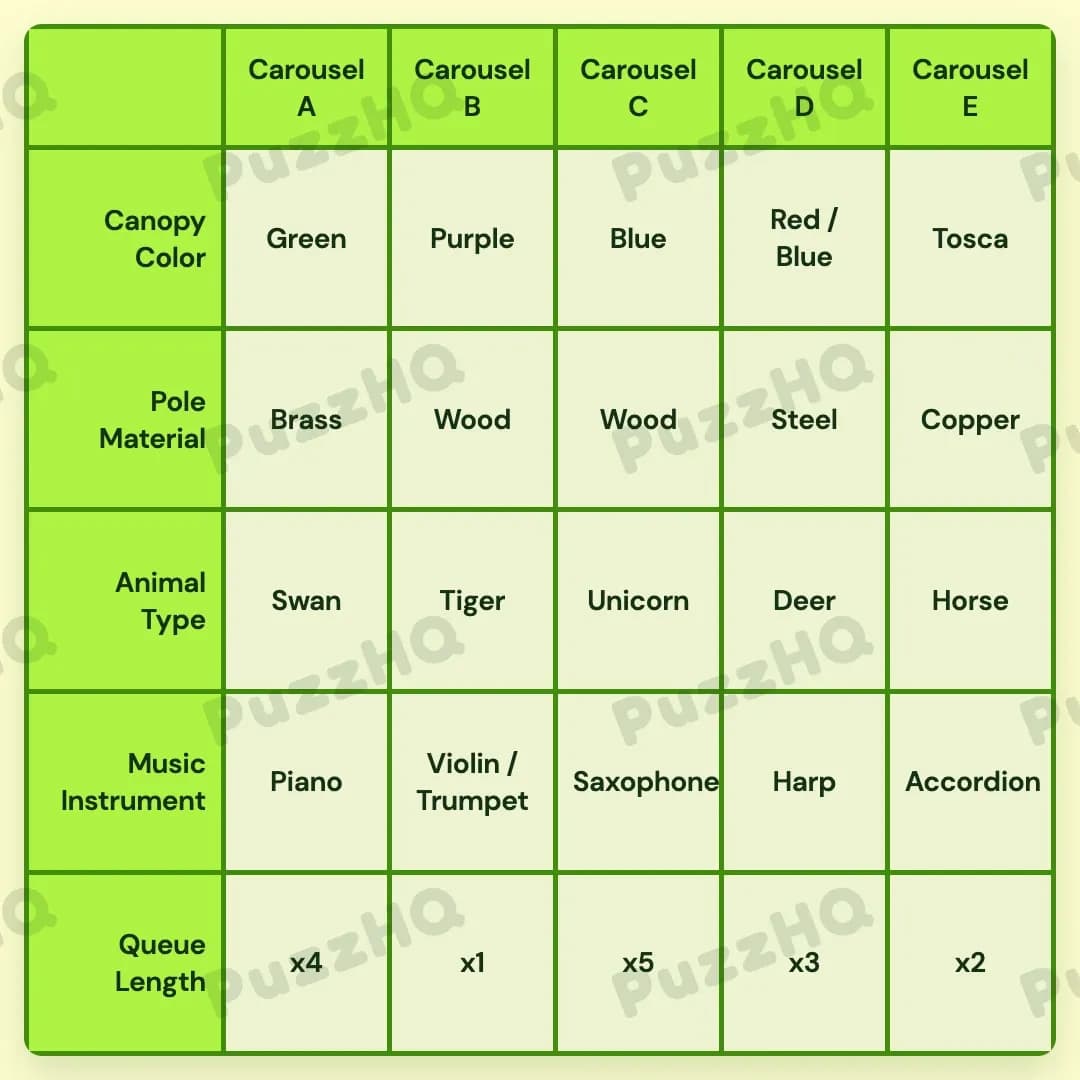
Profile Perfect Level 680 Answer
To solve this level, anchor the carousel pole materials and queue lengths through positional clues, match unique animal traits to canopy colors, and use remaining process of elimination to complete the board.
| Trait | Carousel A | Carousel B | Carousel C | Carousel D | Carousel E |
|---|---|---|---|---|---|
| Canopy Color | Green | Purple | Blue | Red / Blue | Tosca |
| Pole Material | Brass | Wood | Wood | Steel | Copper |
| Animal Type | Swan | Tiger | Unicorn | Deer | Horse |
| Music Instrument | Piano | Violin / Trumpet | Saxophone | Harp | Accordion |
| Queue Length | x4 | x1 | x5 | x3 | x2 |
How To Think Through Profile Perfect Level 680
The most reliable habit on this level is identifying anchor clues that combine an exact position with a neighbor relationship. When a clue specifies both an end position and the material of its neighbor, it establishes two subjects at once. From there, you can connect queue rankings, unique thematic traits, and process of elimination without guessing.
Anchor Through Neighbor Clues: Lock In Carousel E And Carousel D
Clues that name an edge position while describing an adjacent subject are ideal starting points. They fix multiple cells immediately and give relative clues something solid to reference.
The clue stating that Carousel E has a Copper pole that is not as durable as its Steel neighbor gives two facts at once. Because Carousel E sits at the far right of the layout, its only neighbor is Carousel D. This directly assigns:
- Carousel E receives the Copper pole.
- Carousel D receives the Steel pole.
Placing these two poles immediately narrows down where the other pole materials can go. It also establishes fixed references for any comparison clues involving Steel or Copper later in the solve.
Use Positional Superlatives: Find Carousel A And Carousel B
Superlatives such as most unpopular or shortest queue refer to extreme values in a trait set. When paired with a spatial direction, they pin down subjects across columns.
The clue noting that the carousel to the left of the most unpopular one has a Brass pole establishes two positions. Because the carousels run from A through E, the subject to the left of another carousel can only be Carousel A, B, C, or D. If the most unpopular carousel is Carousel B with a queue length of x1, then the carousel to its immediate left must be Carousel A.
This confirms:
- Carousel A receives the Brass pole.
- Carousel B holds the lowest queue length of x1.
- Carousel A receives its queue length of x4.
With Brass at Carousel A, Steel at Carousel D, and Copper at Carousel E, the remaining unassigned pole material is Wood. Because Carousel B and Carousel C are the only empty slots left for pole materials, both Carousel B and Carousel C must have Wood poles.
Apply Extremes To Duplicate Values: Resolve The Remaining Queues
When a clue mentions a pair sharing a trait and links them to an extreme mathematical difference, look for the widest spread among the remaining numbers.
The clue states that two carousels sharing the same pole material have the biggest difference in queue lengths. The duplicate pole material is Wood, which belongs to Carousel B and Carousel C. Since Carousel B already has the lowest queue length of x1, Carousel C must take the highest queue length on the board, which is x5.
Next, look at the clue stating that slightly more people queue for the Steel pole carousel than the Copper pole carousel. We already know:
- Carousel D has the Steel pole.
- Carousel E has the Copper pole.
The remaining unassigned queue lengths are x2 and x3. Because the Steel carousel queue is slightly larger than the Copper carousel queue, Carousel D receives x3 and Carousel E receives x2. Every single queue length is now completely resolved.
Link Thematic Descriptions: The Magical Animal And Carnivore
Clues often use descriptive categories instead of literal subject names. Recognizing how these categories map to the available options allows you to combine multiple traits into a single subject.
Two clues use category descriptions:
- The carnivore animal is under the Purple tent.
- Saxophone solos accompany the magical animal.
Looking at the available animal options, the only carnivore is the Tiger. Looking at the available canopies, the Purple canopy must therefore belong with the Tiger. The clue describing Carousel B's instrument as a guitar's little brother points toward Violin / Trumpet, placing the Tiger and the Purple canopy at Carousel B.
For the magical animal, the only creature that qualifies is the Unicorn. The clue binds the Unicorn directly to the Saxophone. Carousel C is the only open slot that can hold both the Unicorn and the Saxophone. This places the Unicorn as the animal and the Saxophone as the instrument at Carousel C.
Eliminate Alternates: Separate The Final Animals And Canopies
Binary clues give you a choice between two specific values for a slot. They are designed to sit idle until one of those two values is claimed or eliminated by another subject.
The clue stating that either the Horse or the Swan is under the Green canopy becomes powerful once the rest of the animals fall into place. At Carousel E, the clue describing the herbivore next to the Horse shows that the Horse sits at the edge next to another herbivore, placing the Horse at Carousel E and the Deer at Carousel D.
With the Horse committed to Carousel E:
- The Green canopy cannot belong to the Horse, so it must belong to the Swan.
- The only remaining carousel needing both a canopy and an animal for this pair is Carousel A, placing the Green canopy and the Swan at Carousel A.
- Carousel D receives the Red / Blue canopy.
- The remaining canopy for Carousel E is Tosca, while Carousel C receives Blue.
Close Out The Final Traits: Finish The Instruments
Once the major attributes are filled, use the final descriptive clues along with standard elimination to finish the board.
The clue stating that sounds under the Red canopy come from a plucked instrument directs you to Carousel D, which carries the Red / Blue canopy. The Harp is a plucked instrument, which locks the Harp into Carousel D.
With four instruments placed (Piano, Violin / Trumpet, Saxophone, and Harp), only the Accordion remains unassigned. Placing the Accordion into the final open instrument slot at Carousel E completes the grid.
What This Level Teaches You
Edge Positions Turn Neighbor Clues Into Direct Hits
When a clue mentions a neighbor of an edge position such as Carousel E, there is only one possible adjacent carousel. Always look at the ends of the board first when reading neighbor clues, because edge positions remove all ambiguity about which neighbor the clue means.
Use Extreme Spread Clues Right After Finding One Extreme
The clue about the carousels with identical poles having the largest queue difference was unsolvable until Carousel B was identified as the minimum value. Once you fix a minimum or maximum, relative spread clues instantly solve the opposite end of the spectrum.
Thematic Categories Cut Down Trial And Error
Words like carnivore, magical animal, or plucked instrument are not decorative flavor text. They are strict category filters. Grouping your options into categories before placing them prevents you from guessing among names that share the same general type.
Final Thoughts
The key to mastering Profile Perfect Level 680 is sequencing your steps by certainty. Starting with the edge neighbor relationship at Carousel E unlocked the pole materials, which immediately set up the queue length extremes. When you let fixed structural placements guide your thematic matches, the entire grid falls into place without any need for guesswork.
Comments