
Profile Perfect Level 694 Answer
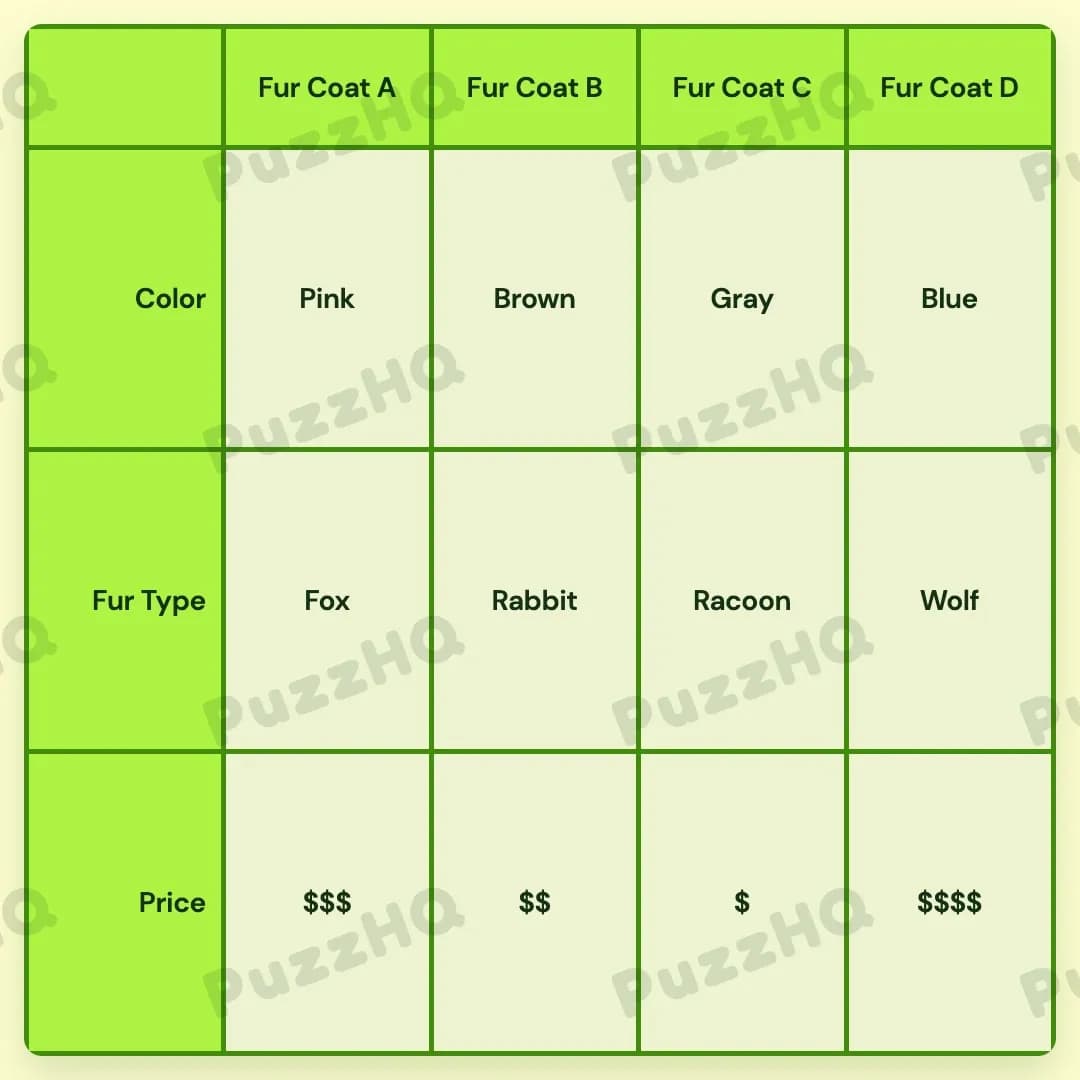
Fur Coat A is Pink Fox fur priced at $$$, Fur Coat B is Brown Rabbit fur priced at $$, Fur Coat C is Gray Racoon fur priced at $, and Fur Coat D is Blue Wolf fur priced at $$$$.
| Trait | Fur Coat A | Fur Coat B | Fur Coat C | Fur Coat D |
|---|---|---|---|---|
| Color | Pink | Brown | Gray | Blue |
| Fur Type | Fox | Rabbit | Racoon | Wolf |
| Price | $$$ | $$ | $ | $$$$ |
How I Solved Profile Perfect Level 694
Looking at the board initially, the grid set up four distinct coats labeled A through D across the top, while the traits asked me to assign a fur type, a color base, and a price tier to each one. What immediately caught my eye was a relative placement clue mentioning the Racoon fur and the Pink coat, along with a pair of specific identity clues that locked down the second coat right away.
Pinning Down Coat B And The Pink Coat Spacing
The first thing I noticed was the mention of the longest ear animal in the second clue. Between a fox, a rabbit, a raccoon, and a wolf, the rabbit is unmistakably the animal known for having the longest ears. That gave me my very first confirmed trait: Fur Coat B used Rabbit fur.
Right beside that discovery, the fifth clue stated that Rabbit fur is paired with a Brown coat base. Because Fur Coat B held the Rabbit fur, it immediately took Brown as its color.
With Fur Coat B locked in as Brown, I turned back to the clue linking the Racoon fur and the Pink coat. That clue specified that the Racoon fur was located exactly two columns to the right of the Pink coat. In a four-column grid running from Coat A to Coat D, there were only two theoretical starting positions for something two steps to the left of another item. The Pink coat had to be either Coat A, which would place the Racoon in Coat C, or Coat B, which would place the Racoon in Coat D.
Because I had just discovered that Coat B was Brown, Coat B could not possibly be Pink. That single elimination settled the question. The Pink coat had to belong to Fur Coat A. Moving two columns to the right landed directly on Fur Coat C, which meant Fur Coat C had to be the one made with Racoon fur.
Spacing Ruled Out Where The Wolf Fur Could Go
With Fur Coat B established as Rabbit and Fur Coat C established as Racoon, only two coats remained without an assigned fur type: Fur Coat A and Fur Coat D. The two remaining fur options were Fox and Wolf.
At this stage, the adjacency restriction came into play. The fourth clue warned that Wolf and Rabbit furs were not used side by side. Rabbit fur was already fixed onto Fur Coat B. Its immediate physical neighbors in the rack were Fur Coat A to its left and Fur Coat C to its right. Because Wolf fur could not sit next to Rabbit fur, it was strictly forbidden from appearing on either Coat A or Coat C.
Coat C already had Racoon fur, so that was already safe, but the restriction definitively ruled out Coat A for the Wolf fur. That left only Fur Coat D with an open slot that was not adjacent to Coat B. I placed Wolf fur into Fur Coat D. By basic process of elimination, the Fox fur had to belong to Fur Coat A.
At that point, the entire fur row was complete: Coat A was Fox, Coat B was Rabbit, Coat C was Racoon, and Coat D was Wolf.
Sorting The Remaining Colors And Prices
With colors, Coat A was Pink and Coat B was Brown. That left only Gray and Blue to distribute between Fur Coat C and Fur Coat D.
Looking at the remaining clues about color, two of them tied colors directly to price rankings. One clue noted that the Gray coat was priced the lowest of all coats, which corresponds to the single dollar sign tier. Another clue stated that superior quality made the Blue coat the most expensive, corresponding to the four dollar sign tier.
To determine which coat was Gray and which was Blue, I looked at the clue mentioning that Coat C uses a color similar to two of the animals. Fur Coat C featured Racoon fur, and Coat D featured Wolf fur. Both raccoons and wolves are naturally associated with shades of gray. Coat C taking the Gray base aligned cleanly with this observation. Blue, on the other hand, is an artificial coat hue that does not resemble any of the wild animals in the puzzle.
That placed Gray on Fur Coat C and Blue on Fur Coat D.
Once the colors were fully settled, the price assignments quickly unfolded. Because Fur Coat C was Gray, it received the lowest price tag of $. Because Fur Coat D was Blue, it received the top price tag of $$$$.
That left only the middle two price tiers, $$ and $$$, to be divided between Coat A and Coat B. The seventh clue stated that the Pink coat's neighbor has a lower price tag. The Pink coat was Coat A. Its only immediate neighbor on the grid was Coat B. For Coat B to have a lower price tag than Coat A, Coat A had to take the higher of the two available tiers, which was $$$, while Coat B took $$.
With that final comparison, every slot on the board was accounted for.
The Point Where I Nearly Went Wrong
The clue stating that the Pink coat's neighbor has a lower price tag could easily lead to an assumption that the Pink coat sits somewhere in the middle of the grid with two neighbors. If someone rushes, they might wonder which neighbor the clue refers to, or assume Coat A cannot be Pink because it only has one neighbor on its right side.
In logic puzzles of this format, an end column item still has an adjacent neighbor, just a single one rather than two. Recognizing that Fur Coat A's only neighbor is Fur Coat B keeps the deduction clean and avoids unnecessary second-guessing. Once Coat B was confirmed as Brown, Fur Coat A was the only possible starting point for the two-column jump to the Racoon anyway, which completely resolved any doubt.
Looking Back At The Solution
The crucial turning point was pairing the longest ear deduction with the Brown coat clue right at the start. Locking Fur Coat B down as the Brown Rabbit immediately broke the two-column spacing clue wide open, fixing both the Pink coat and the Racoon in a single stroke and leaving the rest of the board to resolve naturally.
Comments