
Profile Perfect Level 91 Answer
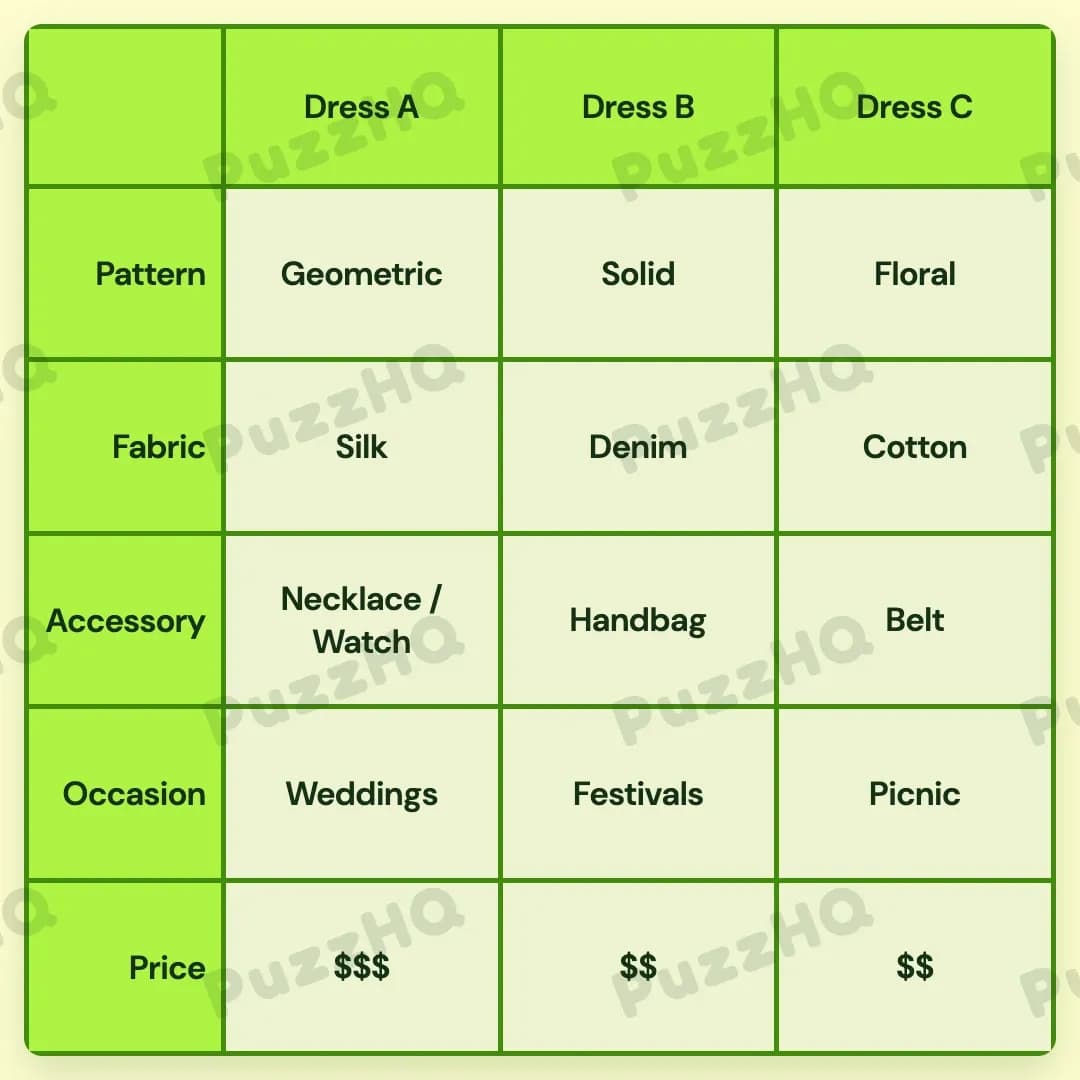
Every dress finds its exact style profile once spatial clues for fabric and occasion lock the outer columns into place.
| Trait | Dress A | Dress B | Dress C |
|---|---|---|---|
| Pattern | Geometric | Solid | Floral |
| Fabric | Silk | Denim | Cotton |
| Accessory | Necklace / Watch | Handbag | Belt |
| Occasion | Weddings | Festivals | Picnic |
| Price | $$$ | $$ | $$ |
Building The Grid By Trait
Starting with spatial anchors allows the entire logic grid to unfold naturally. The combination of fabric and occasion provides the most reliable starting point because direct placement rules immediately limit where the garments can sit across the three positions.
Fabric And Occasion Establish Positional Anchors
The quickest entry point into the puzzle comes from locating fixed column positions. We learn that the dress on the far right is intended for a picnic, which instantly assigns the picnic occasion to Dress C.
Next, we look at the fabric row. Silk is naturally recognized as the smoothest material among the options, and Denim is positioned directly to the right of this smoothest dress. Because Denim must sit to the right of Silk, Silk must occupy Dress A on the far left, while Denim sits immediately next to it on Dress B. That leaves Cotton to fill the remaining fabric slot under Dress C.
With Silk fixed at Dress A and Cotton at Dress C, occasion assignments become much clearer. Since Dress C is already designated for a picnic, the remaining occasions are weddings and festivals. Later price comparisons between weddings and picnics will solidify Dress A for weddings and Dress B for festivals.
Accessory Fits Alongside The Fabric Row
Once the fabric row is completely mapped, the accessory category falls into place through direct adjacency and negative constraints. We know that the dress with a handbag sits directly beside the silk dress. Since Silk is locked into Dress A, the handbag must belong to Dress B.
That leaves two accessory options: the necklace and watch combination, and the belt. We are told that the cotton dress is not paired with a necklace. Because Cotton belongs to Dress C, the necklace and watch cannot go to Dress C. This means Dress A receives the necklace and watch, leaving the waist accessory, the belt, as the only remaining choice for Dress C.
Pattern Separates Across The Outer Columns
The pattern row resolves by looking at separation rules. A geometric pattern cannot sit beside a floral pattern. In a three column layout, two items that cannot be adjacent must occupy the two opposite ends, namely Dress A and Dress C.
This requirement forces the middle column, Dress B, to take the solid monotone pattern. Between the two outer dresses, clues referencing blossoms point directly to the floral pattern. Because the picnic dress on the right pairs with the blossom motif, Dress C takes the floral pattern, while Dress A takes the geometric pattern on the far left.
Price Resolves Through Occasion And Pattern Links
Price is the final trait to resolve, functioning as a relative scale. We are told that the dress for weddings is more expensive than the dress for picnics. Furthermore, the monotone dress has the exact same price as the blossoms dress.
Because the solid dress at Dress B and the floral dress at Dress C share the same cost, they form the lower price baseline of two dollar signs each. The wedding dress at Dress A is strictly more expensive than the picnic dress at Dress C, placing Dress A at the highest tier of three dollar signs. The waist accessory clue confirms that the belt pairs with the cheapest dress tier, which aligns perfectly with Dress C sharing the lowest price point.
Where The Trait Rows Intersect
Fabric Placement Unlocks Immediate Accessory Adjacency
The connection between fabric texture and accessory styling is critical early on. Recognizing Silk as the smoothest material places Silk at Dress A and Denim at Dress B. The moment Dress A is confirmed as Silk, the clue placing the handbag next to Silk immediately resolves Dress B's accessory. Without solving the fabric row first, the handbag could have fit into multiple positions.
Negative Accessory Rules Anchor The Remaining Patterns
Knowing that Cotton occupies Dress C prevents the necklace from landing on the rightmost column. When combined with the pattern separation rule that splits geometric and floral patterns to opposite outer columns, the accessory assignment eliminates ambiguity. Dress A takes the necklace and geometric pattern simultaneously, while Dress C claims the belt and floral blossom style.
Relative Pricing Ties Occasions To Patterns
Price acts as the final connective bridge between pattern and occasion. The solid monotone pattern at Dress B and the floral blossoms pattern at Dress C are stated to be equal in price, creating a balanced lower tier. When the wedding occasion at Dress A is shown to exceed the picnic occasion at Dress C in price, all three price values lock in without needing absolute currency amounts.
Final Grid Check
Every category now supports the others seamlessly across all three dresses. The physical layout matches every adjacency rule, the fabric choices align with their accessory pairings, and the relative pricing reflects the requirements of both pattern and occasion. The completed grid satisfies every constraint cleanly and logically.
Comments