
Profile Perfect Level 85 Answer
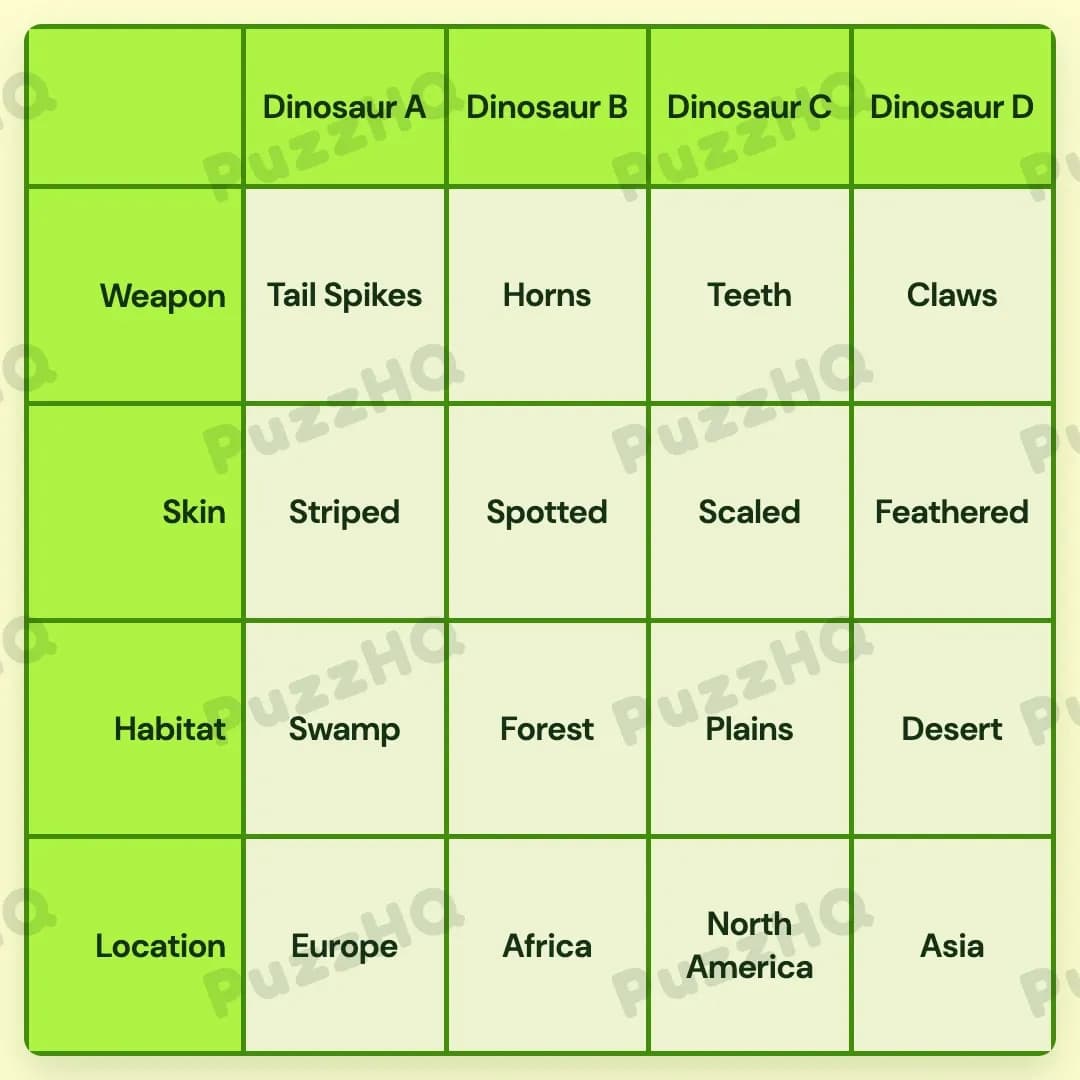
Every prehistoric beast claims a distinct weapon, skin type, native habitat, and continental discovery site across the four research columns.
| Trait | Dinosaur A | Dinosaur B | Dinosaur C | Dinosaur D |
|---|---|---|---|---|
| Weapon | Tail Spikes | Horns | Teeth | Claws |
| Skin | Striped | Spotted | Scaled | Feathered |
| Habitat | Swamp | Forest | Plains | Desert |
| Location | Europe | Africa | North America | Asia |
Building The Grid By Trait
Starting with positional spacing between specific skins and global discovery sites provides an immediate foundation, allowing physical weaponry and terrain categories to lock into place naturally.
Skin And Location Establish The Outer Columns
The grid begins to take shape by looking at how broad positional clues restrict the extreme ends of the board. We are told that the dinosaur discovered in Asia sits exactly three columns away from the dinosaur with striped skin. Because the grid spans only four columns from Dinosaur A through Dinosaur D, a three column gap can only exist between the first column and the fourth column.
This structural restriction immediately tells us that Dinosaur A and Dinosaur D represent the pair consisting of the striped skin specimen and the Asian discovery site. Clue details confirm that the Asian dinosaur relies on claws to hunt, while Dinosaur A attacks directly using its tail spikes. Because Dinosaur A possesses tail spikes instead of claws, Dinosaur A cannot be the Asian dinosaur.
This deduction establishes that Dinosaur A has striped skin, while Dinosaur D is the dinosaur native to Asia. Dinosaur D must also be the one equipped with claws.
With striped skin locked at Dinosaur A, we can examine the remaining skin types. The scaled skin dinosaur was discovered in North America, and the striped dinosaur is not adjacent to the scaled dinosaur. Since Dinosaur A is striped, its immediate neighbor Dinosaur B cannot have scaled skin. Dinosaur D is already confirmed as the Asian dinosaur, meaning it cannot be the North American specimen with scaled skin. That leaves Dinosaur C as the only possible match for scaled skin and the North American origin.
With North America assigned to Dinosaur C and Asia assigned to Dinosaur D, only Europe and Africa remain for Location. We learn that the dinosaur found in Europe has a neighbor equipped with horns. If Dinosaur A were from Africa, Dinosaur B would have to be from Europe, meaning Europe's neighbor would be either Dinosaur A (tail spikes) or Dinosaur C. However, placing Europe at Dinosaur A gives it an immediate neighbor in Dinosaur B, which fits the requirement when Dinosaur B carries horns. Thus, Europe belongs to Dinosaur A, and the remaining location, Africa, belongs to Dinosaur B.
Only two skin varieties remain unsolved: spotted and feathered. Clues state that the horned dinosaur does not possess feathered skin. Since Dinosaur B carries horns, it cannot be feathered, leaving Dinosaur B with spotted skin and Dinosaur D with feathered skin.
Weapon Identifies The Combat Roles
With the skin and location rows firmly structured across the grid, the weaponry row falls into line with ease. Dinosaur A is already explicitly assigned tail spikes, and the Asian predator at Dinosaur D is equipped with claws.
That leaves only two weapons to distribute between Dinosaur B and Dinosaur C: horns and teeth. The clue mentioning that Europe's dinosaur has a horned neighbor points directly to Dinosaur B, since Dinosaur A is from Europe and Dinosaur B is its adjacent neighbor. This assigns horns to Dinosaur B.
The remaining weapon is teeth, which fits neatly onto Dinosaur C. This aligns perfectly with the fact that the dinosaur armed with sharp teeth reigns over the plains.
Habitat Completes The Environmental Grid
The habitat row is resolved by matching the assigned weapons and skin traits to their required environments. The dinosaur armed with sharp teeth is declared the king of the plains. Since teeth belong to Dinosaur C, the plains habitat belongs to Dinosaur C as well.
Next, we know that the feathered dinosaur hates watery places. Dinosaur D has feathered skin, which means it cannot reside in any wet or watery environment such as a swamp. This leaves the arid desert habitat as the clear choice for Dinosaur D.
Two habitats remain to be assigned between Dinosaur A and Dinosaur B: swamp and forest. Since the swamp represents the watery terrain that Dinosaur D avoided, it cannot belong to Dinosaur D, but Dinosaur A has no such restriction. Dinosaur A takes the swamp habitat, while the remaining forest habitat goes to Dinosaur B.
Where The Trait Rows Intersect
Solving this puzzle relies on tracking how clues bridge multiple trait rows simultaneously, turning physical descriptions into structural column anchors.
Positional Distance Links Skin And Location Across The Grid
The requirement that the Asian dinosaur is three columns apart from the striped one acts as a bridge between the Location and Skin categories. Instead of waiting to discover which dinosaur lived in Asia through process of elimination, the geometric spacing forces both traits into the grid's extreme outer edges. Cross checking this requirement against Dinosaur A's tail spikes instantly reveals which edge belongs to Asia and which edge belongs to striped skin.
Skin Types And Locations Rule Out Adjacent Spaces
The rule that the striped dinosaur is not next to the scaled dinosaur unites the Skin trait with the Location trait. Because the scaled specimen comes from North America, identifying where scaled skin cannot go simultaneously eliminates North America from the middle left column. This cross category connection prevents Dinosaur B from taking either the scaled skin or the North American origin, channeling those traits straight into Dinosaur C.
Combat Weapons Unlock The Final Habitat Placements
Weapon assignments directly govern the placement of environmental habitats. The clue pairing sharp teeth with the plains habitat combines Weapon and Habitat in a single stroke, immediately locking Dinosaur C's environment once its weapon is settled. At the same time, the feathered skin trait eliminates watery environments, directing the swamp habitat away from Dinosaur D and into Dinosaur A.
Final Grid Check
Every category now aligns without contradiction across all four subjects. Dinosaur A pairs tail spikes, striped skin, a swamp habitat, and a European origin. Dinosaur B holds horns, spotted skin, a forest habitat, and an African origin. Dinosaur C claims teeth, scaled skin, a plains habitat, and a North American origin. Dinosaur D brings together claws, feathered skin, a desert habitat, and an Asian origin. Each trait row mutually reinforces the adjacent clues to form a completely consistent deduction.
Comments