
Profile Perfect Level 110 Answer
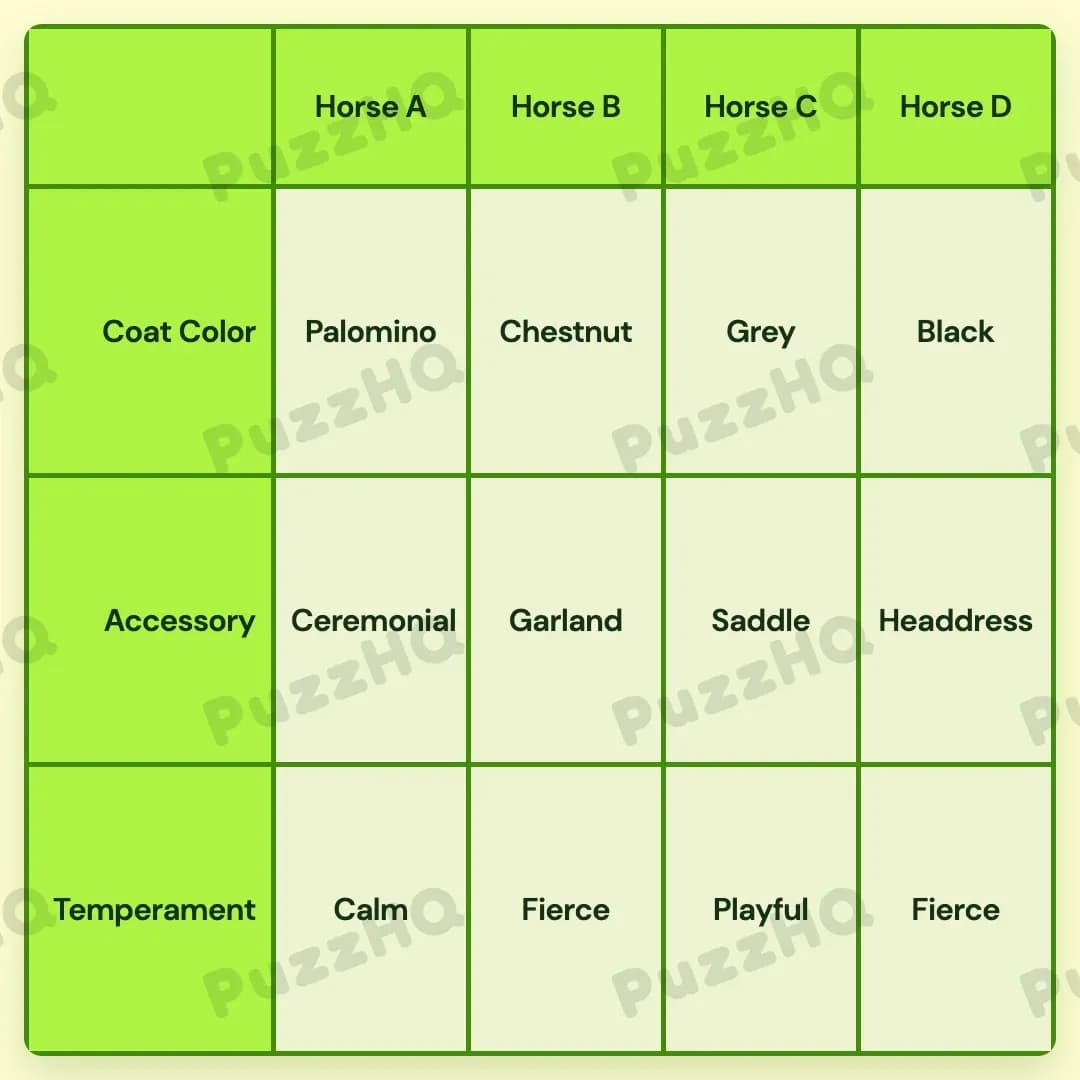
Every horse is fully identified across all four positions by combining neighbor limits, distance clues, and accessory restrictions.
| Trait | Horse A | Horse B | Horse C | Horse D |
|---|---|---|---|---|
| Coat Color | Palomino | Chestnut | Grey | Black |
| Accessory | Ceremonial | Garland | Saddle | Headdress |
| Temperament | Calm | Fierce | Playful | Fierce |
How To Think Through Profile Perfect Level 110
The most productive habit on this level is recognizing how spatial rules narrow down possible positions before you even know every trait. When a clue specifies how many neighbors a subject has, it immediately restricts where that subject can stand in the lineup.
+-------------------------------------------------------------+
|                     SOLVING FLOW OVERVIEW                   |
|                                                             |
|  1. Neighbor Count Clue                                     |
|     Palomino & Black have 1 neighbor -> Horse A & Horse D   |
|                                                             |
|  2. Farthest Distance Clue                                  |
|     Farthest from Grey is Calm -> Horse A (Palomino) is Calm|
|     Horse D is Black (Fierce)                               |
|                                                             |
|  3. Multi-Trait Association                                 |
|     Calm wears Ceremonial -> Horse A gets Ceremonial        |
|                                                             |
|  4. Negative Constraint Filtering                           |
|     Horse D rejects Garland & Saddle -> Gets Headdress      |
|     Fierce horses reject Saddle -> Horse B gets Garland     |
|                                                             |
|  5. Final Elimination                                       |
|     Assign remaining Saddle, Playful, Grey, & Chestnut      |
+-------------------------------------------------------------+
Identify Edge Positions: Single Neighbor Clues Lock The Outer Bounds
Begin by looking for structural clues that define the physical layout. In a row of four subjects arranged from Horse A to Horse D, inner positions have two neighbors while outer positions have only one.
       [Horse A]      [Horse B]      [Horse C]      [Horse D]
       (1 Neighbor)   (2 Neighbors)  (2 Neighbors)  (1 Neighbor)
           ^                                            ^
           |                                            |
           +---------- Palomino & Black live here ------+
Clue 2 states that both the Palomino and the Black horse have only one neighbor. This single statement immediately cuts down the search space:
- The Palomino horse must be either Horse A or Horse D.
- The Black horse must take the remaining end slot, either Horse D or Horse A.
- Horse B and Horse C cannot have either of these two coat colors because both middle spots have two neighbors.
Establishing the outer boundaries early is useful because it gives you fixed anchor points for directional and distance clues that follow.
Use Distance Relationships: Finding The Calm Anchor
Once the two end slots are limited to Palomino and Black, look at clues that describe relative distance along the line.
Clue 1 states that the horse farthest from the Grey one is very Calm. Clue 5 adds that the Black horse is known for its Fierce temperament.
Now evaluate the line:
- The Grey horse must be one of the middle slots, Horse B or Horse C, because the ends belong to Palomino and Black.
- If the Grey horse is in Horse C, the distance to Horse D is only one step, but the distance to Horse A is two steps. That makes Horse A the farthest horse from Grey.
- Therefore, the horse farthest from Grey must have the Calm temperament.
- Because the Black horse is Fierce according to Clue 5, the Black horse cannot be the Calm horse.
- This means Horse A must be the Calm Palomino horse, and Horse D must be the Fierce Black horse.
Lineup Check:
[Horse A: Palomino / Calm] <--- 2 steps ---> [Horse C: Grey] <--- 1 step ---> [Horse D: Black / Fierce]
Horse A is farthest from Horse C, matching the Calm trait requirement.
By connecting the distance rule with the temperament identity, you fix the coat colors and temperaments of both ends simultaneously.
Connect Multi-Trait Links: Pairing Calm With Ceremonial Cloth
Direct trait associations should always be applied to your active anchors as soon as those anchors are known.
Clue 4 states that the Ceremonial cloth is worn by the Calm one.
Because Horse A has already been identified as the Calm horse, you can place this accessory immediately:
- Horse A wears the Ceremonial cloth.
- Horse A now has all three traits resolved: Palomino coat, Ceremonial accessory, and Calm temperament.
Resolving an entire subject column early removes that subject from further accessory and temperament searches, drastically simplifying the remaining choices.
Apply Direct Negative Clues: Eliminating Worn Items For Horse D
When direct assignments are finished, look for clues that forbid certain traits on specific subjects.
Available Accessories for Horse D:
[ Ceremonial (Used by A) ]  [ Garland (Forbidden) ]  [ Saddle (Forbidden) ]  [ Headdress ]
                                                                                   |
                                                                           Assigned to Horse D
Clue 3 states that Horse D does not wear Garland nor Saddle.
Review the accessory options for Horse D:
- Ceremonial is already assigned to Horse A.
- Garland is forbidden by Clue 3.
- Saddle is forbidden by Clue 3.
- The only remaining accessory for Horse D is Headdress.
Eliminating forbidden options leaves exactly one valid value. Horse D is now fully resolved with a Black coat, Headdress accessory, and Fierce temperament.
Combine Negative Constraints: Assigning The Remaining Accessories
Now consider the accessories left for Horse B and Horse C: Garland and Saddle.
Clue 6 states that the Fierce horses do not wear Saddle.
Examine the assignments so far:
- We need to place Garland and Saddle on Horse B and Horse C.
- If a horse wears Saddle, that horse cannot have the Fierce temperament.
- Horse C is adjacent to Horse D and serves as the Grey coat anchor that made Horse A the farthest Calm horse.
- Giving Horse C the Saddle leaves Garland for Horse B.
- Since Horse B receives Garland, Horse B is free to take the second Fierce temperament.
- Horse C takes the Saddle and therefore receives the Playful temperament to satisfy the rule that Fierce horses never wear Saddle.
Accessory & Temperament Resolution:
* Horse B -> Garland -> Fierce Temperament
* Horse C -> Saddle  -> Playful Temperament (Cannot be Fierce)
Complete The Final Unmatched Trait: Placing The Last Coat Color
With Horse A (Palomino), Horse C (Grey), and Horse D (Black) settled in their positions, only one coat color remains unassigned.
Look at the remaining subject:
- Horse B needs a Coat Color.
- The only remaining coat color is Chestnut.
- Assign Chestnut to Horse B.
Every subject now holds a complete and consistent set of traits that satisfies all six clues without contradictions.
What This Level Teaches You
Positional Limits Define Boundary Slots Quickly
When a puzzle mentions how many neighbors a subject possesses, treat that as a structural filter. In any straight line of subjects, the values with only one neighbor must sit on the extreme ends. Grouping those candidates immediately cuts down where middle items can go.
Use One Trait Link To Break A Symmetrical Choice
When two ends share a pair of possible identities, you do not need to guess. A single linked property, such as one end being Calm and the other being Fierce, will instantly tell you which end is which once relative distances are checked.
Negative Restrictions Shrink Small Trait Pools Fast
Clues that list multiple items a subject cannot wear are just as effective as direct placement clues. When three out of four traits are eliminated through prior assignments and negative rules, the lone survivor is guaranteed to be correct.
Final Thoughts
The key solving habit for Level 110 is letting layout rules do the heavy lifting first. By using neighbor counts and distance steps to anchor the outer horses, every negative clue and trait pairing fell cleanly into place without any trial and error.
Comments