
Profile Perfect Level 121 Answer
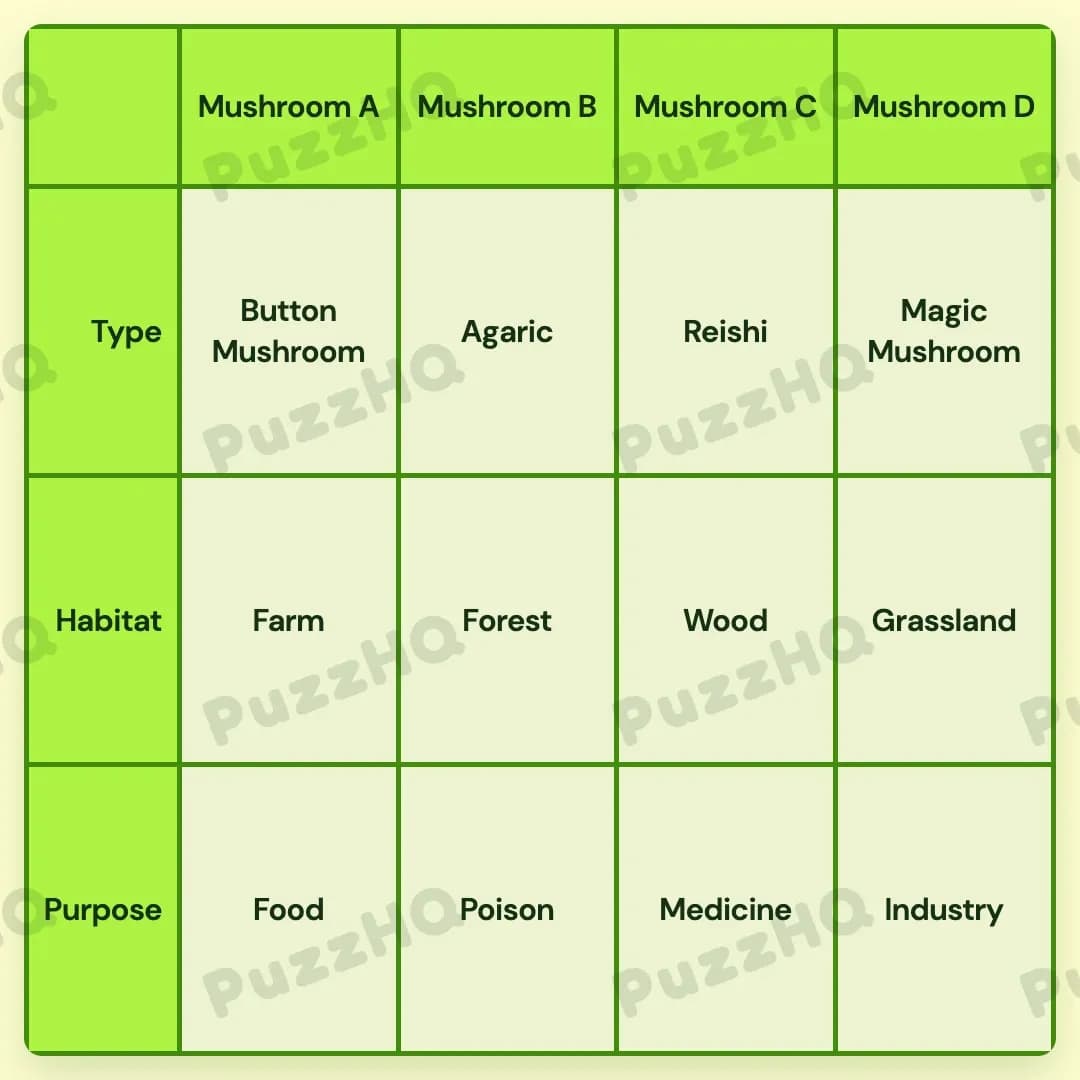
Every mushroom variety can be accurately identified by tracking how habitat conditions and intended purposes pinpoint each species across the four positions.
| Trait | Mushroom A | Mushroom B | Mushroom C | Mushroom D |
|---|---|---|---|---|
| Type | Button Mushroom | Agaric | Reishi | Magic Mushroom |
| Habitat | Farm | Forest | Wood | Grassland |
| Purpose | Food | Poison | Medicine | Industry |
Building The Grid By Trait
Starting with the direct assignments given to the subjects allows us to ground our logic immediately. Habitat and Purpose provide the most concrete physical anchors on the board, letting us map out environmental placements and functional roles before resolving the botanical identities.
Habitat And Purpose Establish Key Anchors
The puzzle gives an immediate direct match for Mushroom A. We learn that Mushroom A is cultivated for consumption and is found on a Farm. This fills two rows for the first subject right away: Mushroom A has Food as its Purpose and Farm as its Habitat.
With Farm claimed by Mushroom A, the remaining habitats to distribute among Mushroom B, Mushroom C, and Mushroom D are Forest, Wood, and Grassland.
Next, we look at the positional clue concerning Purpose: the mushroom harvested for Medicine is located to the left of the one used for Industry. Since Mushroom A is already dedicated to Food, Medicine cannot be in slot A. If Medicine were in slot B, Industry could be in C or D. If Medicine were in slot C, Industry would have to be in slot D.
We can narrow this down by examining the habitat restrictions on Industry. We know that the Industrial mushroom is not found in the Forest. Furthermore, another clue links Reishi directly to the Wood habitat while also establishing that Reishi is neither Mushroom A nor Mushroom D. Because Reishi cannot be Mushroom A or D, Reishi must be either Mushroom B or Mushroom C, meaning Wood must also belong to Mushroom B or Mushroom C.
Type Merges With Habitat To Lock In Positions
Knowing that Reishi requires dry Wood narrows the possible slots for both this Type and its Habitat. Since Reishi cannot be in position A or position D, it has to reside in position B or position C.
Let us evaluate what happens if Reishi and Wood are placed in slot B versus slot C:
If Reishi and Wood were placed in slot B, then Mushroom C and Mushroom D would need to take the remaining habitats, Forest and Grassland. But consider the Purpose alignment: Medicine must be placed somewhere to the left of Industry. In addition, Agaric is tied directly to deadly Poison.
If Agaric is Poison, and Food is already placed in Mushroom A, then the remaining purposes to assign across Mushroom B, Mushroom C, and Mushroom D are Poison, Medicine, and Industry.
If Reishi in slot B took Medicine, then Industry would be in slot C or D, leaving Agaric (Poison) for the other slot. But if Reishi took Poison, it would contradict the fact that Agaric is the one with Poison.
When we test the relative positions, placing Reishi and its Wood habitat in Mushroom C creates a clean alignment. With Mushroom C set to Wood, the Medicine purpose fits naturally in Mushroom C, placing it directly to the left of Industry in Mushroom D.
This assignment neatly resolves the remaining Purpose row: Mushroom A is Food, Mushroom B is Poison, Mushroom C is Medicine, and Mushroom D is Industry.
Habitat And Type Complete The Board
With Purpose completely filled across all four columns, we can finalize the Habitat row.
We know that Mushroom D is the Industrial mushroom. A specific condition states that the Industrial mushroom cannot be found in the Forest. Since Farm belongs to Mushroom A and Wood belongs to Mushroom C, the only two habitats left for Mushroom B and Mushroom D are Forest and Grassland. Because Mushroom D cannot be in the Forest, Mushroom D must be in the Grassland. Consequently, Mushroom B takes the Forest habitat.
Now every Habitat is locked in place:
- Mushroom A is on the Farm
- Mushroom B is in the Forest
- Mushroom C is on Wood
- Mushroom D is in the Grassland
Finally, we fill in the remaining Type identities. We know that Agaric corresponds to Poison. Since Mushroom B has the Poison purpose, Mushroom B is Agaric.
For the remaining Type entries, we know Magic Mushroom cannot grow on a Farm. Mushroom A is the only mushroom on a Farm, so Magic Mushroom cannot be Mushroom A. That leaves Mushroom D as the only possible match for Magic Mushroom.
With Mushroom B identified as Agaric, Mushroom C as Reishi, and Mushroom D as Magic Mushroom, the only type left for Mushroom A is Button Mushroom.
Where The Trait Rows Intersect
Purpose Constraints Reveal Habitat Distributions
The connection between the Industrial purpose and its habitat restriction serves as a vital cross trait bridge. Clues that restrict where a specific purpose can exist eliminate entire habitat options for individual columns. Knowing that Industry cannot exist in the Forest immediately forces the Grassland habitat into Mushroom D, which in turn frees up the Forest habitat for Mushroom B. Without checking how Purpose and Habitat limit each other, resolving the final two habitats would require guesswork.
Dual Trait Clues Lock Down Botanical Types
The puzzle features multiple clues pairing a Type directly with another category, such as Agaric with Poison and Reishi with Wood. These paired statements act as rigid two trait blocks. When combined with negative location clues, such as Reishi being forbidden from slots A and D, these compound blocks instantly restrict multiple rows at once. Placing the Reishi and Wood block into column C simultaneously satisfies type, habitat, and sequence rules.
Negative Type Placements Finalize The Origin Slot
The rule stating that Magic Mushroom does not grow on a Farm acts as an intersection between Type and Habitat. Rather than telling us where Magic Mushroom belongs, it eliminates Mushroom A from consideration. Because Button Mushroom is the only open type without negative constraints, it drops into Mushroom A by default, bringing the entire logical sequence to a tidy conclusion.
Final Grid Check
Each category now reinforces the others without any contradictions. Mushroom A thrives on a Farm as a Button Mushroom for Food. Mushroom B grows in the Forest as a toxic Agaric used for Poison. Mushroom C rests on Wood as medicinal Reishi, safely to the left of Mushroom D, which grows in the Grassland as an industrial Magic Mushroom. Every clue requirement is fully satisfied across all four subjects.
Comments