
Profile Perfect Level 120 Answer
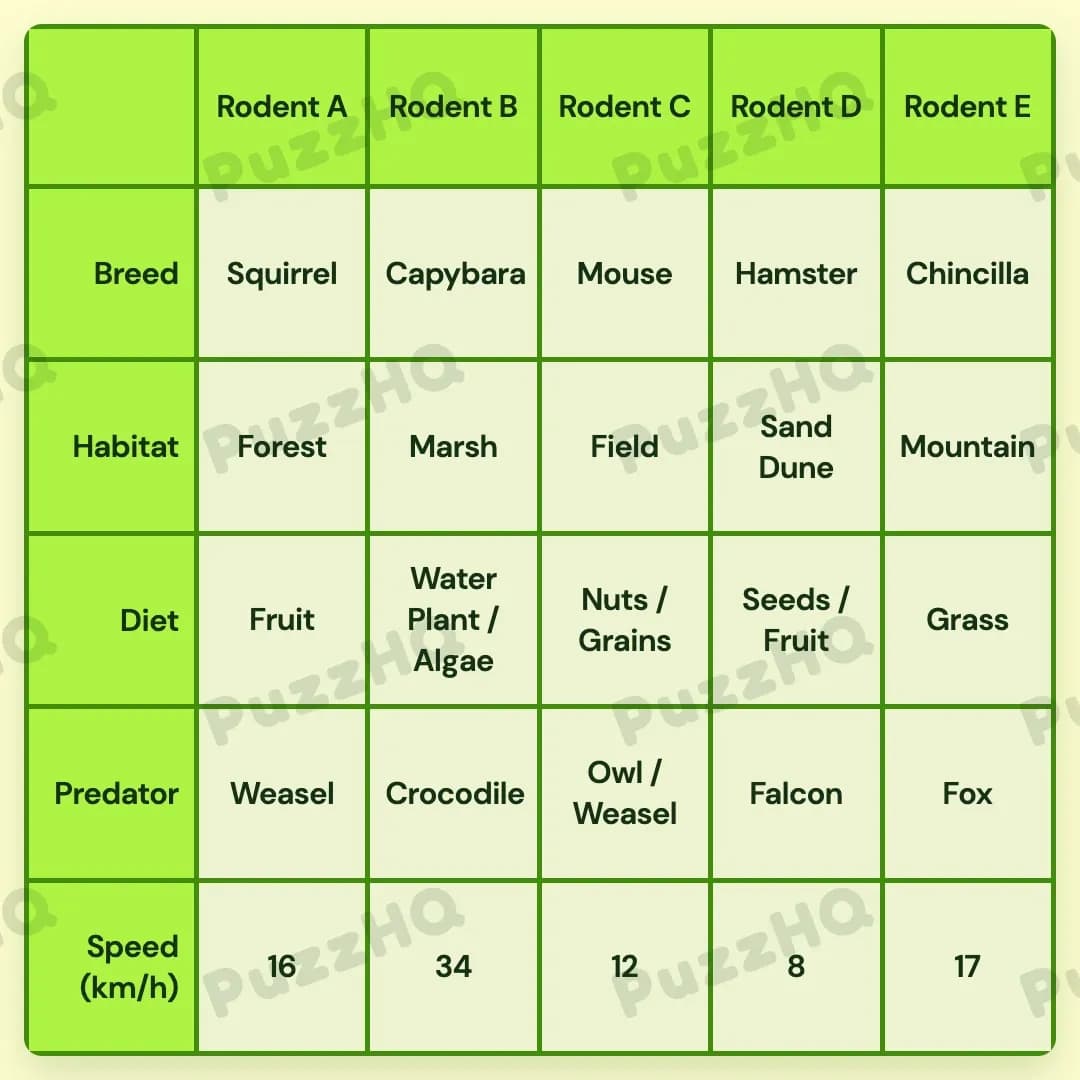
Here is the complete roster of rodents, their native habitats, preferred diets, hunting predators, and top running speeds.
| Trait | Rodent A | Rodent B | Rodent C | Rodent D | Rodent E |
|---|---|---|---|---|---|
| Breed | Squirrel | Capybara | Mouse | Hamster | Chincilla |
| Habitat | Forest | Marsh | Field | Sand Dune | Mountain |
| Diet | Fruit | Water Plant / Algae | Nuts / Grains | Seeds / Fruit | Grass |
| Predator | Weasel | Crocodile | Owl / Weasel | Falcon | Fox |
| Speed (km/h) | 16 | 34 | 12 | 8 | 17 |
The Logic Behind Profile Perfect Level 120
This grid resolves quickly once you recognize how much weight rests on positional geometry. Rather than handing out neat pairs of attributes right away, the board relies on column spacing, neighbor relationships, and relative runner speeds to lock down the physical layout before the food chain takes over.
Spatial Spacing Establishes The Lineup
The central column, Rodent C, gives us our first fixed reference points. We are told the middle rodent fears the Owl and sits next to the Hamster. That immediately restricts the Hamster to Rodent B or Rodent D.
Another positional clue breaks that choice wide open: the rodent from the Forest is located three columns away from the Hamster. In a five-rodent grid, being three columns apart requires the pair to occupy columns one and four or columns two and five. Because the Hamster must sit beside column three, placing it in column two would force the Forest habitat off the edge of the board to the left or into column five. But we also know the Squirrel is three columns away from that Hamster if the Forest belongs to the Squirrel, and the Squirrel sits next to the Marsh rodent. Putting the Hamster in Rodent D places the Forest at Rodent A.
From there, the remaining habitats and breeds fall into line. The Capybara lives in the Marsh, and since the Squirrel at Rodent A sits next to the Marsh, Rodent B must be the Capybara in the Marsh. With Rodent E known to eat Grass, and a clue noting that a rodent found in the Dunes is adjacent to the Chincilla, placing Chincilla at Rodent E sets Sand Dune at Rodent D. That leaves Rodent E in the Mountain and Rodent C in the Field. The Mouse takes its place at Rodent C, completing the breed and habitat lines.
Speeds Fall Into Order Through Comparisons
With the breeds settled from left to right, numerical speed values can be assigned by comparing neighbors. We know the Hamster is slower than both of its neighbors and that the Squirrel runs twice as fast as the Hamster.
The fastest runner in the group flees from a Crocodile, which targets the Capybara at Rodent B. That awards Rodent B the top speed of 34 km/h. Because the Hamster at Rodent D sits at the low mark of 8 km/h, the Squirrel at Rodent A is calculated at 16 km/h.
The remaining speeds belong to the Mouse in the Field and the Chincilla in the Mountain. A direct clue tells us the Field rodent runs slower than the Mountain rodent. Between the remaining figures of 12 km/h and 17 km/h, the Mouse takes 12 km/h and the Chincilla claims 17 km/h. Every rodent now has a verified pace across the board.
Dietary Habits And Predators Close The Gaps
The final third of the board brings diets and predators into alignment. The semi aquatic Crocodile preys on the Capybara at Rodent B. We also know the predator next to the middle rodent's Owl is another bird of prey, which places the Falcon at Rodent D, leaving the Fox for Rodent E and the Weasel for Rodent A and Rodent C.
Dietary habits wrap up neatly alongside these predator slots. The Falcon's target at Rodent D feeds on Seeds and Fruit, while the Seeds eater is specifically noted as being flanked by the residents of the Field and Mountain, perfectly matching column four. The Mouse at Rodent C feeds on Nuts and Grains, confirmed by the note that the Nuts eater avoids the Mountain and that the Algae eater sits to the left of the Grains eater. That places Water Plant and Algae with the Capybara at Rodent B and Fruit with the Squirrel at Rodent A. Every trait across all five rodents is accounted for without ambiguity.
The Clue I Would Read Twice
"Rodent found in Forest is 3 columns away from Hamster"
Spacing clues like this can easily trip you up if you count steps instead of column distance. In a grid of five subjects, being three columns away is an aggressive constraint that instantly eliminates middle placements. It acts as the structural keystone of the entire solve, turning an open field of five columns into a rigid frame within the first few minutes.
Final Thoughts
What makes this puzzle enjoyable is how cleanly the physical layout coordinates with ecological food chains. Once the spatial distance between the Forest and the Sand Dune is understood, the predator pairings and running speeds click into place with complete certainty.
Comments