
Profile Perfect Level 115 Answer
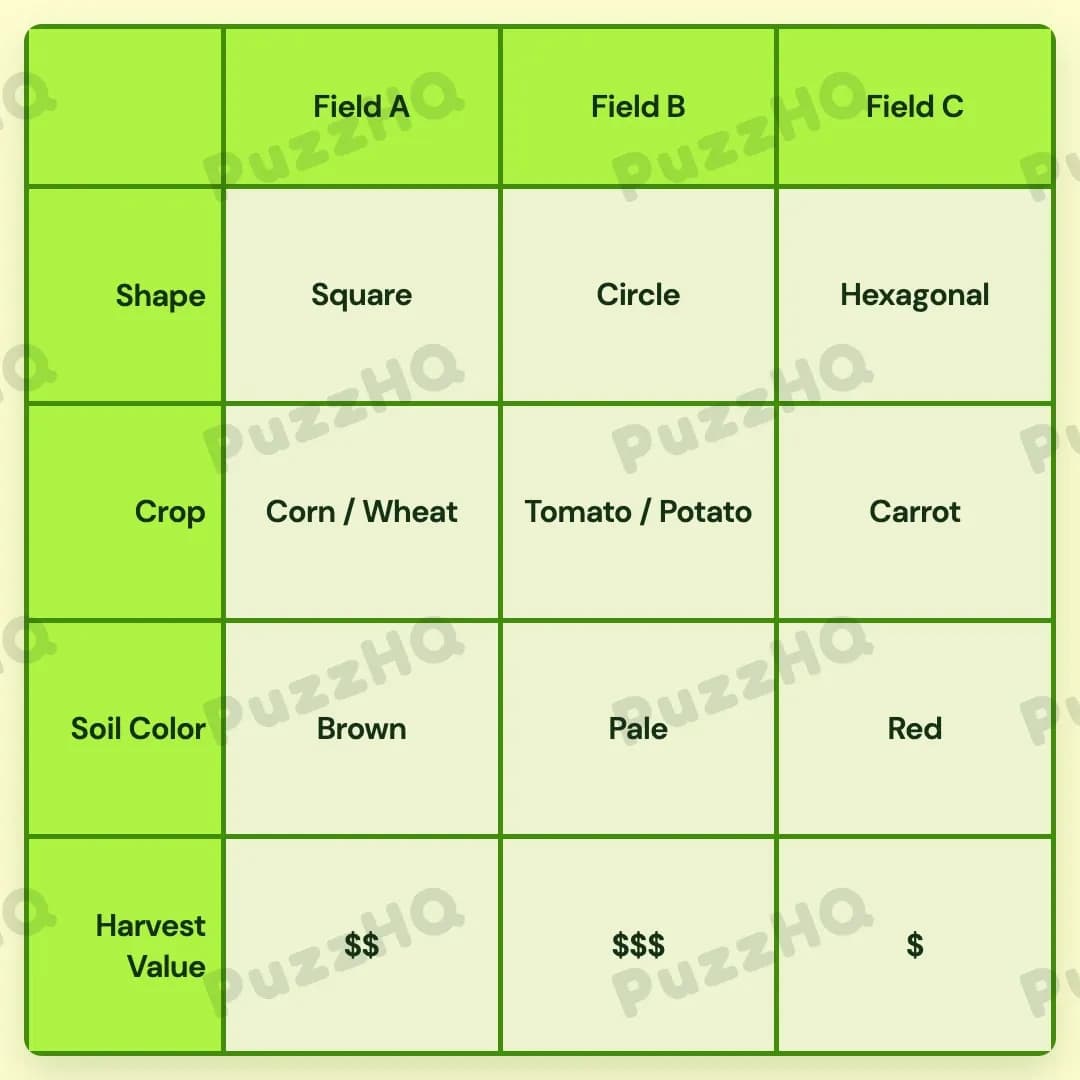
By linking crop placements to soil types and field geometry, every trait across the three fields falls neatly into place.
| Trait | Field A | Field B | Field C |
|---|---|---|---|
| Shape | Square | Circle | Hexagonal |
| Crop | Corn / Wheat | Tomato / Potato | Carrot |
| Soil Color | Brown | Pale | Red |
| Harvest Value | $$ | $$$ | $ |
Building The Grid By Trait
Starting with the spatial layout of crops offers the clearest entry point because field adjacency dictates where the crops can grow. From there, crop assignments unlock soil colors, which directly feed into the value and shape categories.
Crop Row Layout Establishes Positional Anchors
The puzzle establishes three crop profiles across the fields: one field dedicated purely to Carrot, one field pairing Tomato and Potato, and one field pairing Corn and Wheat.
Positioning these crops relies on two structural clues. We know that Wheat cannot be adjacent to Carrot, and we know that one field contains only Carrot. In a three-field layout arranged from left to right as Field A, Field B, and Field C, the middle position, Field B, is adjacent to both ends. If Carrot were placed in Field B, Wheat would be forced into either Field A or Field C, making adjacency unavoidable. Therefore, Carrot cannot occupy Field B.
Similarly, Wheat cannot be placed in Field B because Carrot would then sit in an adjacent outer field. This means Field B must hold the dual crop combination of Tomato and Potato.
With Tomato and Potato occupying Field B, Carrot and the Corn and Wheat combination are split between the outer fields, Field A and Field C. Because Wheat cannot neighbor Carrot, Carrot must be on one end while Corn and Wheat occupy the other. Field C takes Carrot alone, while Field A takes the combination of Corn and Wheat. This completely settles the Crop row.
Soil Color Locks Onto The Crop Pairings
Once the crops are fixed to specific fields, Soil Color resolves rapidly through direct association clues.
We are told that Tomato and Potato grow strictly in Pale soil. Since Tomato and Potato are settled in Field B, Field B must have Pale soil.
That leaves two soil colors, Brown and Red, to distribute between Field A and Field C. The clue regarding Brown soil states that its harvest value is neither the highest nor the lowest. In a three-tier value hierarchy of $, $$, and $$$, the middle value is $$. Because Field B is already committed to Pale soil, Brown soil must be assigned to either Field A or Field C.
Harvest values and shape requirements will confirm which field takes Brown and which takes Red, tying soil characteristics directly into economic value.
Harvest Value Separates The Outer Fields
The Harvest Value category uses three distinct levels: lowest ($), medium ($$), and highest ($$$).
We know that Brown soil cannot have the highest or lowest harvest value, which forces Brown soil into the medium value of $$. Field B already holds Pale soil, so Field B is not the Brown soil field.
Furthermore, the field with the lowest harvest value ($) is Hexagonal in shape. Looking at the crop restrictions, Field C has Carrot and Field A has Corn and Wheat. When we examine the shapes, Field A cannot be Hexagonal if it holds the medium value of $$.
Assigning the medium value ($$) to Field A pairs it with Brown soil. This leaves Field C with the lowest value ($), which also determines that Field C has Red soil. Field B, holding Pale soil and Tomato and Potato crops, takes the remaining highest harvest value of $$$.
Shape Finalizes The Puzzle Framework
With values and crops locked, the Shape trait resolves the remaining visual properties of each field.
The clue stating that the lowest harvest value belongs to a Hexagonal field immediately pins the Hexagonal shape to Field C, since Field C carries the $ value.
Next, we are told that the Square field is not in the middle. Field B is the middle field, so Field B cannot be Square. This leaves Field A as the only valid location for the Square shape.
The remaining shape is Circle, which goes directly to Field B. This also agrees with the clue stating that the Circle field does not grow Corn, since Field B grows Tomato and Potato while Corn is grown in Field A. Every shape is now fully accounted for across the board.
Where The Trait Rows Intersect
Understanding how the clues weave across multiple categories makes the entire solution fall together smoothly without guesswork.
Crops Meet Spatial Adjacency To Solve The Middle Column
The requirement that Wheat cannot sit next to Carrot is a pure crop constraint, but it immediately determines the layout of the entire board. Because Field B touches both neighbors, placing either Wheat or Carrot in the center would create an illegal adjacency. This forces Tomato and Potato into Field B, which instantly identifies Field B as the location with Pale soil. A simple adjacency rule between two crops ends up anchoring both the middle column and the soil category.
Soil Color Bridges Crops And Harvest Values
The clue linking Brown soil to a non-extreme harvest value acts as a vital bridge between soil types and economic yields. Because Field B is occupied by Pale soil, only Field A or Field C can contain Brown soil. Knowing that Brown soil must have the middle value of $$ immediately stops Field A from taking the lowest or highest value. This creates a clean path to assign the lowest value ($) to Field C and the highest value ($$$) to Field B.
Harvest Value Drives Shape Distribution
The connection between the lowest harvest value and the Hexagonal shape provides the final key for geometric traits. Once Field C is recognized as the lowest-earning field with single-crop Carrot production, it automatically inherits the Hexagonal shape. That leaves only Square and Circle. Because the middle field cannot be Square, Field A becomes Square and Field B becomes Circle, seamlessly aligning with the rule that the Circle field never grows Corn.
Final Grid Check
Every row and column now supports the surrounding traits consistently. Field A pairs its Square shape and Brown soil with Corn and Wheat for a balanced medium value ($$). Field B pairs its Circle shape and Pale soil with Tomato and Potato to reach the highest harvest value ($$$). Field C rounds out the layout with a Hexagonal perimeter, Red soil, and a focused single-crop Carrot yield at the lowest value ($). All clue conditions are completely satisfied.
Comments