
Profile Perfect Level 149 Answer
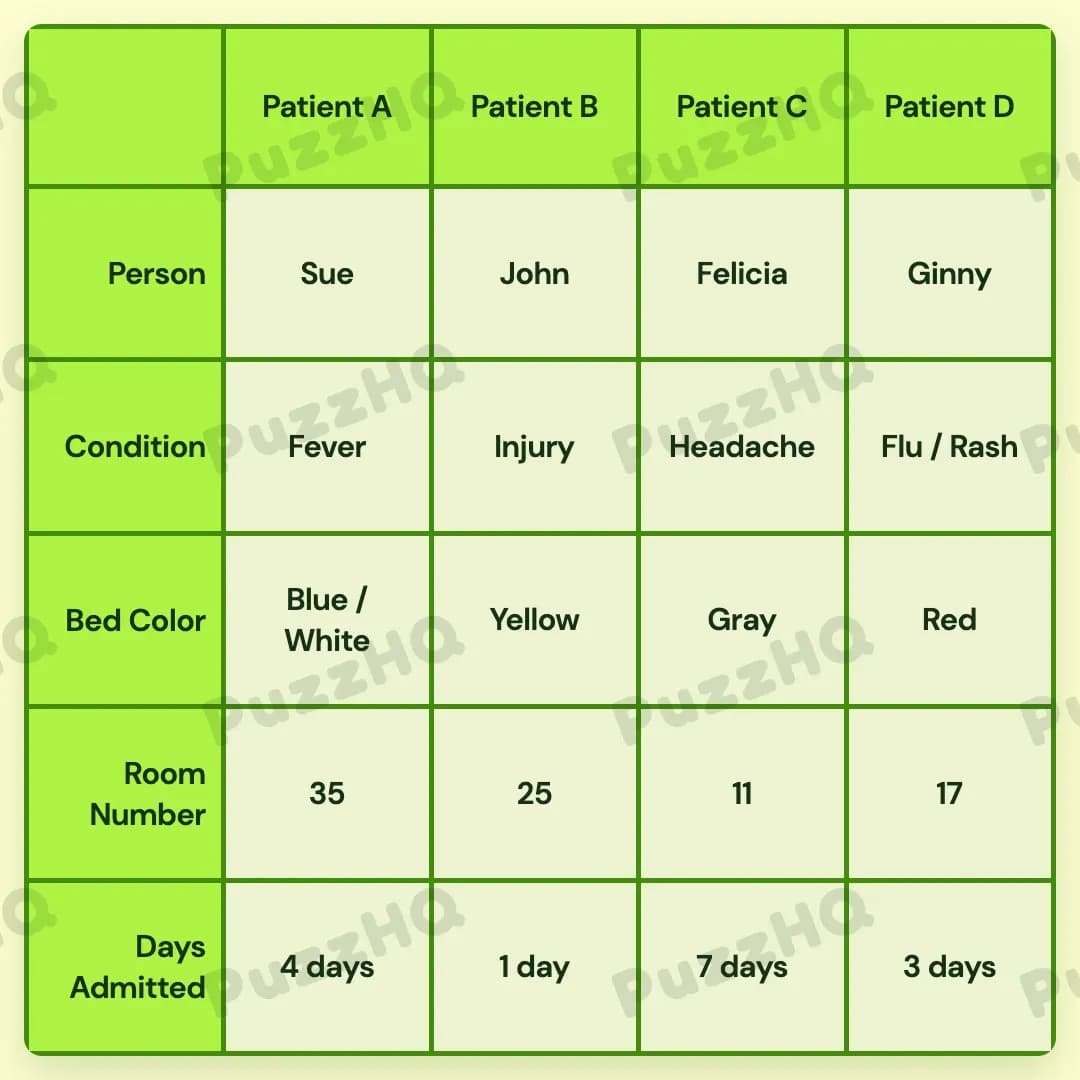
Here is the completed roster for the hospital ward, mapping out each patient, their room, condition, bed color, and length of stay.
| Trait | Patient A | Patient B | Patient C | Patient D |
|---|---|---|---|---|
| Person | Sue | John | Felicia | Ginny |
| Condition | Fever | Injury | Headache | Flu / Rash |
| Bed Color | Blue / White | Yellow | Gray | Red |
| Room Number | 35 | 25 | 11 | 17 |
| Days Admitted | 4 days | 1 day | 7 days | 3 days |
The Logic Behind Profile Perfect Level 149
This puzzle is anchored by timeline cues and positional boundaries that immediately lock down the sequence of patients from left to right. Once the timeline of admissions pairs up with the physical positions of the beds, the remaining medical conditions and room assignments fall into place through direct elimination.
Establishing The Anchor On The Left
The solve begins with direct placement. Sue is stated to be the leftmost person, which immediately fixes her as Patient A. Right alongside her, we learn that the most recently admitted patient sits next to Sue. Looking at the timeline cues across the board, John is noted as having had an accident yesterday, meaning he has been admitted for only one day. That makes John the most recently admitted person in the ward, placing him squarely in the position of Patient B.
With Patient B identified, we can also note that Patient B has a Yellow colored bed. Meanwhile, the white colored bed is restricted from the right half of the ward, meaning it must belong to either Patient A or Patient B. Because Patient B already has the yellow bed, the white bed belongs to Patient A. Combined with the clue establishing that the blue bed belongs to the patient who has been admitted for four days, Patient A takes on both the blue and white bed colors along with a four day hospital stay.
Connecting Symptoms And Stays Across The Ward
With Patient A and Patient B established in the first two slots, the remaining two patients are Felicia and Ginny. The clue regarding a patient whose head is still spinning after a full week ties a seven day admission directly to a headache. Because Sue has been here for four days and John for one day, this seven day stay must belong to Patient C or Patient D.
Ginny is described as having multiple symptoms, specifically sneezing a lot alongside another condition, while the person with a rash sleeps in the red bed. This pairing gives Patient D the combination of flu and rash symptoms on a red bed, which leaves the headache and seven day stay to Patient C. By process of elimination among the names, Patient C must be Felicia, leaving Patient D as Ginny.
Ginny's stay falls into place as three days, while John's condition from his recent accident is categorized as an injury. Sue's condition is narrowed down as well. Since Sue's symptom does not affect her skin, the rash belongs entirely to Ginny, leaving Sue with a fever. The only unassigned bed color left is gray, which naturally goes to Felicia in Patient C.
Sorting The Room Numbers
The final layer involves assigning the room numbers across the four patients. Felicia and Sue are both referenced alongside specific room indicators, while John's room number is explicitly stated to be larger than Ginny's.
When evaluating the remaining numerical values of 35, 25, 17, and 11, Sue takes room 35 on the far left. To satisfy the comparison where John's room number exceeds Ginny's, John receives room 25 while Ginny is assigned room 17. That leaves room 11 as the sole remaining option for Felicia in room C. With every condition, length of stay, room number, and bed color aligned with the given clues, the entire ward roster is complete.
The Clue I Would Read Twice
The clue stating that John had an accident yesterday is the quiet workhorse of the early solve. It does not hand you a number on a silver platter, but when read alongside the note that the most recently admitted patient is right next to Sue, it instantly locks down Patient B. Without recognizing that yesterday translates directly into a single day of admission, John might float unassigned for several steps longer than necessary.
Final Thoughts
What makes Level 149 enjoyable is how smoothly everyday narrative phrases like having an accident yesterday or feeling dizzy after a week translate into precise numerical values. It feels less like doing rigid arithmetic and more like assembling a coherent medical chart from casual shift notes.
Comments