
Profile Perfect Level 151 Answer
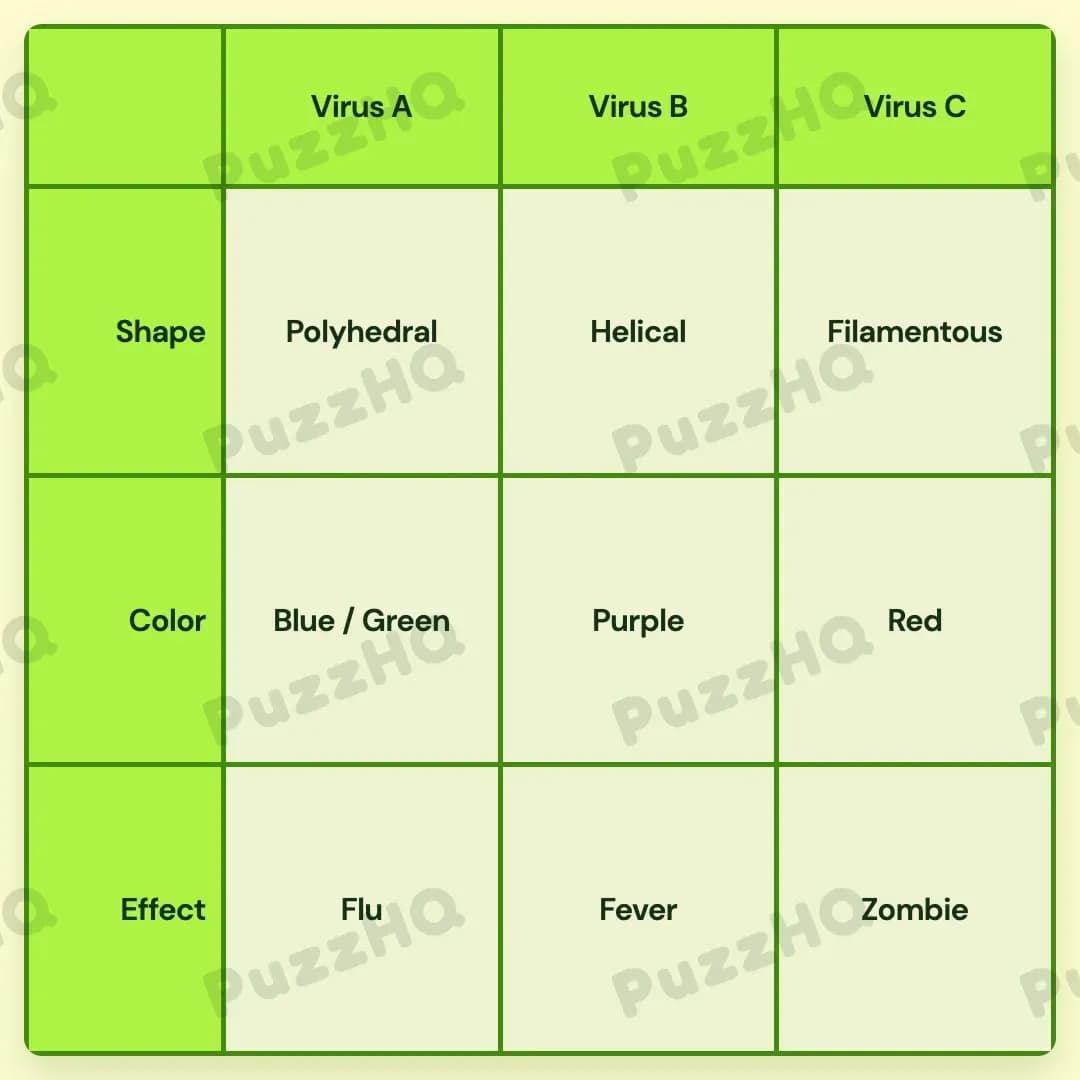
Every virus strain is fully identified by coordinating structural shapes, symptomatic effects, and distinct colors across the research board.
| Trait | Virus A | Virus B | Virus C |
|---|---|---|---|
| Shape | Polyhedral | Helical | Filamentous |
| Color | Blue / Green | Purple | Red |
| Effect | Flu | Fever | Zombie |
Building The Grid By Trait
Starting with physical traits and symptomatic outcomes gives the most dependable foundation for this puzzle. Because explicit structural clues directly identify one subject and pair two traits together, focusing on how Shape and Effect interact allows you to resolve the entire layout before tackling the color row.
Shape And Effect Establish The Framework
The investigation begins by pinpointing the structural shapes and how they correlate with virus effects. A direct statement informs us that Polyhedral is the shape of Virus A. This gives an immediate, unmovable anchor in the first column.
Next, we look at the interaction between shape and symptom. We learn that the Filamentous virus turns people into a Zombie. Because Virus A is already established as Polyhedral, Virus A cannot be the Filamentous virus, and therefore Virus A cannot cause the Zombie effect. That leaves the Filamentous and Zombie pairing to occupy either Virus B or Virus C.
To determine which column holds this dangerous combination, we examine the relative positioning clue regarding symptoms. We know that the virus causing Flu is situated to the left of the virus causing Fever. In a three column setup featuring Virus A, Virus B, and Virus C, placing Flu to the left of Fever requires two adjacent or ordered slots.
If Virus B were the Filamentous virus causing the Zombie effect, there would not be enough room to place Flu to the left of Fever, because Flu would have to be in Virus A while Fever would be forced out of position. Thus, Virus C must be the Filamentous virus responsible for turning people into a Zombie.
With Virus C committed to the Zombie effect, the remaining two symptom slots fall neatly into place. Virus A must be the virus causing Flu, and Virus B must be the virus causing Fever. This perfectly satisfies the requirement that Flu sits to the left of Fever.
Returning to the Shape category, we have Polyhedral assigned to Virus A and Filamentous assigned to Virus C. The only remaining structural shape is Helical, which naturally fills the open slot for Virus B. At this stage, every subject has both its Shape and its Effect completely determined.
Color Locks In The Final Details
With the physical forms and symptoms locked down, the Color category can be resolved by layering negative restrictions and positional relationships onto the existing grid.
The clues note that the Purple colored virus is positioned directly next to the multi-color virus. Looking at our color options, Virus A contains the multi-color combination of Blue and Green. Because Virus A sits on the far left edge of the grid, its only neighbor is Virus B. Consequently, Virus B must be the Purple colored virus.
This leaves only the final color assignment for Virus C. We are told that the Filamentous virus does not possess a Green color, and that the Blue colored virus does not turn people into a man-eater or Zombie. Both clues reinforce that Virus C, which is Filamentous and causes the Zombie condition, cannot take Blue or Green.
With Blue and Green assigned to Virus A and Purple assigned to Virus B, the only remaining color for Virus C is Red. Every subject now possesses a complete, unique profile across all three trait categories.
Where The Trait Rows Intersect
Solving logic puzzles efficiently requires observing how restrictions in one category limit possibilities in another. Several key moments demonstrate how these trait rows intersect to simplify deductions.
Structural Clues Constraining Symptom Order
The connection between the Filamentous shape and the Zombie effect serves as a powerful cross trait bridge. Rather than treating shape and effect as separate lists, pairing them immediately reduces the number of open symptom slots. Knowing that Virus A is Polyhedral instantly prevents the Zombie effect from occupying the first position. This cross category link directly dictates how the horizontal ordering of Flu and Fever must be arranged across the remaining columns.
Symptom Identity Guiding Color Exclusions
The clue stating that the Blue colored virus does not turn people into a man-eater creates a crucial intersection between Color and Effect. Since Virus C is already proven to cause the Zombie state, this negative rule guarantees that Blue cannot belong in the third column. Connecting the behavioral symptom directly to a color exclusion prevents misplacing the multi-color attributes and ensures Virus C receives Red.
Positional Adjacency Bridging Color And Column Placement
The clue linking Purple to the multi-color virus bridges subject placement with color distribution. By recognizing that the multi-color blend belongs to Virus A on the far left, the spatial requirement of adjacency forces Purple into Virus B. This eliminates any ambiguity without needing a direct statement explicitly naming Virus B.
Final Grid Check
The completed deduction presents a completely harmonious grid where every trait reinforces the others. Virus A pairs the Polyhedral structure with Flu and the multi-color blend of Blue and Green. Virus B holds the Helical shape, Fever symptoms, and Purple coloration. Virus C concludes the set with the Filamentous structure, the dangerous Zombie effect, and the Red color. Every positional requirement, structural pairing, and color restriction is satisfied without a single contradiction.
Comments