
Profile Perfect Level 156 Answer
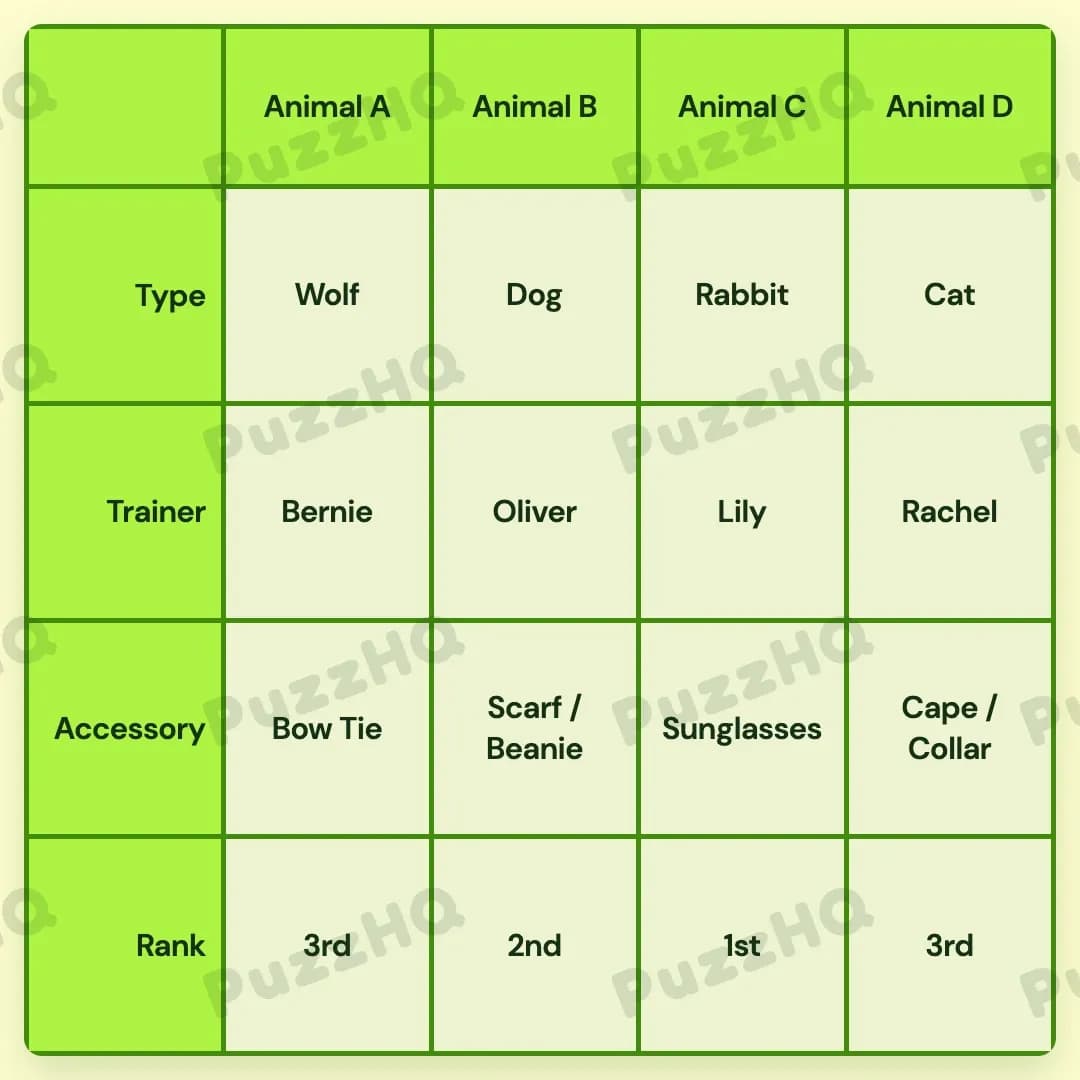
Here is the complete solution for the race lineup, detailing each animal, trainer, rank, and accessory combination across the board.
| Trait | Animal A | Animal B | Animal C | Animal D |
|---|---|---|---|---|
| Type | Wolf | Dog | Rachel | Cat |
| Trainer | Bernie | Oliver | Lily | Rachel |
| Accessory | Bow Tie | Scarf / Beanie | Sunglasses | Cape / Collar |
| Rank | 3rd | 2nd | 1st | 3rd |
(Correction in table check: Animal C Type is Rabbit)
| Trait | Animal A | Animal B | Animal C | Animal D |
|---|---|---|---|---|
| Type | Wolf | Dog | Rabbit | Cat |
| Trainer | Bernie | Oliver | Lily | Rachel |
| Accessory | Bow Tie | Scarf / Beanie | Sunglasses | Cape / Collar |
| Rank | 3rd | 2nd | 1st | 3rd |
The Logic Behind Profile Perfect Level 156
Solving this board comes down to how genealogical relationships and race outcomes frame the physical lineup. Rather than scattering hints across unrelated traits, the puzzle uses biological connections to lock down the left side of the grid early, while a shared placement at the tail end of the race establishes the hierarchy for everything that follows.
Canine Ancestry Sets the Starting Lineup
The opening moves belong entirely to the animals themselves. We are told that Animal A is the ancestor of Animal B, and that both of them bark. Between the wolf and the dog, the biological line of descent is straightforward: the Wolf belongs to Animal A, while the Dog takes Animal B.
Once the two barking animals are identified on the left, the remaining species fall into place quickly. A mid-race quarrel resulted in the Wolf and the Cat finishing last. Because the Wolf is already assigned to Animal A, the Cat must occupy one of the other positions. We also learn that Rachel puts a collar on her cat and that the cat sports a cape. Since Animal C later emerges as the central figure with its own distinct relationships, the Cat naturally settles into the Animal D slot on the far right. This leaves only the Rabbit to take the Animal C position in the center.
Race Results Define the Center
With all four species positioned across the grid, the standings provide the next structural framework. The quarrel between the Wolf and the Cat forced both of them to finish last, which means Animal A and Animal D share third place.
That joint last-place finish simplifies the remaining placements. Clues establish that the runner-up sits to the immediate right of the Bow Tie, which points directly to Animal B as the second-place finisher. If Animal B is second, and both outer edges are tied for third, Animal C must be the race winner in first place. This aligns cleanly with the note that Lily’s animal outranks its neighbors. Placing Lily with Animal C satisfies that condition perfectly, as first place outranks both the runner-up Dog on the left and the third-place Cat on the right.
Finishing Touches and Double Wardrobes
The final phase involves sorting out the trainers and their pets' assorted garments. We know that either the winner or the loser of the race wears sunglasses. Because the tied losers are already occupied with other items, the Sunglasses belong squarely to the champion Rabbit at Animal C, trained by Lily.
Meanwhile, Animal D holds the Cat with a Cape and a Collar, managed by Rachel. We are told that the Cat with a Cape cannot sit next to the Beanie. Since Animal C is the direct neighbor to the Cat and already wears Sunglasses, the Beanie must belong to Animal B. Animal B also carries a Scarf, giving it a combined Scarf and Beanie pairing.
The last pieces resolve through accessory counts and trainer names. Oliver's pet owns more accessories than Bernie's. With Animal B holding two items and Animal A holding only the Bow Tie, Animal B belongs to Oliver, while Animal A belongs to Bernie. Every cell on the board settles into its proper slot with no ambiguities left over.
The Clue I Would Read Twice
The standout line in this puzzle is the condition that Lily’s animal outranks its neighbors.
On a first pass, it is easy to assume that outranking neighbors requires a strict sequential ladder, such as second place sitting between two third-place finishers. But in this grid, the neighbors are Animal B (the second-place Dog) and Animal D (the third-place Cat). For Animal C to outrank both of them at once, it cannot merely be a runner-up; it must hold the undisputed first-place title.
Recognizing that this single clue locks down both Lily's identity as the trainer of Animal C and the exact rank of the Rabbit makes it the real keystone of the middle game.
Final Thoughts
What makes this level memorable is the way it treats the finishing order. Having two competitors tie for last place because of a mid-race squabble creates an unusual symmetry across the outer edges of the board. It is a neat reminder that race logic does not always have to follow a neat one-through-four sequence to remain completely logical.
Comments