
Profile Perfect Level 157 Answer
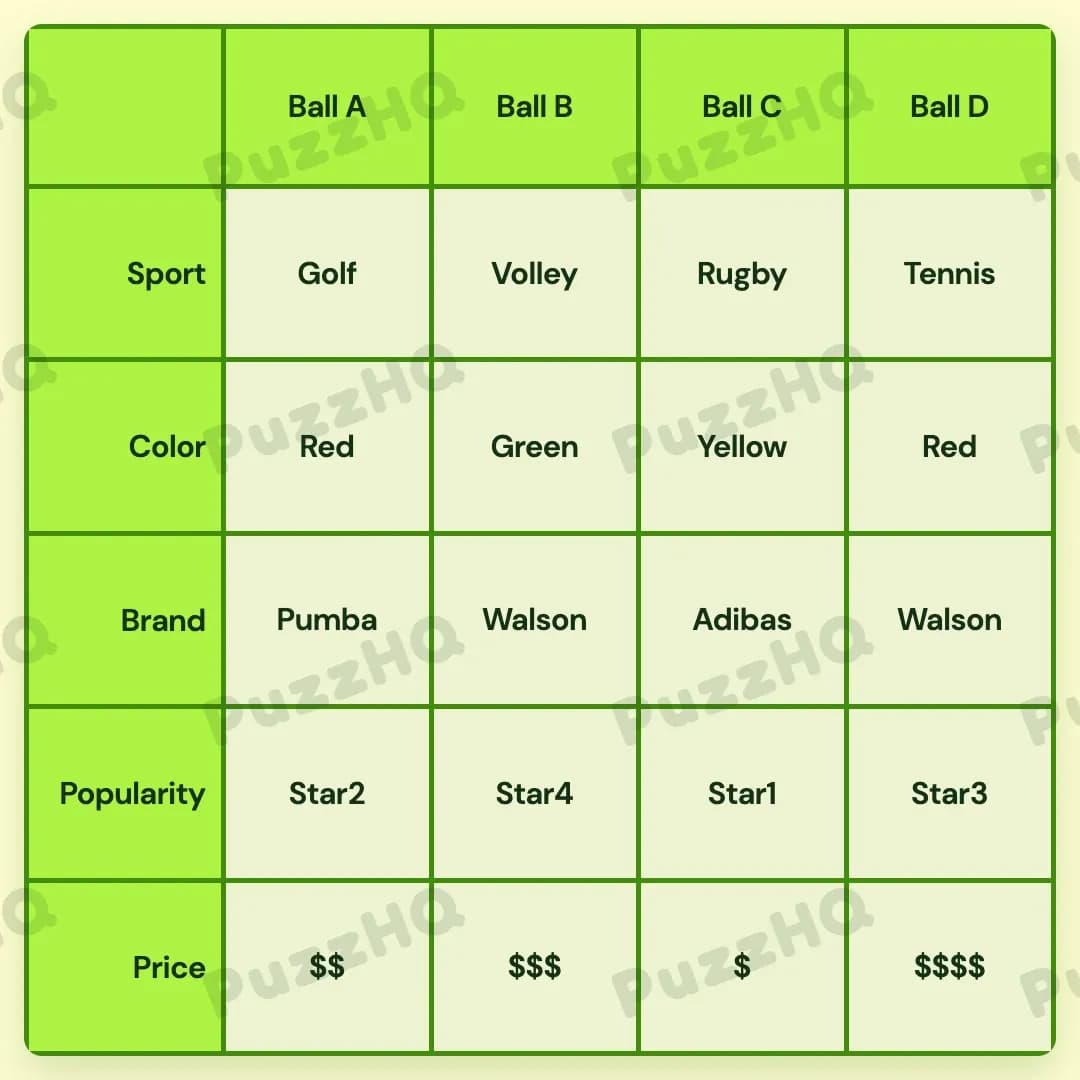
Here is the complete solved grid for this puzzle, matching every ball to its sport, color, brand, popularity ranking, and price tier.
| Trait | Ball A | Ball B | Ball C | Ball D |
|---|---|---|---|---|
| Sport | Golf | Volley | Rugby | Tennis |
| Color | Red | Green | Yellow | Red |
| Brand | Pumba | Walson | Adibas | Walson |
| Popularity | Star2 | Star4 | Star1 | Star3 |
| Price | $$ | $$$ | $ | $$$$ |
Building The Grid By Trait
Starting with physical traits like Sport and Color provides the clearest entry point because clues immediately pin down positional relationships across the four columns.
Sport And Color Establish The Physical Order
We learn early on that the oval ball sits directly between a Green ball and a Red ball. Because Rugby uses an oval ball, Rugby must occupy an interior spot that has neighbors on both sides, which limits it to either Ball B or Ball C. At the same time, we know that Ball B belongs to the smallest court sport, which points directly to Volley. Placing Volley into the Ball B column leaves Ball C as the only possible spot for Rugby.
With Ball C confirmed as Rugby, its two neighbors must be Green and Red. Ball B on the left is Green, which forces Ball D on the right to be Red. Clue details about color tags and positions also resolve Ball A as Red and Ball C as Yellow.
This sport foundation expands as soon as we look at the distance clues. The golf ball is located exactly two columns away from the cheapest ball. Since the cheapest item is in Ball C, the golf ball must sit at Ball A. That leaves Tennis as the final remaining sport, naturally slotting into Ball D.
Price And Popularity Lock The Numerical Values
Price and Popularity share tight direct links throughout the puzzle clues. We are told that the cheapest ball ($) is also the least popular ball (Star1). Furthermore, Pumba's ball is described as one step more popular than Ball C.
Because Ball C is the cheapest ball with a single dollar sign ($) and Star1 popularity, Pumba's ball must have Star2 popularity. Looking across the remaining columns, the most popular ball (Star4) is positioned immediately to the left of the Adibas ball. Since Ball C is made by Adibas, Ball B must hold the Star4 popularity rating. This leaves Star3 for Ball D and completes the popularity row.
The price tiers follow in direct succession. Walson produces the most expensive balls in the lineup. With the lower tiers of $ (Ball C) and $$ (Ball A) already accounted for, Walson takes the top two pricing tiers of $$$ and $$$$. Between the two Walson columns, the Green ball (Ball B) carries the $$$ tag, leaving the highest price tier of $$$$ for Ball D.
Brand Assignments Anchor Across The Row
Brand identities lock into place smoothly once the sport and popularity markers are settled. The golf ball is made by the brand featuring an animal logo, identifying Ball A as Pumba.
Next, the positional clue stating that the most popular ball (Ball B) sits directly to the left of the ball made by Adibas assigns Adibas to Ball C.
Finally, the premium pricing rule indicates that Walson manufactures the higher tier balls. With Ball B and Ball D occupying the $$$ and $$$$ spots, both of these remaining columns take Walson as their brand, completing the Brand category across all four items.
Where The Trait Rows Intersect
Solving logic grids becomes much faster when you focus on how clues bridge two or more trait categories at the same time.
Linking Shape And Neighborhood Colors
The clue stating that the oval ball has Green and Red neighbors binds the Sport category directly to the Color category and to grid geometry. Recognizing Rugby as the oval ball immediately disqualifies the edge columns (Ball A and Ball D) because an edge cannot have two distinct neighbors. When combined with the court size clue that fixes Volley onto Ball B, Rugby has no choice but to settle on Ball C. This single intersection instantly gives us the colors of both surrounding columns: Green for Ball B and Red for Ball D.
Price Distance And Popularity Directives
Another crucial intersection occurs between Price, Popularity, and column spacing. We are told that the cheapest ball is two columns away from the golf ball, while also learning that the cheapest ball is the least popular ball. When a separate clue reveals that Pumba's ball is slightly more popular than Ball C, it establishes a mathematical chain: Ball C must be the bottom tier for both price ($) and popularity (Star1), while Pumba must be Star2. Measuring two columns back from Ball C lands squarely on Ball A, instantly confirming that Ball A is the Golf ball made by Pumba.
Relative Hierarchy Between Brand And Price
The clue noting that Walson balls are more expensive than others creates a powerful bridge between Brand and Price. Rather than giving a fixed column, it divides the grid into brand tiers. Because Ball C is $ and Ball A is $$, the two remaining columns (Ball B and Ball D) must hold the upper price brackets of $$$ and $$$$. This rule instantly assigns the Walson brand to both Ball B and Ball D, allowing the Green color price tag clue to finish sorting the remaining dollar amounts.
Final Grid Check
Every row in the solved grid harmonizes with the surrounding traits. Ball A holds the Red Pumba golf ball at $$ and Star2, sitting exactly two columns away from Ball C, the Yellow Adibas rugby ball at $ and Star1. Ball B is the Green Walson volley ball with top Star4 popularity at $$$, placed directly left of Adibas, while Ball D completes the set as the Red Walson tennis ball at $$$$ and Star3. Each clue constraint is met cleanly across all four subjects.
Comments