
Profile Perfect Level 162 Answer
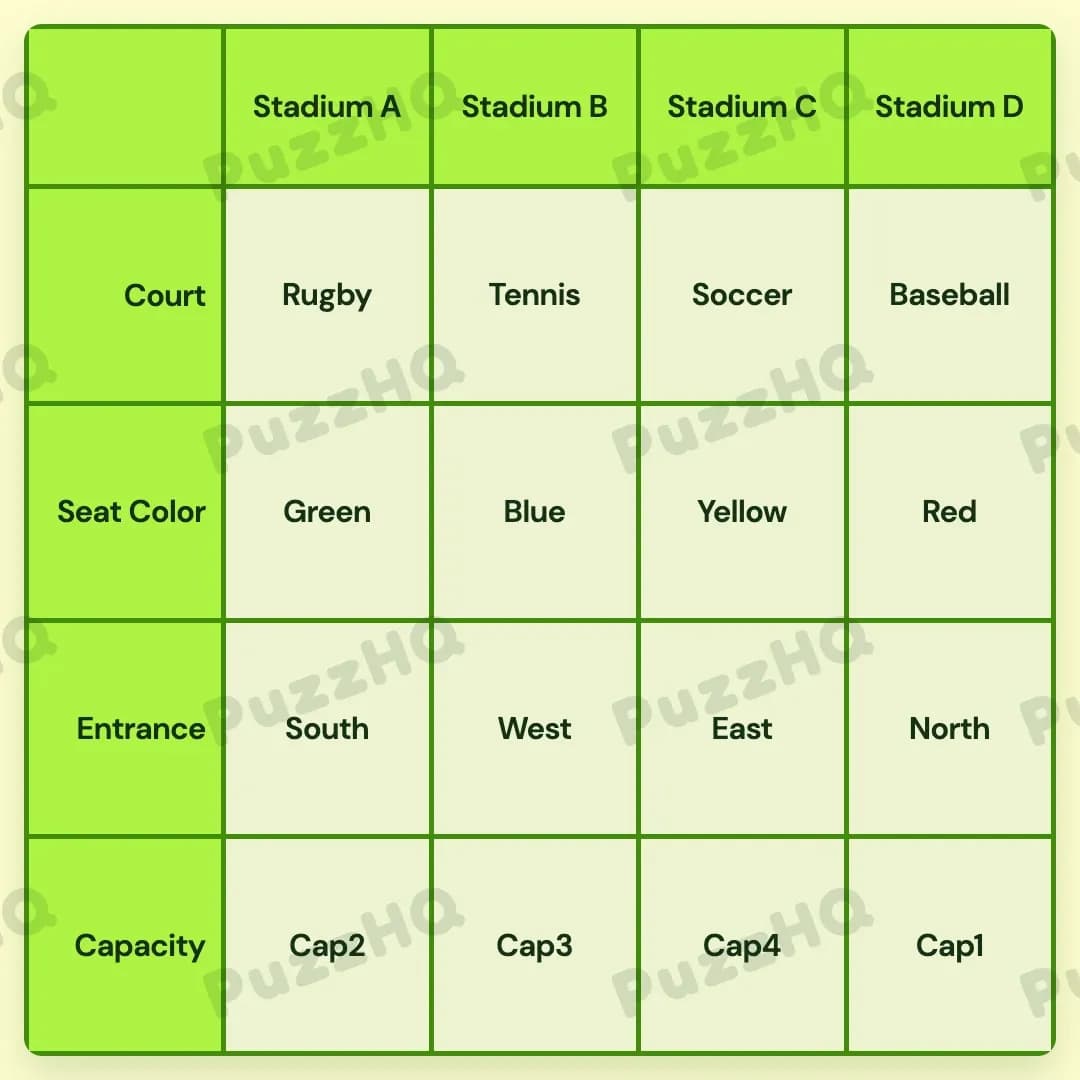
Every stadium finds its exact match once you pair the specific sports with their assigned entrance directions and seat colors before calculating their capacities.
| Trait | Stadium A | Stadium B | Stadium C | Stadium D |
|---|---|---|---|---|
| Court | Rugby | Tennis | Soccer | Baseball |
| Seat Color | Green | Blue | Yellow | Red |
| Entrance | South | West | East | North |
| Capacity | Cap2 | Cap3 | Cap4 | Cap1 |
Building The Grid By Trait
Starting with the sports and directional entrances provides the cleanest way into the puzzle because several clues directly tie Court types to Entrance orientations before linking them to column positions.
Court And Entrance Form The First Solid Pairings
The puzzle gives us two direct trait pairings between sports and entryways right away. We learn that Soccer crowds gather at the East side, which links Soccer directly to the East entrance. At the same time, fans entering from the South are heading in to watch the Rugby match, locking Rugby to the South entrance.
These pairings narrow down the remaining sports, Tennis and Baseball, as well as the remaining entrances, North and West. We also know that the East entrance stadium sits next to a neighbor with the opposite entrance. Because the opposite of East is West, the East and West stadiums must be adjacent to each other. This spatial requirement will become critical once we anchor the sports to specific stadium columns.
Seat Color Ties Venues To Specific Columns
Seat Color acts as the primary bridge between these sport and entrance pairs and the four named columns. Stadium A is immediately identified as having Green seats. We are told that the Green seats stadium cannot have its entrance at the North. Furthermore, the Tennis match audience in the left half of the layout sits on Blue seats.
Because the left half consists only of Stadium A and Stadium B, and Stadium A is already fixed with Green seats, Stadium B must host the Tennis match and feature Blue seats.
With Stadium B claimed by Tennis and Stadium A confirmed with Green seats, we can place the Rugby and South entrance combination. Stadium A cannot take North, and Stadium B is already occupied by Tennis. Placing Rugby with its South entrance into Stadium A perfectly satisfies all conditions, giving Stadium A Green seats, the Rugby court, and the South entrance.
This leaves Stadium C and Stadium D to share Soccer and Baseball. Since Soccer requires the East entrance, and the East entrance stadium must sit beside its opposite entrance (West), Stadium C must take the East entrance and Soccer. This naturally places the West entrance into its neighbor, Stadium B, alongside Tennis and Blue seats.
Stadium D is left with the final remaining entrance, North, and the final remaining sport, Baseball. Looking at the remaining seat colors, Yellow and Red must be distributed between Stadium C and Stadium D. The clue stating that the Red seats stadium is closer to Yellow than to Blue tells us that Red sits adjacent to Yellow at the right end of the line. Therefore, Stadium C gets Yellow seats, and Stadium D takes Red seats.
Capacity Levels Complete The Remaining Gaps
With Court, Seat Color, and Entrance fully settled across all four stadiums, the Capacity row resolves through proportional relationships and direct ranking clues.
We learn that the Red seats stadium has the smallest capacity, which corresponds to Cap1. Since Stadium D has Red seats and the North entrance, it takes Cap1. Next, the clue noting that the Rugby stadium holds half the capacity of the Soccer stadium locks in the two even capacity values. Rugby in Stadium A must take Cap2, which allows Soccer in Stadium C to take double that amount at Cap4.
The only remaining capacity level is Cap3, which neatly fills the vacant slot in Stadium B.
Where The Trait Rows Intersect
Solving this layout relies heavily on moments where single clues bridge multiple traits at once, bypassing the need for guess-and-check deduction.
Connecting Court Types Directly To Entrance Directions
The clues linking Soccer to the East entrance and Rugby to the South entrance create self-contained two-trait units. Instead of treating Court and Entrance as independent rows, these clues allow us to treat "Soccer East" and "Rugby South" as single building blocks. When evaluating where these blocks can fit relative to the fixed Green seats in Stadium A, the options shrink immediately without needing any column-by-column trial.
Using Seat Colors To Position The Sports Across Columns
The clue placing the Tennis audience on Blue seats within the left half of the layout intersects Seat Color, Court, and column geography simultaneously. By constraining Blue seats and Tennis to either Stadium A or Stadium B, and knowing Stadium A already holds Green seats, the puzzle forces Tennis and Blue directly into Stadium B. This single deduction sets off a chain reaction that locks Stadium A into Rugby and pushes Soccer into the right half of the grid.
Capacity Ratios Lock Down The Final Two Stadiums
The mathematical relationship between the Rugby stadium and the Soccer stadium links Court types directly to numerical Capacity values. Because Rugby is already placed in Stadium A and Soccer is in Stadium C, the one-to-two ratio between Cap2 and Cap4 resolves both stadiums at once. This avoids any confusion with Cap3, leaving it cleanly for Stadium B while confirming Cap1 for the Red seats in Stadium D.
Final Grid Check
Every row in the completed grid reinforces the others without any contradictions. Stadium A holds the Rugby match with Green seats, a South entrance, and Cap2 capacity. Stadium B provides West entry for Tennis fans sitting in Blue seats with Cap3 capacity. Stadium C features Soccer on the East side with Yellow seats and Cap4 capacity, while Stadium D finishes the line with Baseball, Red seats, the North entrance, and Cap1 capacity.
Comments