
Profile Perfect Level 18 Answer
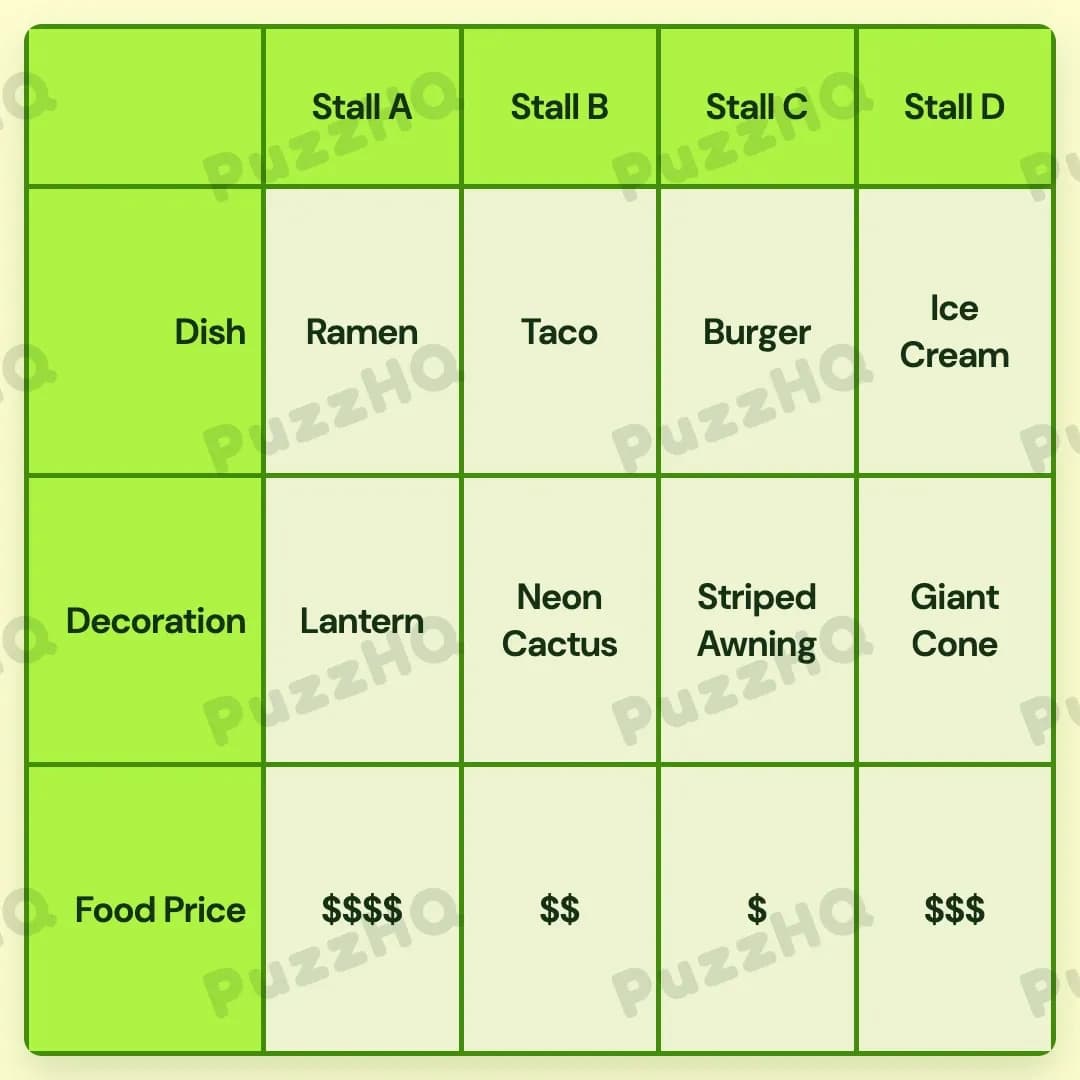
Before you start shuffling stalls and menu boards, here is the completed record for all four vendors.
| Trait | Stall A | Stall B | Stall C | Stall D |
|---|---|---|---|---|
| Dish | Ramen | Taco | Burger | Ice Cream |
| Decoration | Lantern | Neon Cactus | Striped Awning | Giant Cone |
| Food Price | $$$$ | $$ | $ | $$$ |
The Logic Behind Profile Perfect Level 18
This layout turns on how quickly the food options pin down the physical row, giving the financial and decorative details an immediate framework to settle into. When a puzzle gives you clear anchors on both ends of a linear row, the remaining neighbors have almost no room to wander. Once you see where the treats and bowls land, the rest of the board behaves like falling dominoes.
Anchoring The Ends Of The Street
The opening deductions are about as clean as they come. We learn right away that Stall A serves a warm bowl of ramen and Stall D dishes out a cold treat, which can only be ice cream. With the outer posts established, the spatial clues take over.
The burger vendor sits directly beside ice cream. Because ice cream is fixed at Stall D on the far right, the burger must occupy Stall C. That leaves exactly one open spot for the taco stall, sliding it straight into Stall B. In just a few sentences, every single dish is locked to its vendor stall from left to right: Ramen at Stall A, Taco at Stall B, Burger at Stall C, and Ice Cream at Stall D.
Working Out The Price Of Lunch
With the menu locked down, the pricing tiers resolve through simple arithmetic and placement. We are told that the cheapest stall in the row stands next to the ice cream stall. Since ice cream sits at Stall D, its neighbor at Stall C must be the one-dollar tier.
That gives us a clear baseline for the burger. From there, we look at the relationship between the tacos and the ramen. The clue specifies that a bowl of ramen costs the exact equivalent of two orders of tacos. Looking at standard logic tier scales from one dollar sign to four, the only viable doubling pair that leaves the one-dollar spot free for Stall C is two dollars and four dollars.
Tacos at Stall B take the two-dollar spot, which automatically pushes Ramen at Stall A up to the four-dollar tier. With one dollar, two dollars, and four dollars allocated across Stalls C, B, and A, the remaining three-dollar price tag belongs entirely to the ice cream at Stall D.
Keeping Distance With The Lantern
The final phase comes down to visual accents, where simple exclusions clear the board without friction. The giant cone is a natural thematic fit for ice cream at Stall D, and our spatial rules prevent the lantern from sitting anywhere near it.
Because Stall C is immediately adjacent to the giant cone at Stall D, the lantern cannot go there. Stall B is also eliminated by the requirement that the taco stall does not use red decor, steering the lantern into the far corner at Stall A where it stays safely away from Stall D.
That leaves the neon cactus and the striped awning. With Stall B hosting tacos and avoiding red decor, the neon cactus claims Stall B comfortably. The striped awning settles over Stall C, completing the entire vendor row without a single loose thread.
The Clue I Would Read Twice
The pricing relationship between the ramen and the tacos is the one clue where players might hesitate if they rush. Hearing that one item equals two of another often prompts people to guess whether they are dealing with raw dollars or abstract tiers.
In this setup, the clue works because it relies on the cheapest stall clue to establish the floor first. Once you know Stall C takes the single dollar sign, the doubling formula cannot be one and two. It must be two and four. It is a neat little mechanical lock where neither pricing clue works in isolation, but together they completely solve the row's finances.
Final Thoughts
What makes this level pleasant to work through is how tidy the geometry feels. Four stalls in a row can sometimes feel too tight or restrictive, but here every trait type uses that tight space differently. The food relies on direct end-caps, the pricing uses relative neighbors and basic math, and the decorations rely on spacing rules. It is a compact solve that rewards reading the street from left to right.
Comments