
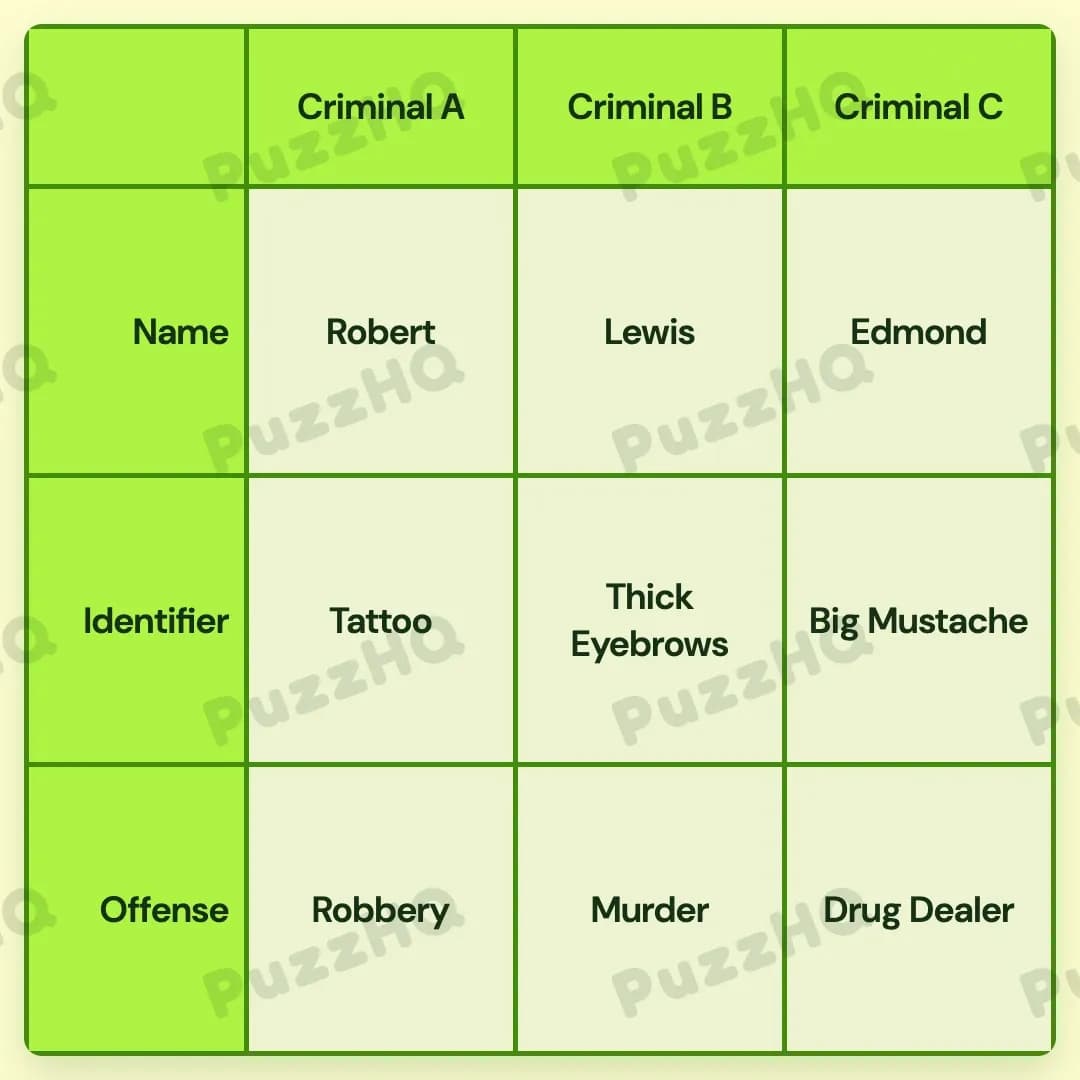
Profile Perfect Level 21 Answer
Robert committed the robbery, Lewis is the murderer, and Edmond is the drug dealer.
| Trait | Criminal A | Criminal B | Criminal C |
|---|---|---|---|
| Name | Robert | Lewis | Edmond |
| Identifier | Tattoo | Thick Eyebrows | Big Mustache |
| Offense | Robbery | Murder | Drug Dealer |
How To Think Through Profile Perfect Level 21
The most reliable habit for this puzzle is locking down direct subject and position anchors before attempting to link multi trait pairs across the board. When you place confirmed values into specific slots right away, paired clues naturally drop into place without any need to guess.
Start With Direct Subject Placements: Criminal B Is The Murderer
The fastest way to gain momentum in any Profile Perfect puzzle is finding clues that explicitly name a specific subject column.
In this puzzle, clue 1 gives you an exact match: Criminal B is a Murderer.
You do not need to compare traits or test possibilities here. Place Murder directly under Criminal B in the Offense row.
Direct subject clues give you an immediate anchor. Criminal B now has a known offense, which narrows down the remaining two offenses (Robbery and Drug Dealer) to Criminal A and Criminal C.
Use Spatial Clues As Anchors: The Mustache On The Right
Positional clues function just like direct subject clues once you translate relative position into column positions.
Clue 2 states that the criminal on the right has a notable mustache.
Looking at your grid layout:
- Criminal A is on the left.
- Criminal B is in the middle.
- Criminal C is on the right.
This immediately assigns the Big Mustache identifier to Criminal C.
Notice how this single spatial clue sets up downstream connections. You now have Criminal B defined by an offense (Murder) and Criminal C defined by an identifier (Big Mustache).
Link Trait Pairs To Fixed Anchors: Edmond And The Big Mustache
Once individual values are anchored to columns, look for clues that connect two different trait types together. These paired clues bridge the gap between categories.
Clue 6 states that the Drug Lord can be identified with a Big Mustache.
Because you already placed the Big Mustache on Criminal C using spatial reasoning, you can immediately combine these two traits:
- Criminal C has the Big Mustache.
- The person with the Big Mustache is the Drug Dealer.
- Therefore, Criminal C is the Drug Dealer.
Next, look at clue 4: Edmond was the Drug Dealer in his area.
Since you know Criminal C is the Drug Dealer, Edmond must be Criminal C.
In just two logical steps built on your anchor, you have completely solved all three rows for Criminal C:
- Name: Edmond
- Identifier: Big Mustache
- Offense: Drug Dealer
Chain Linked Pairs To Remaining Columns: Lewis And His Thick Eyebrows
Now examine the clues that pair names, offenses, and identifiers for the remaining open spots.
Clue 5 tells you that Lewis is always proud of his Thick Eyebrows.
Look at where this pair can fit:
- Criminal C is fully solved (Edmond, Big Mustache, Drug Dealer).
- Criminal B has no Name and no Identifier yet, only the Offense of Murder.
- Criminal A has no Name, no Identifier, and no Offense yet.
Now look at clue 3: The person who did Robbery has a Tattoo.
You have two bundled pairs to place into two remaining columns:
- The pair of Lewis and Thick Eyebrows.
- The pair of Robbery and Tattoo.
Look at Criminal B. Criminal B already has the Murder offense assigned. Therefore, the pair with Robbery cannot belong to Criminal B.
Because Robbery cannot go to Criminal B, Robbery must belong to Criminal A.
Along with Robbery comes the Tattoo from clue 3. Place Robbery and Tattoo under Criminal A.
With Robbery and Tattoo assigned to Criminal A, the pair of Lewis and Thick Eyebrows must belong to Criminal B. Place Lewis in the Name row and Thick Eyebrows in the Identifier row under Criminal B.
Eliminate Used Values: Robert Claims The Final Cell
At this point, nearly every cell across all three criminals is filled:
- Criminal A has Robbery and Tattoo.
- Criminal B has Lewis, Thick Eyebrows, and Murder.
- Criminal C has Edmond, Big Mustache, and Drug Dealer.
Only one empty cell remains: the Name for Criminal A.
By checking the available names, Robert is the only unused option. Place Robert under Criminal A to complete the entire puzzle grid cleanly and decisively.
What This Level Teaches You
Positional Labels Map Directly To Columns
When a clue mentions a criminal on the left, in the middle, or on the right, treat it as a direct coordinate. In this level, identifying the criminal on the right gave an immediate home to the Big Mustache on Criminal C, unlocking the entire right side of the board.
Linked Trait Clues Form Moveable Dominoes
Clues like "The person who did Robbery has a Tattoo" link two traits together like a two sided domino tile. Instead of trying to place Robbery or Tattoo alone, look for columns that have space for both traits at the same time. Since Criminal B already had Murder, the Robbery and Tattoo tile was forced into Criminal A.
Anchor Clues Turn Abstract Pairs Into Concrete Solutions
A paired clue is only potential information until it touches a confirmed slot on the grid. In this level, learning that the Drug Dealer had a Big Mustache was useful specifically because Criminal C was already locked into having the mustache. Always look for overlapping traits between your floating clue pairs and your established board state.
Final Thoughts
Solving this level efficiently comes down to anchoring the fixed points first. Once Criminal B received Murder and Criminal C received the Big Mustache, every remaining trait pair fell into place by straightforward elimination.
Comments