
Profile Perfect Level 200 Answer
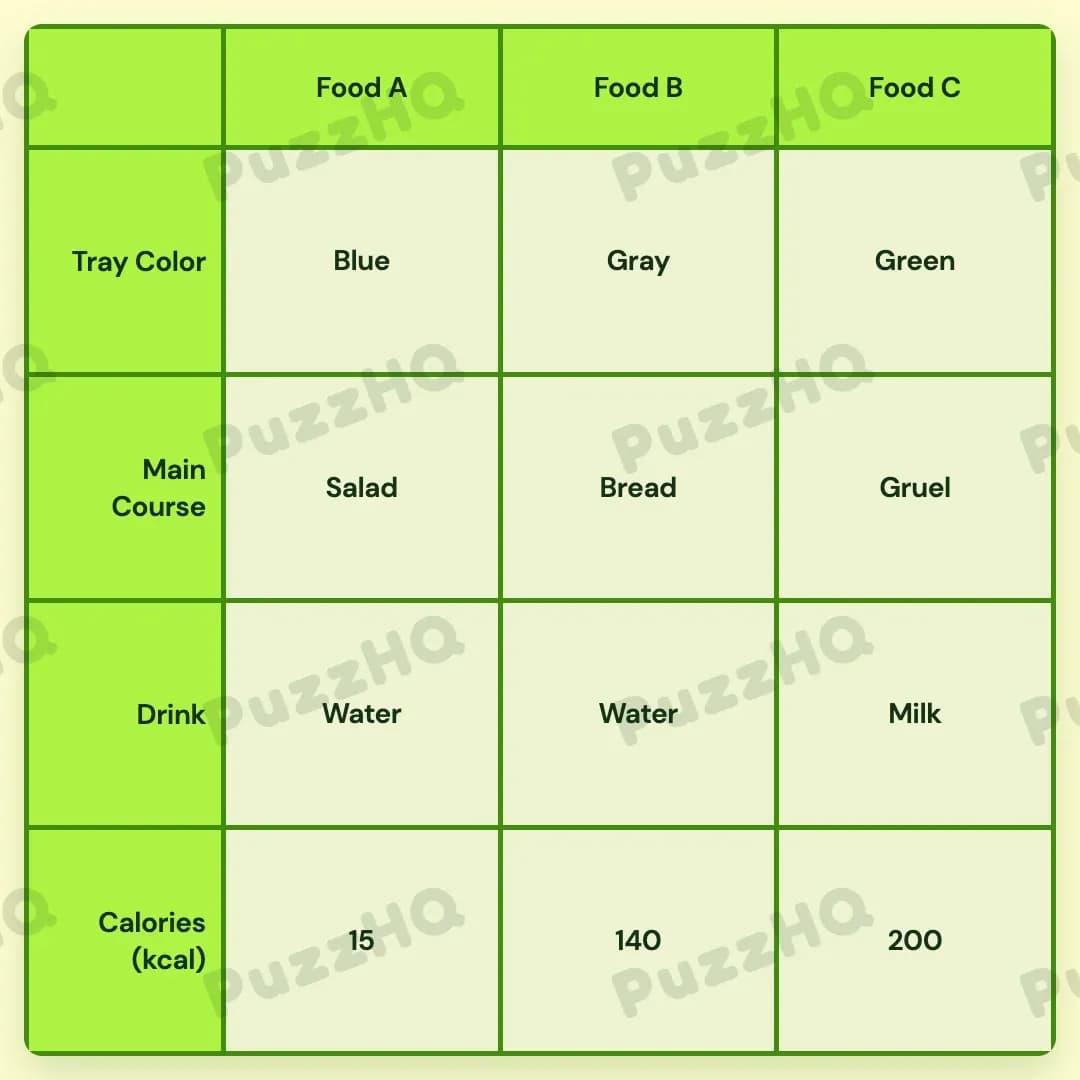
Food A is served in a Blue tray with Salad, Water, and 15 kcal; Food B is served in a Gray tray with Bread, Water, and 140 kcal; Food C is served in a Green tray with Gruel, Milk, and 200 kcal.
| Trait | Food A | Food B | Food C |
|---|---|---|---|
| Tray Color | Blue | Gray | Green |
| Main Course | Salad | Bread | Gruel |
| Drink | Water | Water | Milk |
| Calories (kcal) | 15 | 140 | 200 |
How To Think Through Profile Perfect Level 200
The key to solving this puzzle efficiently is recognizing how spatial constraints and mathematical comparisons narrow down positions before you even place a single color or drink. When working with three items in a line, negative neighbor clues immediately fix the middle position, creating an anchor for the rest of your deduction.
Use Non-Neighbor Clues To Find The Middle Subject: Bread Goes To Food B
When you have three subjects aligned from left to right as Food A, Food B, and Food C, the only way two items cannot be neighbors is if they sit on opposite ends.
Look at the clue stating that Salad and Gruel main courses are not neighbors. Because Food B borders both Food A and Food C, neither Salad nor Gruel can be placed in Food B. If either one were in Food B, it would automatically neighbor the other regardless of where the other was placed.
This leaves only one possible spot for the third main course. Bread must be placed in the center at Food B. You do not yet know whether Salad belongs to Food A or Food C, but isolating Bread in the center gives you a stable baseline for the next step.
Test Value Comparisons Against Remaining Pairs: Matching Salad And Bread Calories
Once Bread is locked in the middle, look for clues that mention the items you already know something about. The clue stating that the Bread meal almost has 10x the calories of Salad lets you evaluate the three calorie numbers: 15, 140, and 200.
Test how these numbers relate to each other:
- Ten times 15 is 150, which is very close to 140.
- Ten times 140 is 1400, which is far higher than any number available.
- Ten times 200 is 2000, which is also impossible.
This confirms that Salad must have 15 kcal and Bread must have 140 kcal. By elimination, Gruel must take the remaining calorie count of 200 kcal.
Because Salad has 15 kcal and Gruel has 200 kcal, you can now determine their exact positions. You know from earlier that Salad and Gruel occupy Food A and Food C. A separate clue states that the food in the Blue tray has the lowest calorie count. Since 15 kcal is the lowest value, Salad must be in the Blue tray.
Anchor Trait Pairs To Finalize The Main Courses: Salad At Food A And Gruel At Food C
Now connect the calorie values to their subject positions. The clue notes that the food in the Blue tray has the lowest calorie count, meaning the Blue tray contains 15 kcal and therefore holds the Salad.
Because Food B already holds Bread with 140 kcal, Food A and Food C hold the extremes. Salad with 15 kcal is placed at Food A, leaving Gruel with 200 kcal at Food C.
At this point, every main course and calorie value is completely locked in place:
- Food A: Salad with 15 kcal
- Food B: Bread with 140 kcal
- Food C: Gruel with 200 kcal
Apply Exclusive Direct Matches: Gruel Receives Milk
With the main courses and subjects settled, turn to the drinks. The clue stating that Gruel is the only food accompanied by Milk gives a direct pairing.
Since Gruel is confirmed at Food C, Milk must also belong to Food C. The available drink options contain two Waters and one Milk. Because Food C takes the only Milk, both Food A and Food B must receive Water.
This completely resolves the Drink category:
- Food A has Water
- Food B has Water
- Food C has Milk
Eliminate Tray Colors Based On Negative Restrictions: Green Tray At Food C
Only two tray colors remain unassigned: Green and Gray, since Food A is already confirmed as the Blue tray.
The clue stating that Waters are not part of the Green tray resolves this remaining choice. Food A and Food B both have Water as their drink. Food A is already Blue, and Food B cannot be Green because it has Water. Therefore, Food B cannot take the Green tray.
Food C is the only subject that does not have Water, as it has Milk. This means Food C must take the Green tray.
Assigning Green to Food C leaves Gray as the only remaining tray color, which belongs to Food B. The entire grid is now fully solved with zero guesswork.
What This Level Teaches You
Three Subject Boards Turn Separation Clues Into Fixed Center Pieces
On a three subject board, any clue stating that two items are not adjacent immediately forces those two items into the outer slots and defines the center slot. Whenever you see a negative adjacency clue on a small grid, do not wait for more information. Use it immediately to identify the middle subject.
Numerical Clues Resolve Trait Identities Before Subject Positions
You do not need to know which food belongs to Food A or Food C before figuring out which calorie count belongs to which main course. By comparing the numbers 15 and 140 directly through the 10x clue, you established the trait pair of Salad and 15 kcal independently. Resolving trait to trait links often unlocks the subject positions right afterward.
Negative Constraints Point Directly To Exceptions
When a clue says that a common trait cannot pair with a certain option, look for the unique subject. The clue that Waters are not part of the Green tray seemed to restrict two foods, but because Milk was the only alternative drink, it instantly pointed to the Milk subject as the only valid home for the Green tray.
Final Thoughts
This puzzle highlights the power of combining spatial geometry with relative math clues. By using the non-neighbor rule to lock Bread in the center and checking the calorie multiplier, you avoided trial and error entirely. Looking for structural guarantees first will always keep your deductions solid.
Comments