
Profile Perfect Level 241 Answer
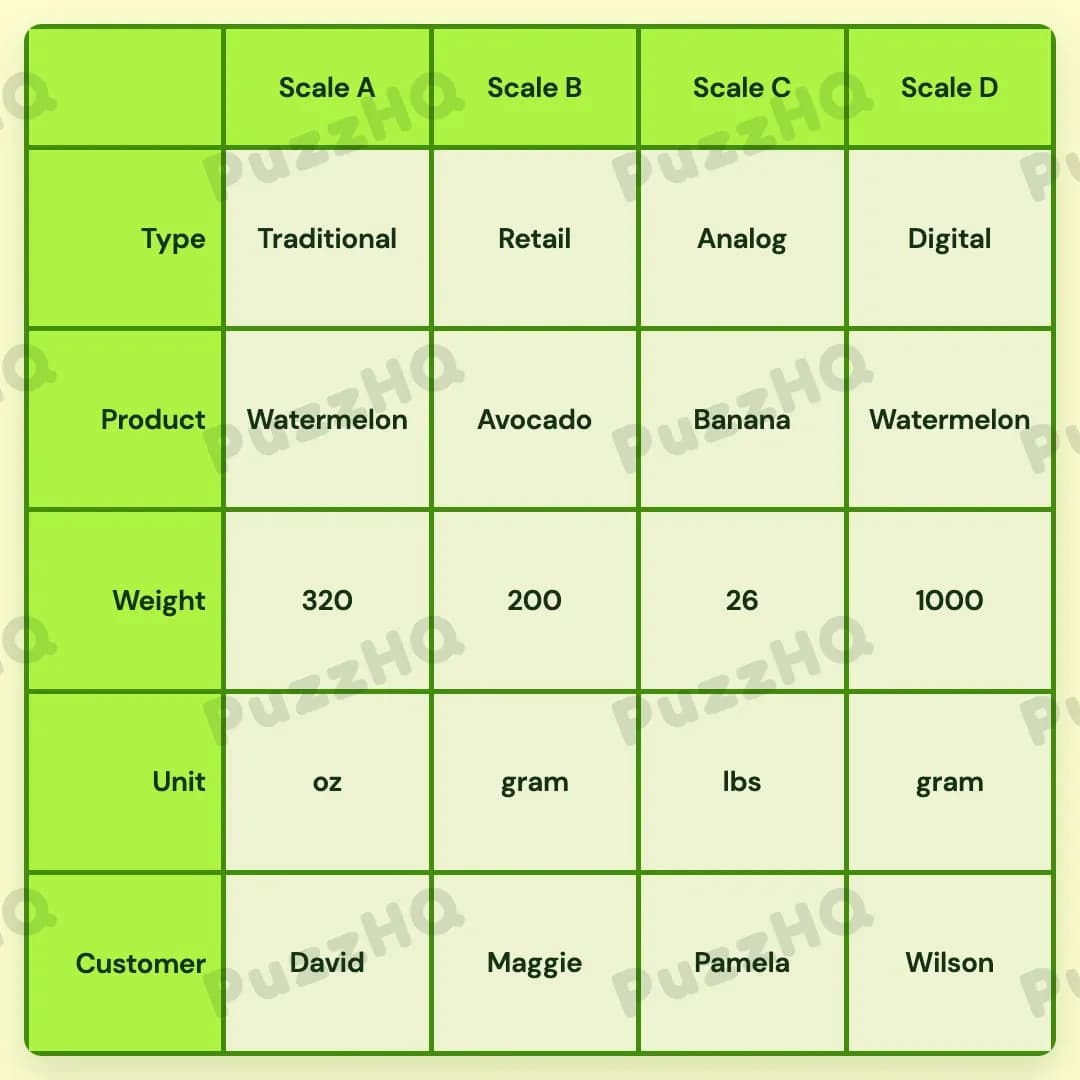
Here is the complete solution to balance every scale with its correct product, weight, unit, type, and shopper.
| Trait | Scale A | Scale B | Scale C | Scale D |
|---|---|---|---|---|
| Type | Traditional | Retail | Analog | Digital |
| Product | Watermelon | Avocado | Banana | Watermelon |
| Weight | 320 | 200 | 26 | 1000 |
| Unit | oz | gram | lbs | gram |
| Customer | David | Maggie | Pamela | Wilson |
Building The Grid By Trait
The best way into this puzzle is through the Type and Unit categories, where structural clues about scale mechanics and unit conversions quickly fix the column layout.
Type And Unit Establish The Column Framework
The clues provide direct descriptions of how various scale types operate. The Traditional scale balances with 28.35 gram pieces, which represents the standard conversion for ounces. This ties the Traditional scale to ounces (oz). Meanwhile, the Digital scale measures a 1 kilogram item, which translates to 1000 grams.
We learn that Wilson and Maggie use scales measuring in the smallest unit category, which is grams. Because the Digital scale measures in grams (1000 grams) and Scale B shows weight numbers above the product as a Retail scale, the gram units settle on Scale B and Scale D.
Scale C uses pounds (lbs) because the clue notes that the lightest item sits to the left of the scale using pounds, placing pounds at Scale C and the lightest item at Scale B. This leaves ounces for Scale A. Consequently, the Traditional scale sits at Scale A, and the Digital scale sits at Scale D.
The Analog scale is placed between an Avocado and a Watermelon. Since it sits between two other items, it must occupy Scale C. This finishes the Type row: Scale A is Traditional, Scale B is Retail, Scale C is Analog, and Scale D is Digital.
Customer Positions Lock Onto Specific Scales
With the Type row mapped, Pamela's location is immediately resolved. Pamela stands two columns away from the Traditional scale at Scale A, placing her directly at Scale C.
We also know that Wilson and Maggie share the two scales measuring in grams (Scale B and Scale D). A clue mentions that a woman is thinking about making avocado juice, which aligns Maggie with the Avocado. Another clue indicates that Maggie buys the fewest items or the lightest total, placing her at Scale B with the 200 gram Avocado. Wilson therefore takes the remaining gram scale at Scale D.
With Maggie at Scale B, Pamela at Scale C, and Wilson at Scale D, the only remaining shopper, David, belongs at Scale A.
Weight Values Resolve Through Unit Conversions
The numeric weights can now be distributed by comparing relative weights across different units. Every 16 ounces equals 1 pound, and 1 kilogram is 1000 grams.
The clue stating that Pamela's item has only a two digit number but is actually the heaviest provides the key calculation. Pamela is at Scale C, which uses pounds. A value of 26 pounds equals 416 ounces, or roughly 11.79 kilograms, making it considerably heavier than 1000 grams (1 kilogram), 320 ounces (20 pounds), or 200 grams (0.2 kilograms). Thus, Pamela's weight value is 26 at Scale C.
The Digital scale at Scale D measures 1 kilogram, which gives Scale D a numeric weight of 1000 grams.
The item measured in ounces is slightly lighter than the item at Scale C. Scale C holds 26 pounds, which equals 416 ounces. An item measured in ounces at Scale A that is slightly lighter is 320 ounces (equivalent to 20 pounds).
Finally, the lightest item belongs to Maggie at Scale B, giving Scale B the weight of 200 grams.
Product Assignments Complete The Layout
With customer, scale type, unit, and weight firmly established, the products fall neatly into place.
The Analog scale at Scale C is positioned between Avocado and Watermelon. Because Scale B holds Avocado for Maggie, Scale A must hold Watermelon. Scale D also receives Watermelon to satisfy the remaining weight of 1000 grams.
The final missing fruit is Banana, which fills the remaining product slot at Scale C for Pamela.
Where The Trait Rows Intersect
Scale Types And Unit Conversions Define Column Positions
The interaction between scale mechanics and unit definitions is central to solving the puzzle. Knowing that 28.35 grams represents 1 ounce links the Traditional scale directly to the ounce measurement. Combining this with the fact that 1 kilogram equals 1000 grams on the Digital scale immediately anchors the outer columns. This cross connection prevents confusion about which scales use metric units and which use imperial units.
Customer Identities Resolve Through Weight Comparisons
Pamela's clue bridges Customer, Weight, and Unit simultaneously. By stating that her weight is a two digit number yet represents the heaviest actual mass, the puzzle forces an inspection of the unit values. The only way a two digit number can outweigh 1000 grams or 320 ounces is if the unit is pounds, because 26 pounds equals over 11 kilograms. This simultaneously confirms Pamela at Scale C, assigns her the unit of pounds, and fixes her weight at 26.
Product Placement Bridges Shopper Intent And Scale Type
Maggie's intention to make avocado juice links Customer to Product at Scale B. Because the Analog scale must sit between Avocado and Watermelon, Maggie's position at Scale B dictates that Scale C is Analog and Scale A is Watermelon. This single connection harmonizes the layout across three separate trait categories.
Final Grid Check
Every category now aligns seamlessly across all four columns. The Traditional scale at Scale A balances 320 ounces of Watermelon for David. Scale B features Maggie using the Retail scale to weigh 200 grams of Avocado. At Scale C, Pamela weighs 26 pounds of Bananas on the Analog scale. Finally, Scale D features Wilson weighing 1000 grams of Watermelon on the Digital scale. All clues and mathematical conversions match the completed grid perfectly.
Comments