
Profile Perfect Level 266 Answer
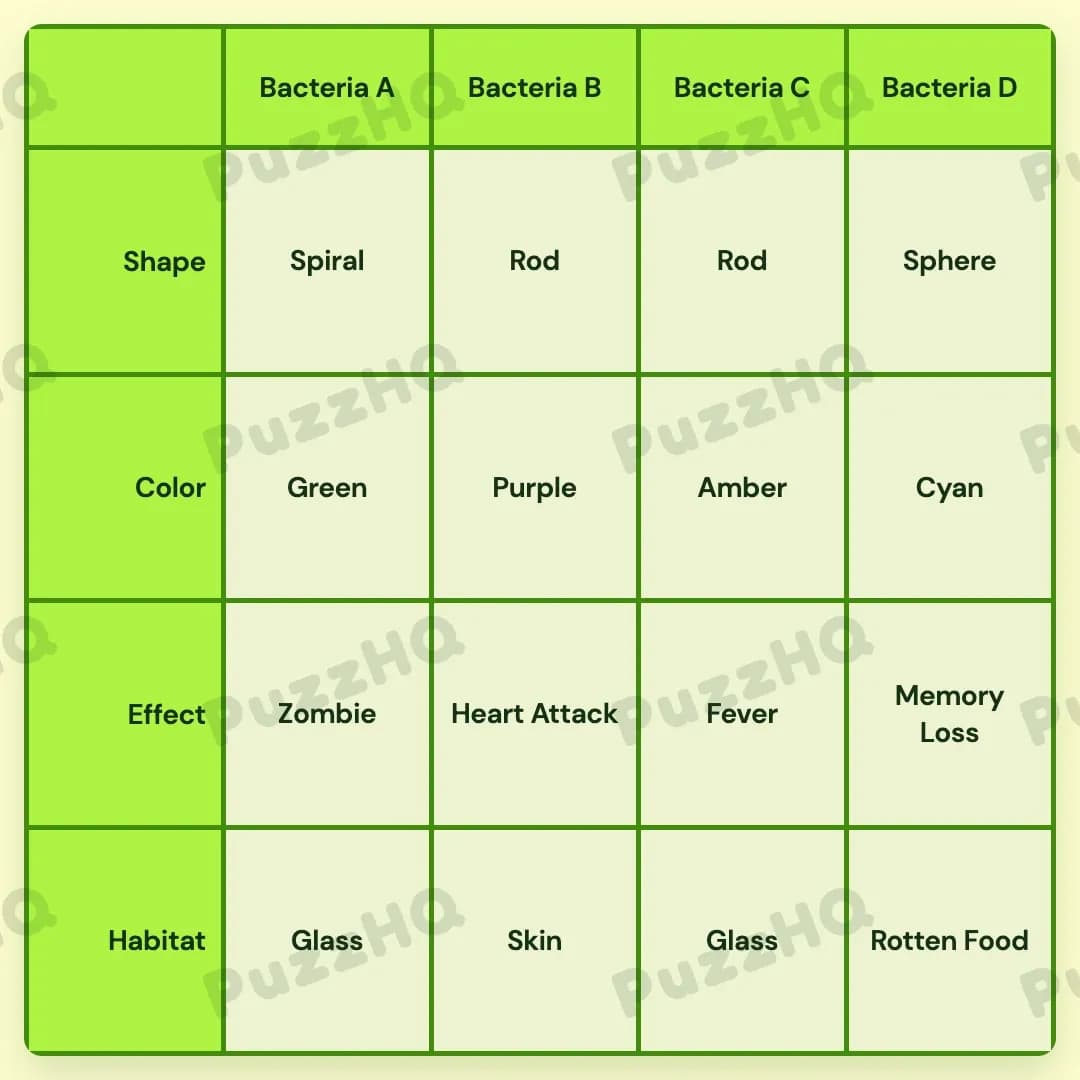
Bacteria A causes the Zombie effect from Glass, Bacteria B causes Heart Attack from Skin, Bacteria C causes Fever from Glass, and Bacteria D causes Memory Loss from Rotten Food.
| Trait | Bacteria A | Bacteria B | Bacteria C | Bacteria D |
|---|---|---|---|---|
| Shape | Spiral | Rod | Rod | Sphere |
| Color | Green | Purple | Amber | Cyan |
| Effect | Zombie | Heart Attack | Fever | Memory Loss |
| Habitat | Glass | Skin | Glass | Rotten Food |
How To Think Through Profile Perfect Level 266
The key habit for this level is anchoring direct statements first, then using those fixed points to unlock positional clues and negative constraints. When you match identity clues right away, board positions become concrete targets rather than abstract possibilities.
Lock In Direct Identity Matches: Bacteria C And Bacteria D
Direct clues give you a solid foundation because they assign specific traits without requiring any positional guesswork. Starting with these clues immediately reduces the board to a smaller set of unknowns.
Look at the clues that name specific bacteria:
- Clue 1 states that Bacteria C is a staple cause of Fever.
- Clue 3 notes that the Fever bacteria has a radiant orange like color, which matches Amber.
- Clue 5 tells you that the ball-like Bacteria D causes dementia, giving Bacteria D both the Sphere shape and the Memory Loss effect.
By combining Clue 1 and Clue 3, you determine that Bacteria C has the Fever effect and the Amber color. Clue 5 directly assigns the Sphere shape and Memory Loss effect to Bacteria D. You now have two distinct subjects partially solved, which simplifies the rest of the puzzle.
Use Multi Trait Connections: Linking Cyan And Rotten Food
Multi trait clues link two different categories together before you even know which subject claims them. Once connected, the pair must move as a single unit.
Clue 9 states that the Cyan bacteria can be found in expired food, which corresponds to Rotten Food. This tells you that whichever bacterium has the Cyan color must also have the Rotten Food habitat.
Now look at your existing assignments:
- Bacteria C already has the Amber color.
- Clue 7 states that the leftmost bacteria does not grow from Rotten Food, meaning Bacteria A cannot have Rotten Food and therefore cannot be Cyan.
- Bacteria D already has the Sphere shape and Memory Loss effect, leaving its Color and Habitat open.
Because Bacteria D needs both a color and a habitat, the Cyan and Rotten Food pairing fits Bacteria D perfectly. Bacteria D is now fully resolved with Sphere shape, Cyan color, Memory Loss effect, and Rotten Food habitat.
Apply Positional Math: Finding The Heart Attack Host
A row of four subjects arranged from left to right contains two outer ends with only one neighbor each, and two inner positions with two neighbors each. Recognizing this layout allows you to turn structural clues into exact assignments.
Clue 2 states that Heart Attack is caused by a bacterium with two neighbors. In the line of four subjects:
- Bacteria A has one neighbor to its right.
- Bacteria D has one neighbor to its left.
- Bacteria B and Bacteria C each have two neighbors.
Since Bacteria C is already locked into the Fever effect, it cannot cause a Heart Attack. That leaves Bacteria B as the only available bacterium with two neighbors. Bacteria B takes the Heart Attack effect. With Fever on Bacteria C, Memory Loss on Bacteria D, and Heart Attack on Bacteria B, the final remaining effect, Zombie, belongs to Bacteria A.
Use Negative Elimination To Place The Green Color
Negative clues tell you where a trait cannot go. When combined with your established anchors, they quickly isolate the single valid location for a color or trait.
Clue 4 states that the bacteria beside the Fever bacteria are not Green.
- The Fever bacterium is Bacteria C.
- The neighbors beside Bacteria C are Bacteria B and Bacteria D.
- Neither Bacteria B nor Bacteria D can be Green.
- Bacteria C is Amber.
With Bacteria B, Bacteria C, and Bacteria D ruled out, Green must belong to Bacteria A.
Now check the remaining colors. Bacteria A is Green, Bacteria C is Amber, and Bacteria D is Cyan. The only unused color is Purple, which naturally belongs to Bacteria B.
Trace Neighbor Chains: Finding The Skin Habitat And Shapes
Neighbor clues work best when you have an immovable anchor on the board. You can follow adjacent relationships outward from that fixed position.
Clue 8 says that the bacteria living on Skin is next to the Green one.
- You have already confirmed that Bacteria A is Green.
- The only neighbor next to Bacteria A is Bacteria B.
- Therefore, Bacteria B has the Skin habitat.
Next, look at Clue 6, which states that Sphere and Spiral bacteria are neighbors of the Rod.
- Bacteria D is already established as Sphere.
- Because Bacteria D sits next to Bacteria C, Bacteria C must be a Rod shape.
- Bacteria B is also a Rod shape, situated between the Spiral shape and the second Rod.
- This places the Spiral shape on Bacteria A.
Finally, complete the remaining Habitat trait. Bacteria B lives on Skin and Bacteria D lives on Rotten Food. The remaining Glass habitat fills the two open slots on Bacteria A and Bacteria C.
What This Level Teaches You
Positional Count Rules Out Endpoints Immediately
When a clue mentions an exact count of two neighbors in a four subject row, it immediately eliminates both outer ends. Recognizing that only interior positions qualify lets you assign traits quickly without testing every slot manually.
Linked Pairs Fill Double Openings Faster
Treating linked traits as a single block makes matching effortless. When Cyan and Rotten Food were tied together, looking for a subject that needed both a color and a habitat pointed directly to Bacteria D, bypassing unnecessary trial and error.
Final Thoughts
Solving this puzzle smoothly relies on building a chain of deductions from direct matches to neighbor relationships. By fixing Bacteria C and Bacteria D first, every positional rule and negative restriction fell into place with absolute certainty.
Comments