
Profile Perfect Level 308 Answer
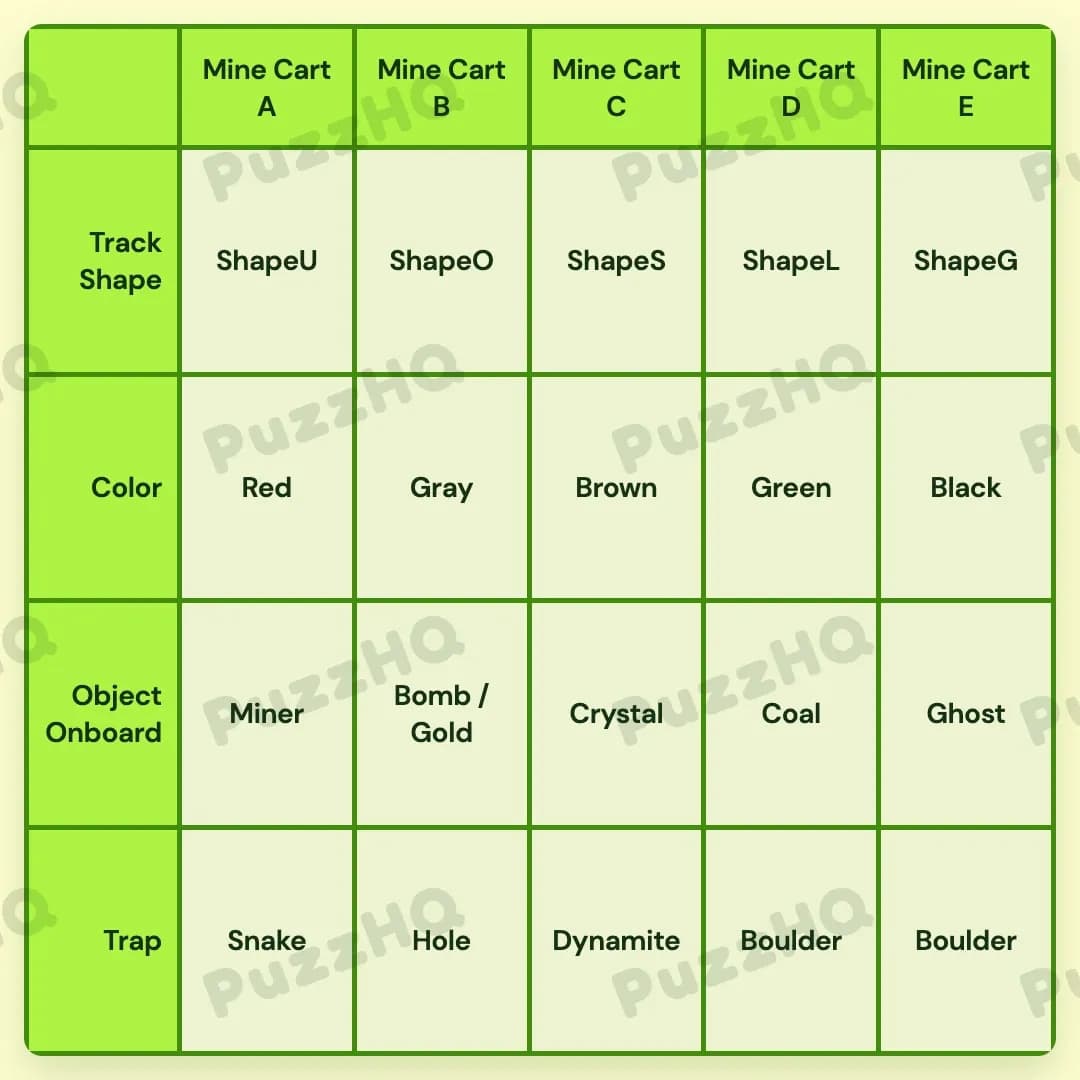
The five mine carts are organized across the tracks from Mine Cart A through Mine Cart E by matching specific positional anchors, color clues, and trap mechanics.
| Trait | Mine Cart A | Mine Cart B | Mine Cart C | Mine Cart D | Mine Cart E |
|---|---|---|---|---|---|
| Track Shape | ShapeU | ShapeO | ShapeS | ShapeL | ShapeG |
| Color | Red | Gray | Brown | Green | Black |
| Object Onboard | Miner | Bomb / Gold | Crystal | Coal | Ghost |
| Trap | Snake | Hole | Dynamite | Boulder | Boulder |
How To Think Through Profile Perfect Level 308
The most reliable habit in this level is finding absolute spatial anchors before trying to interpret relative placement clues. When clues mention positions like the middle cart or the rightmost position, solving those immediately creates a rigid frame. Once that frame exists, relative statements such as right of or next to point directly to clear slots rather than floating possibilities.
Direct Positional Matching: Locking Down The Center And Edge
Direct position clues give you fixed starting squares on the board without needing to compare other carts first.
- The clue stating that the rightmost track is shaped like the seventh letter of the alphabet directly targets Mine Cart E. Since the seventh letter is G, Mine Cart E receives the ShapeG track shape.
- The clue noting that the middle cart is carrying a colorful Crystal immediately places Crystal into Mine Cart C under the Object Onboard row.
Placing these two values right away creates distinct boundaries. You now know the exact contents of the center position and the shape of the far right track, which prevents you from misplacing these items when reading broader spatial clues later.
Decoding Descriptive Wordplay: Color Blends And Narrative Clues
Some clues use descriptive conditions rather than plain names. Translating these descriptions into exact traits gives you definitive entries.
- The clue mentioning that Cart D was supposed to be blue but yellow was mistakenly added relies on primary color mixing. Combining blue and yellow yields green, meaning Mine Cart D is colored Green.
- The clue describing something slithering past feet causing someone to jump into the cart connects two distinct traits to a single cart. Slithering identifies the Snake trap, while a person jumping inside represents the Miner. These belong together in Mine Cart A.
Translating these descriptive clues early eliminates complex traits like Green, Miner, and Snake before you need to resolve more ambiguous neighbor clues.
Linking Multi Trait Clues: The Combined Object And Free Fall
Clues that connect two distinct trait categories without naming the specific cart help you build paired bundles that fit into remaining gaps.
- The clue stating that the cart with multiple objects risks slipping into a free fall links two traits together. The only entry with multiple items is Bomb / Gold, and the risk of a free fall corresponds to the Hole trap.
- Because Mine Cart A already holds the Miner and Snake, and Mine Cart C holds the Crystal, the Bomb / Gold and Hole combination must belong to one of the empty slots. Mine Cart B cleanly takes this pairing.
- The clue about something ticking inside a cart confirms this assignment, as the Bomb in Mine Cart B corresponds to the ticking mechanism on the ShapeO track.
Bundling traits together reduces the total number of moving pieces across the grid, turning two separate questions into a single placement step.
Neighbor Reasoning: Using Color Anchors To Solve The Remaining Rows
Neighbor clues become straightforward once your board has established reference points.
- The clue indicating that the cart in the middle is not Red tells you Mine Cart C cannot be Red.
- Knowing that the person or conductor is to the right of the Red cart means the Red cart must have a cart to its right. Since Mine Cart A holds the Miner, Mine Cart A must be the Red cart, placing it immediately to the left of Mine Cart B.
- The clue stating that the cart to the right of the Brown one is carrying an insulator lets you resolve both Mine Cart C and Mine Cart D. Setting Mine Cart C to Brown makes the cart to its right Mine Cart D. The insulator carried by Mine Cart D is Coal.
- With Red, Green, and Brown assigned to Mine Cart A, Mine Cart D, and Mine Cart C respectively, the Gray color fits into Mine Cart B next to the track mentioned in the clues, leaving Black as the final color for Mine Cart E.
Using an already fixed cart as a landmark allows neighbor clues to reveal both the target cart and its neighbor simultaneously.
Eliminating Remaining Trait Values: Final Traps And Track Shapes
The final stage involves using frequency counts and process of elimination to complete the remaining open spaces.
- The clue stating that more tracks are hindered by Boulders than other traps establishes that Boulders must appear multiple times. The remaining unfilled trap slots on Mine Cart D and Mine Cart E both receive Boulder.
- For the Object Onboard row, the only remaining unassigned item is Ghost, which fills the final slot in Mine Cart E.
- For the Track Shape row, aligning the clue that the track shape is to the left of Dynamite in Mine Cart C places ShapeU in Mine Cart A, ShapeO in Mine Cart B, ShapeS in Mine Cart C, and ShapeL in Mine Cart D.
Elimination ensures you do not need dedicated clues for the final traits, as they naturally fall into the last available cells.
What This Level Teaches You
- Anchor fixed positions first: Clues that specify absolute layout locations, like the middle cart or the rightmost position, provide immovable landmarks that make neighbor clues easy to navigate.
- Group connected traits into portable blocks: When a clue describes two traits belonging together, such as multiple objects paired with a free fall trap, combine them into a single block before searching for where they fit on the board.
- Let color mixing and wordplay resolve distinct identities: Translating descriptions like color blends or slithering actions into exact board values removes guesswork and narrows the pool of available choices.
Final Thoughts
Success in this level relies on anchoring the center and edge positions before evaluating neighbor relationships. Once fixed points are established, descriptive clues and multi trait blocks fit together cleanly without any need to guess.
Comments