
Profile Perfect Level 312 Answer
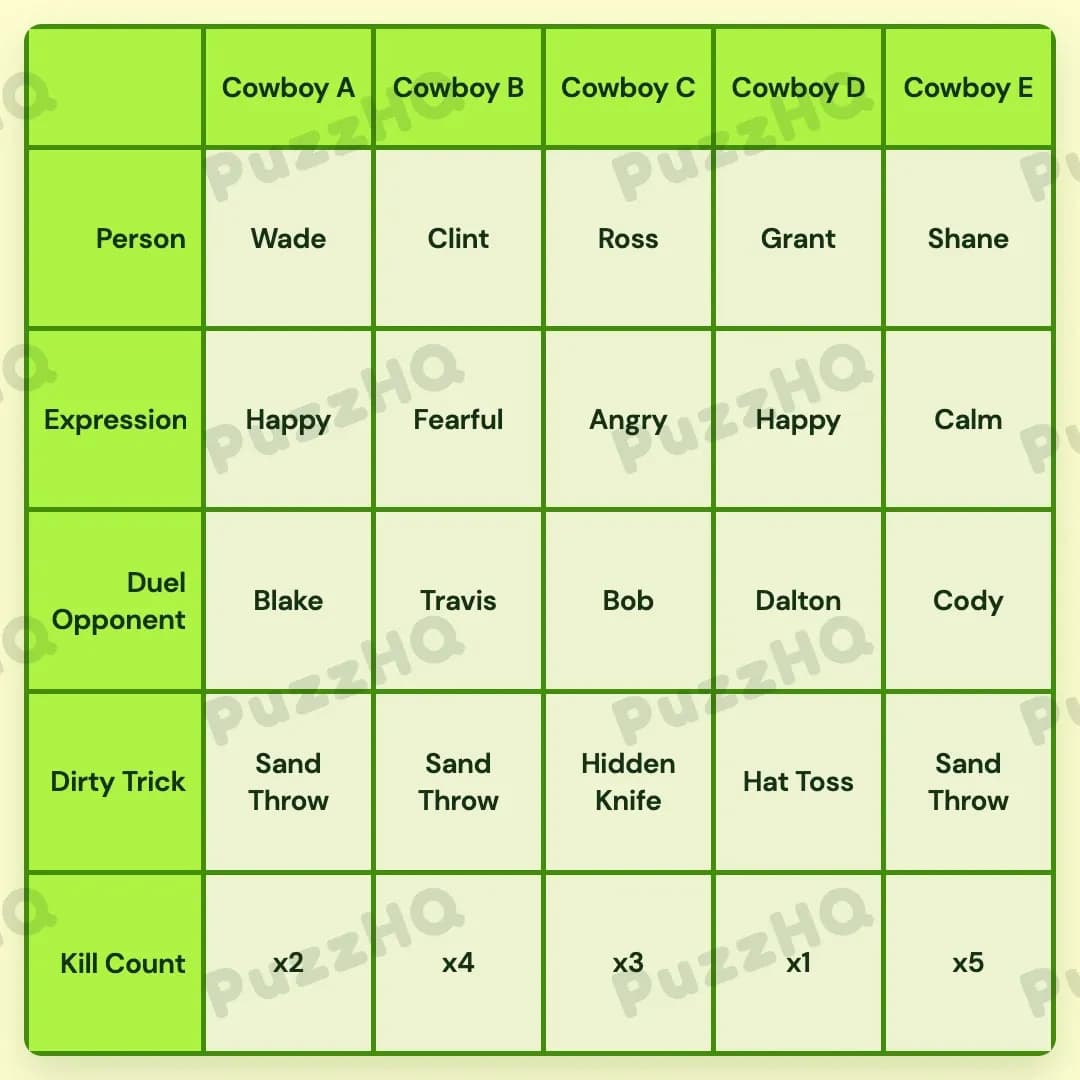
Every cowboy can be identified by matching neighbor relationships, numerical ratios, and emotional descriptors across the line.
| Trait | Cowboy A | Cowboy B | Cowboy C | Cowboy D | Cowboy E |
|---|---|---|---|---|---|
| Person | Wade | Clint | Ross | Grant | Shane |
| Expression | Happy | Fearful | Angry | Happy | Calm |
| Duel Opponent | Blake | Travis | Bob | Dalton | Cody |
| Dirty Trick | Sand Throw | Sand Throw | Hidden Knife | Hat Toss | Sand Throw |
| Kill Count | x2 | x4 | x3 | x1 | x5 |
How To Think Through Profile Perfect Level 312
Profile Perfect puzzles reward players who start with firm anchors rather than scattered guesses. The most effective approach for this puzzle is to secure the fixed numeric ranks and physical positions first, then let neighbor conditions narrow down the identities.
Anchor Known Positions: The Leftmost Cowboy
Positional clues give you immediate coordinates on the board. Look for clues that explicitly state a slot or boundary.
One clue specifies that the leftmost cowboy brags and holds the second lowest kill count. The leftmost position belongs to Cowboy A. Because the full set of kill counts spans from 1 to 5, the lowest is x1 and the second lowest is x2.
Cowboy A must have a kill count of x2.
This single entry provides a solid reference point for comparing other kill counts and positions across the lineup.
Use Numerical Constraints: Ross and the One-Third Ratio
When a clue mentions an exact mathematical ratio between neighbors, check the available number pool immediately. Most values will be mathematically impossible, leaving only one valid pair.
The clue states that one of Ross's neighbors has exactly one third of his kill count. Inspect the possible kill counts: 1, 2, 3, 4, and 5.
The only number in this list divisible by three is 3.
This guarantees two facts:
- Ross has a kill count of x3.
- The neighbor next to Ross has a kill count of x1.
Knowing this ratio instantly eliminates guesswork regarding Ross's record. It also tells you that Ross cannot sit on an edge without an adjacent slot open for a neighbor holding an x1 score.
Connect Relative Comparisons: Grant and the Bragging Cowboy
Relative comparisons become much more powerful once you have fixed values on the board.
The clue notes that Happy Grant has killed fewer enemies than the bragging cowboy. You already know from the first step that the bragging cowboy is Cowboy A with a kill count of x2. The only available count lower than x2 is x1.
Grant must have a kill count of x1, and his expression is Happy.
Now connect this to the mathematical ratio from the previous step. Ross's neighbor has a kill count of x1, which means Grant must sit directly adjacent to Ross.
With kill counts x1, x2, and x3 accounted for by Grant, Cowboy A, and Ross, only x4 and x5 remain for Clint and Shane. The clue stating that Shane has killed more than Clint means Shane has x5 and Clint has x4.
Map Neighbor Boundaries: Placing Clint, Wade, and Ross
Neighbor clues require subjects to have available slots on both their left and right sides. A person with two named neighbors cannot be placed on the outer ends of the grid.
The clue mentions that Clint the Timid has neighbors dueling Blake and Bob. Because Clint has two distinct neighbors, he cannot be Cowboy A or Cowboy E. Furthermore, Clint faces Travis, as Travis expects to beat Clint in their duel.
Looking at the layout:
- Cowboy A has a kill count of x2. Wade is named alongside Ross as throwing items from pockets. Wade takes the Cowboy A slot.
- Ross has a kill count of x3. He is placed at Cowboy C, dueling Bob.
- Clint sits at Cowboy B between Wade and Ross, with a kill count of x4 and facing Travis.
- Grant sits at Cowboy D with a kill count of x1, dueling Dalton.
- Shane takes Cowboy E with a kill count of x5, dueling Cody.
This places all five cowboys in their exact positions from left to right: Wade, Clint, Ross, Grant, and Shane.
Match Personality Descriptors: Expressions and Opponents
Descriptive titles and personality traits provide direct matches for the expression row.
Review the descriptors linked to each person:
- Clint is called Timid, which corresponds to the Fearful expression.
- Only Ross is easily triggered, giving Ross the Angry expression.
- Grant is explicitly described as Happy Grant, giving Cowboy D the Happy expression.
- Bob and Dalton's opponents show different expressions. Ross faces Bob and is Angry. Grant faces Dalton and is Happy. Wade at Cowboy A also takes the Happy expression, while Shane at Cowboy E remains Calm.
Final Deduction: Assigning the Dirty Tricks
With identities, opponents, and expressions resolved, the dirty tricks fall into place using pocket and weapon clues.
- Cody's opponent does not bring a knife. Shane faces Cody, so Shane does not use a knife.
- Wade and Ross throw something from their pockets. Wade throws sand, while Ross uses a hidden knife.
- Shane and Clint share the same trick, which is throwing sand.
- Grant uses the remaining trick, the hat toss.
Every cell is now completely verified without making assumptions.
What This Level Teaches You
- Test mathematical ratios against the whole number pool. Ratios like one third severely restrict your choices when working with small sequential numbers. Identifying valid mathematical pairs solves both values simultaneously.
- Use neighbor presence to eliminate outer edges. Whenever a subject is described as having two distinct neighbors, immediately cross off the first and last slots for that character.
- Pair relative comparison clues with established numbers. A comparison such as having fewer kills than the bragging cowboy is only actionable once the bragging cowboy's exact number is locked in.
Final Thoughts
The key to solving Level 312 smoothly is recognizing how mathematical constraints and physical neighbor requirements intersect. By resolving the unique one-third ratio early, you create the structure needed to position every cowboy correctly across the board.
Comments