
Profile Perfect Level 320 Answer
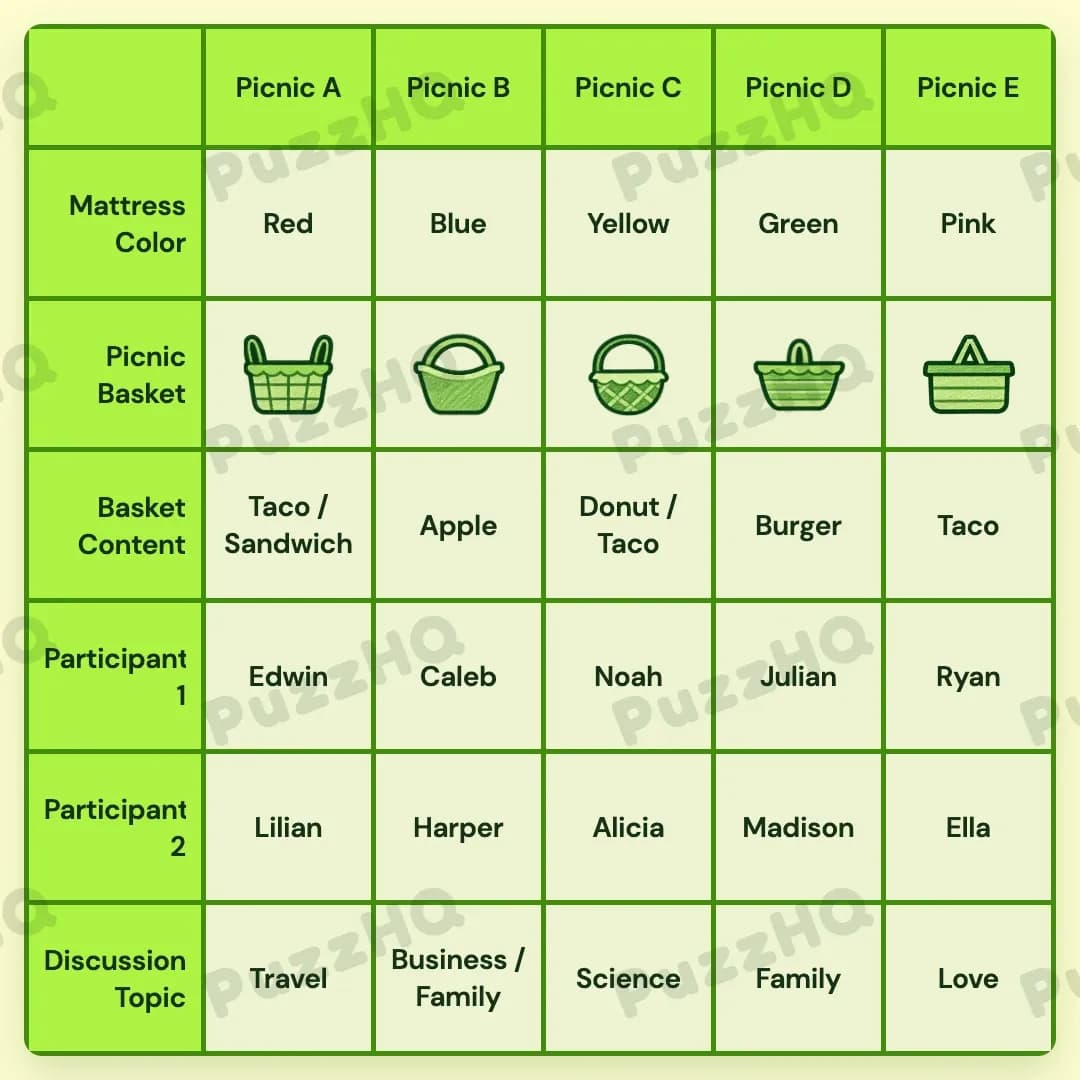
Every picnic setup is resolved by locking the mattress color sequence first, linking conversational topics to specific participants, and applying food preferences across the columns.
| Trait | Picnic A | Picnic B | Picnic C | Picnic D | Picnic E |
|---|---|---|---|---|---|
| Mattress Color | Red | Blue | Yellow | Green | Pink |
| Picnic Basket | Row1Col1 | Row1Col4 | Row2Col3 | Row3Col4 | Row1Col3 |
| Basket Content | Taco / Sandwich | Apple | Donut / Taco | Burger | Taco |
| Participant 1 | Edwin | Caleb | Noah | Julian | Ryan |
| Participant 2 | Lilian | Harper | Alicia | Madison | Ella |
| Discussion Topic | Travel | Business / Family | Science | Family | Love |
How To Think Through Profile Perfect Level 320
The most effective solving habit for this puzzle is using relative layout clues to build a sturdy physical frame before assigning people and conversation topics. When you place the colored mattresses across the columns early, later clues about column distances, partner pairings, and discussion themes immediately have defined landing spots.
Establish Fixed Anchors: Arrange The Mattresses In Order
Begin by looking for clues that define the physical row of picnic spots. You are told that the Yellow and Red mattresses sit directly next to the Blue mattress. For Blue to have both Red and Yellow on either side, Blue must occupy the central spot among that trio.
Looking at the full layout from left to right:
- Picnic A takes the Red mattress.
- Picnic B takes the Blue mattress.
- Picnic C takes the Yellow mattress.
- Picnic D takes the Green mattress.
- Picnic E takes the Pink mattress.
By setting up this color progression across the columns right away, every subsequent clue referencing a specific mattress color or column offset becomes instantly usable.
Match Thematic Clues Directly: Topic And Partner Associations
Once the locations are grounded, look for clues that pair a specific conversational topic directly with a participant or a mattress.
- A couple is described as being lovey-dovey on the Pink mattress. This directly assigns the Love discussion topic to Picnic E on the Pink mattress.
- Alicia spent hours discussing quantum superposition with her partner. Superposition points directly to the Science topic, anchoring Alicia and the Science discussion to Picnic C.
- The travel discussion lasted the entire picnic, placing the Travel topic at Picnic A.
- Harper mentioned something awkward, causing a shift in conversation. This multi-topic split accounts for the Business / Family topic at Picnic B.
- The remaining picnic spots discussing family and in-laws give Picnic D the Family topic.
Direct thematic associations provide instant anchors without requiring complex guesswork.
Use Direct Pairings: Lock In Participant Partnerships
Turn next to clues that bind pairs of people together. You are told that Lilian is accompanying Edwin for a relaxing picnic. Because Alicia is already placed at Picnic C, and Harper is involved in the conversation switch at Picnic B, Edwin and Lilian must fit into an open spot with an available primary and secondary participant slot.
Edwin and Lilian belong at Picnic A.
Now consider the remaining primary participants across the board:
- Caleb and Ryan are stated to be far apart from each other.
- Caleb is positioned at Picnic B, which places Ryan across the board at Picnic E.
- Julian takes the open spot at Picnic D, sitting to the right of the middle group.
- Noah takes the remaining primary slot at Picnic C alongside Alicia.
With the primary participants locked in, the remaining secondary participants fall neatly into place:
- Harper accompanies Caleb at Picnic B.
- Madison accompanies Julian at Picnic D.
- Ella accompanies Ryan at Picnic E.
Apply Negative Preferences: Narrow Down Basket Contents
Dietary rules and basket contents provide clear logical eliminations across the five spots.
You learn that Madison and Harper are the only individuals who dislike Mexican food. Tacos are Mexican food, meaning that any picnic spot containing a Taco cannot belong to Madison at Picnic D or Harper at Picnic B.
This leads to direct deductions:
- Picnic A contains Taco / Sandwich.
- Picnic C contains Donut / Taco, which also aligns with the clue mentioning a dessert on the Yellow mattress.
- Picnic E contains Taco.
Since Madison at Picnic D and Harper at Picnic B cannot have tacos:
- Ryan avoids burgers, leaving the Burger for Picnic D with Julian and Madison.
- Picnic B receives the Apple, matching the clue about food with the least calories that keeps the doctor away.
Check Relative Distance: The Sandwich Offset
Verify the final placements using the column distance clue. The clue states that the Sandwich is found exactly two columns away from Noah.
- Noah is located at Picnic C in column three.
- Counting two columns to the left lands directly on Picnic A in column one.
- Picnic A holds the Taco / Sandwich combination, perfectly satisfying the constraint.
Finally, place the specific basket visual coordinates into their respective slots:
- Picnic A has Row1Col1.
- Picnic B has Row1Col4.
- Picnic C has Row2Col3.
- Picnic D has Row3Col4.
- Picnic E has Row1Col3.
Every trait across all five picnic locations is now fully resolved and verified.
What This Level Teaches You
- Spatial sandwiching provides an early anchor. When a clue states that one item sits between two others, such as Blue being flanked by Red and Yellow, you can immediately lock in the relative sequence of columns before placing individual people.
- Negative group traits eliminate multiple cells at once. The clue noting that Madison and Harper dislike Mexican food immediately rules out Tacos for their respective picnic spots, simplifying food assignment across all five columns simultaneously.
- Column offset clues confirm your structural grid. Clues stating an exact column distance, such as the Sandwich being two columns away from Noah, serve as powerful checks to confirm that your primary subject placements are accurate.
Final Thoughts
The key habit that solved this level was establishing the mattress sequence first. Once the physical columns were locked down from left to right, thematic clues about conversational topics and negative dietary restrictions eliminated ambiguity without any need for trial and error.
Comments