
Profile Perfect Level 470 Answer
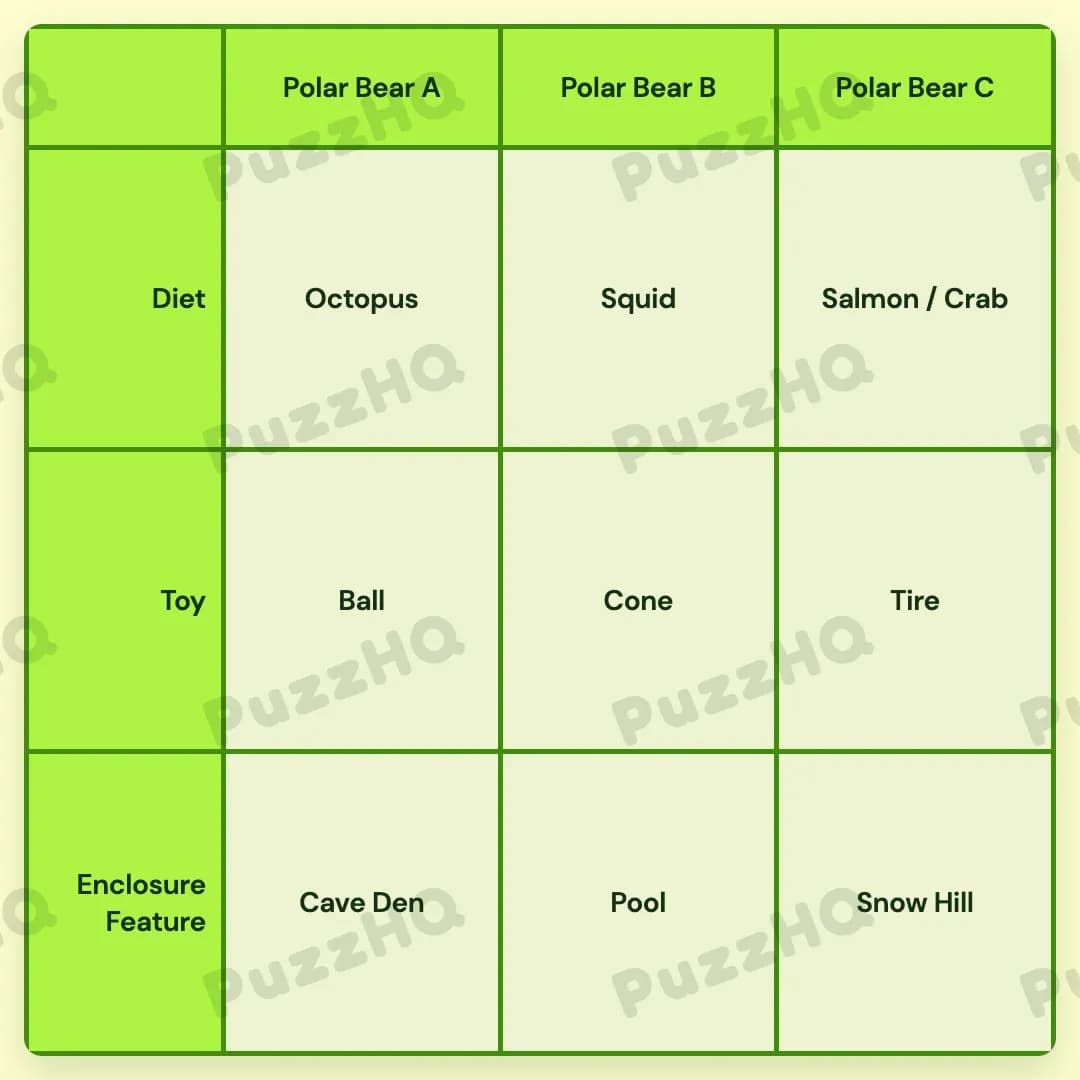
Polar Bear A rests in the Cave Den playing with the Ball and eating Octopus, Polar Bear B swims in the Pool playing with the Cone and eating Squid, and Polar Bear C stays on the Snow Hill playing with the Tire and eating Salmon / Crab.
| Trait | Polar Bear A | Polar Bear B | Polar Bear C |
|---|---|---|---|
| Diet | Octopus | Squid | Salmon / Crab |
| Toy | Ball | Cone | Tire |
| Enclosure Feature | Cave Den | Pool | Snow Hill |
How To Think Through Profile Perfect Level 470
The most productive habit on this level is trait bundling. Several clues link traits directly to other traits rather than directly naming Polar Bear A, Polar Bear B, or Polar Bear C. If you try to place traits onto individual bear columns immediately, the puzzle feels ambiguous. When you instead bundle related traits together first, the entire structure locks into place cleanly. Once you build three complete profiles, a single negative positional clue will show you exactly where each bear belongs.
Combine Descriptive Clues To Define Compound Values: Snow Hill And Salmon / Crab
Begin by examining the available diets. The options are Octopus, Squid, and Salmon / Crab. Two clues discuss the nature of these food choices:
- Clue 2 states that the bear on the Snow Hill eats different kinds of food.
- Clue 5 states that bears that eat cephalopods do not have a mixed diet.
In biology, both octopuses and squids are cephalopods. Clue 5 confirms that neither the Octopus eater nor the Squid eater has a mixed diet. That leaves only one possible diet that includes different kinds of food: Salmon / Crab.
Because Clue 2 specifies that the bear on the Snow Hill eats different kinds of food, you can immediately tie the Snow Hill enclosure feature to the Salmon / Crab diet. You do not yet know which specific polar bear column this represents, but you have established your first two-trait bundle:
- Bundle 1: Snow Hill enclosure with Salmon / Crab diet.
Using categorical knowledge to decipher a descriptive phrase is a common Profile Perfect requirement. When a clue mentions a mixed diet or multiple items, look for the entry with multiple values separated by a slash.
Build Direct Trait Pairs: Matching Toys And Enclosures
Next, look for clues that connect toys and enclosure features to specific diets. Three separate clues provide these connections:
- Clue 1 states that the bear fed with Salmon likes to wrap its toy around its body.
- Clue 3 states that the bear that eats the Squid loves to play with the Cone.
- Clue 6 states that the Octopus eater has shelter during the rain.
Take Clue 1 first. Among the three toys (Ball, Cone, and Tire), only a Tire can realistically be wrapped around a bear's body. Because we already know that the Salmon eater also eats Crab on the Snow Hill, this clue adds the Tire directly to that existing bundle. Bundle 1 is now fully defined:
- Bundle 1: Snow Hill, Salmon / Crab, Tire.
Now consider Clue 3. It directly pairs the Squid diet with the Cone toy. This creates a second bundle:
- Bundle 2: Squid diet and Cone toy.
Now consider Clue 6. The available enclosure features are Cave Den, Pool, and Snow Hill. A cave den is the only enclosure feature that provides overhead shelter during rain. Therefore, the Octopus eater belongs with the Cave Den. This begins our third bundle:
- Bundle 3: Octopus diet and Cave Den.
Resolve Leftover Traits By Elimination
At this stage, you have three partial bundles, and each category has only one unassigned element remaining.
Look at the toys:
- Bundle 1 has the Tire.
- Bundle 2 has the Cone.
- The remaining toy is the Ball.
Because Bundle 3 (Octopus and Cave Den) lacks a toy, the Ball must belong to Bundle 3.
Now look at the enclosure features:
- Bundle 1 has the Snow Hill.
- Bundle 3 has the Cave Den.
- The remaining enclosure feature is the Pool.
Because Bundle 2 (Squid and Cone) lacks an enclosure feature, the Pool must belong to Bundle 2.
Every single trait is now assembled into three complete, airtight packages:
- Package 1: Octopus, Ball, Cave Den
- Package 2: Squid, Cone, Pool
- Package 3: Salmon / Crab, Tire, Snow Hill
Notice how much easier the puzzle becomes once you do this. You no longer have nine separate traits floating around. You only have three unified profiles waiting to be placed into the three subject columns.
Use Center Slot Elimination For Non-Adjacent Traits
Now you must assign these three profiles to Polar Bear A, Polar Bear B, and Polar Bear C. The three bears sit in a row from left to right.
Look at Clue 4:
- The Ball is not next to the Snow Hill.
In a row of three positions, the center position (Polar Bear B) is directly next to both outer positions (Polar Bear A and Polar Bear C). If an item is placed in the center, it is adjacent to everything in the puzzle.
Therefore, any two items that are forbidden from being next to each other can never sit in the center. Neither the Ball nor the Snow Hill can belong to Polar Bear B. Both of those traits must occupy the outer columns (Polar Bear A and Polar Bear C).
Because the Ball belongs to Package 1 and the Snow Hill belongs to Package 3, neither Package 1 nor Package 3 can go to Polar Bear B. This leaves only Package 2 for the center column:
- Polar Bear B: Squid, Cone, Pool.
With the center column locked, Package 1 and Package 3 take the outside spots. Polar Bear A takes the Ball, Octopus, and Cave Den, while Polar Bear C takes the Snow Hill, Salmon / Crab, and Tire. The Ball in column A is separated from the Snow Hill in column C by Polar Bear B, satisfying Clue 4 completely.
What This Level Teaches You
Bundle Traits Together Before Assigning Columns
When clues describe how traits interact with each other rather than naming subjects, do not force them into subject columns right away. Combine traits into self-contained units first. Once you know that the Squid, the Cone, and the Pool always travel together, placing that entire block takes only one logical step.
Use Row Geometry To Isolate The Middle Slot
In any three-column grid, the middle column shares a border with both outer columns. When a clue states that Item X is not next to Item Y, neither Item X nor Item Y can ever be in the middle. Identifying which items are barred from the middle column instantly solves the center subject by elimination.
Look For Semantic Clues In Multi-Value Cells
When a cell contains slash-separated values like Salmon / Crab, look for clues that mention plural items, combinations, or mixed varieties. Recognizing that "different kinds of food" referred to the double-item diet allowed you to connect the Snow Hill to Salmon / Crab without needing an explicit name match.
Final Thoughts
The breakthrough in Level 470 comes from shifting your focus away from the column headers during the early steps. By using categorical clues to form three distinct trait packages, you simplify the puzzle into a clean positional question. Recognizing that non-adjacent items can never occupy the center slot quickly wraps up the entire grid.
Comments