
Profile Perfect Level 511 Answer
Every trial position falls into place once audience turnout and judicial assignments establish the boundaries of the courtroom schedule.
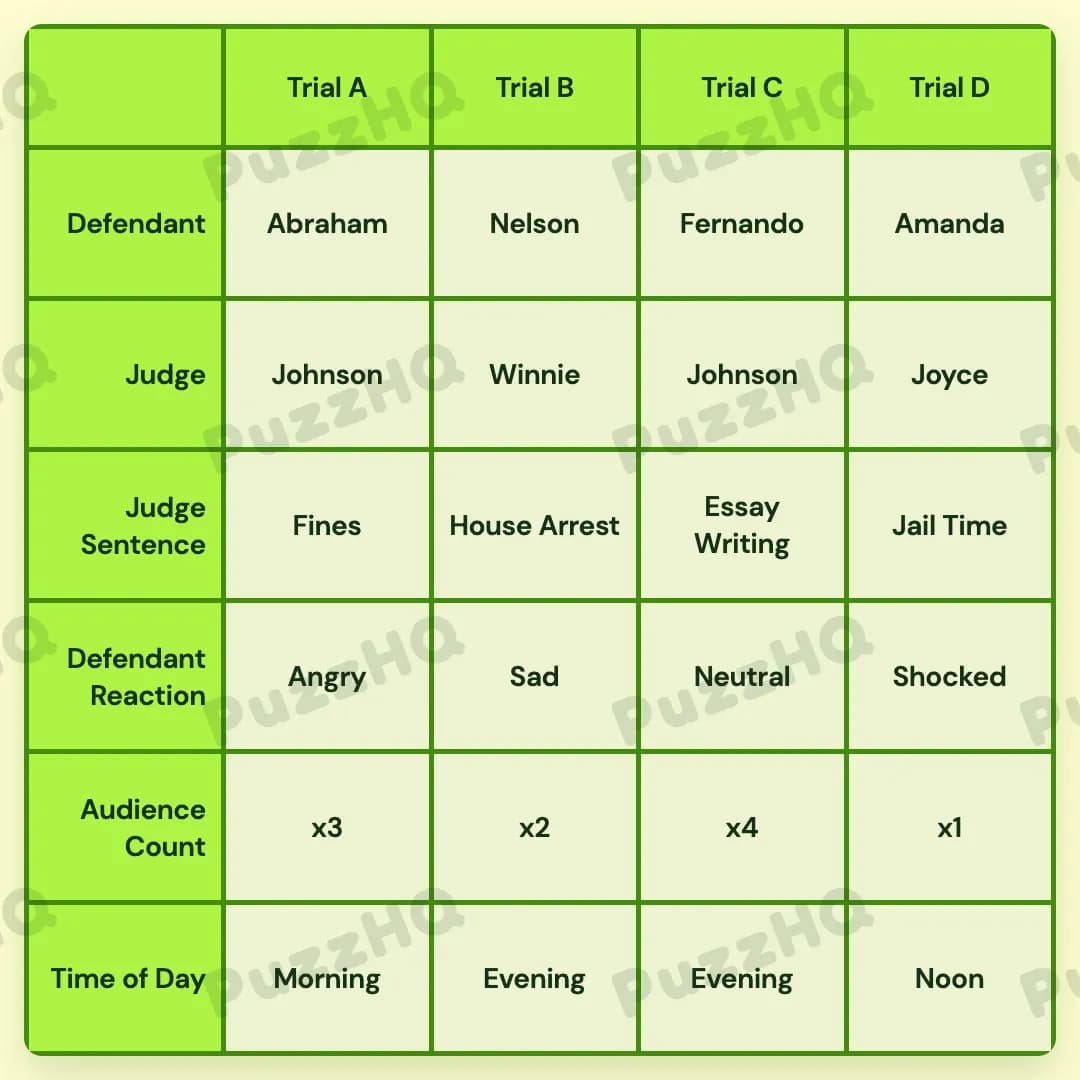
| Trait | Trial A | Trial B | Trial C | Trial D |
|---|---|---|---|---|
| Defent | Abraham | Nelson | Fernando | Amanda |
| Judge | Johnson | Winnie | Johnson | Joyce |
| Judge Sentence | Fines | House Arrest | Essay Writing | Jail Time |
| Defent Reaction | Angry | Sad | Neutral | Shocked |
| Audience Count | x3 | x2 | x4 | x1 |
| Time of Day | Morning | Evening | Evening | Noon |
Building The Grid By Trait
The clearest path through this courtroom puzzle begins by mapping the judges alongside spectator attendance. Once the presiding judges and room capacities take shape, scheduling constraints quickly pinpoint where each defendant stands.
Judge Assignments Anchor The Courtroom Ends And Audience Sizes
Courtroom authority provides the initial framework across the four trials. We learn right away that Joyce presides over the rightmost defendant, fixing her directly to Trial D. At the same time, Johnson is responsible for presiding over two distinct trials, both of which command the largest audience turnouts among all proceedings. Across the four trials, the attendance levels range across four distinct counts: x4, x3, x2, and x1. Because Johnson presides over the two trials with the largest crowds, those sessions must correspond to the x4 and x3 spectator tiers.
This leaves only one available courtroom for Winnie. Since Joyce handles Trial D, Winnie must take Trial B, leaving Trial A and Trial C to Johnson. We also know that Winnie does not have a full room, which aligns her with an attendance of x2 spectators. With Trial D having the lowest attendance of barely any observers (x1), Johnson's two courtrooms claim the remaining higher numbers. Between Trial A and Trial C, attendance divides into x3 and x4. Resolving this pairing gives immediate structure to the trial layout before any defendant even enters the docket.
Time Of Day Locks Suspect Locations In Place
Examining the temporal traits helps distribute the defendants across the schedule. Several proceedings are scheduled toward the end of the day, which places the evening label on both central sessions, Trial B and Trial C. Another defendant, Abraham, openly expresses an urge to finish his trial quickly so he can eat breakfast. This desire connects him firmly to the morning session, locating him in Trial A.
Because Trial A is in the morning and Trials B and C occupy the evening slots, Trial D naturally takes place at noon. With Amanda known to have the trial where almost nobody attends, she takes the sparsely populated x1 courtroom at noon, placing her in Trial D under Joyce.
With Abraham positioned in Trial A and Amanda seated in Trial D, only Nelson and Fernando remain for the two evening sessions in the middle. The blonde suspect is known to face Joyce, confirming Amanda as the blonde suspect at Trial D. Distributing Nelson and Fernando between the two central courtrooms depends on the remaining behavioral and sentencing traits.
Reactions And Sentences Complete The Trial Records
The emotional reactions of the defendants directly expose their verdicts and room placements. In Trial A, the defendant makes an unmistakable scene over the outcome, securing the Angry reaction for Abraham. Another condition specifies that the defendant who shows no emotional reaction at all is not seated beside the angry person. Because Trial A holds the angry defendant, the adjacent seat in Trial B cannot be neutral. Consequently, the neutral reaction must belong to Trial C.
With Trial C marked as Neutral and Trial A marked as Angry, the remaining reactions fall into place. The defendant situated to the right of another specific room does not anticipate the verdict, landing the Shocked reaction in Trial D. This leaves the Sad reaction to settle into Trial B.
Sentencing details finish the puzzle. The defendant who gets locked up is situated immediately to the right of the person assigned essay writing. That locked-up fate, represented by Jail Time, must reside in Trial D, meaning the Essay Writing penalty belongs directly to its left in Trial C. With two alternative penalties distributed between the middle trials, House Arrest fills Trial B. Finally, Abraham in Trial A receives Fines, matching his disruptive scene over an unwelcome financial penalty. Fernando claims the neutral evening trial in Trial C, leaving Nelson to take the sad, house-arrest outcome in Trial B.
Where The Trait Rows Intersect
Matching Spectator Turnout To Judicial Authority
The interaction between Judge and Audience Count is the linchpin for organizing the entire courtroom map. Knowing that Johnson takes the two largest crowds while Joyce is locked to the far right courtroom instantly narrows Winnie's possible locations down to the middle. Without comparing the relative crowd sizes against the roster of judges, neither Winnie nor Johnson could be placed with certainty. Connecting Johnson to the top attendance numbers and Winnie to a reduced audience resolves three courtroom columns in one move.
Morning Routines Identify The First Defendant
Aligning Time of Day with the Defent category bridges personal motives with the daily court docket. Abraham's impatient comment about wanting breakfast provides a contextual anchor for the Morning time slot. Because the clue links an individual defendant directly to an early hour, it bypasses guesswork regarding where morning belongs. Once Abraham occupies Trial A in the morning, the evening block can safely settle into the middle slots, preventing the schedule from drifting across the row.
Reaction Spacing Fixes The Final Emotional States
The connection between Defent Reaction and room placement relies on spatial adjacency. The angry defendant in Trial A casts an exclusionary shadow over Trial B, because the completely unresponsive defendant cannot sit next to an angry one. That simple rule eliminates Trial B from being Neutral, forcing Neutral into Trial C. Once Neutral finds its home, the remaining reactions cascade smoothly across the final two columns without further ambiguity.
Final Grid Check
Reviewing the solved board confirms that each trait row supports every neighboring category without contradiction. The schedule flows logically from Morning through two Evening sessions to a Noon finale. Audience counts align with judicial popularity, giving Johnson the busiest courtrooms while Joyce oversees a sparsely attended noon sentencing. The defendants, their reactions, and their respective sentences fully harmonize with all behavioral clues, proving the deduction complete and consistent across every trial.
Comments