
Profile Perfect Level 526 Answer
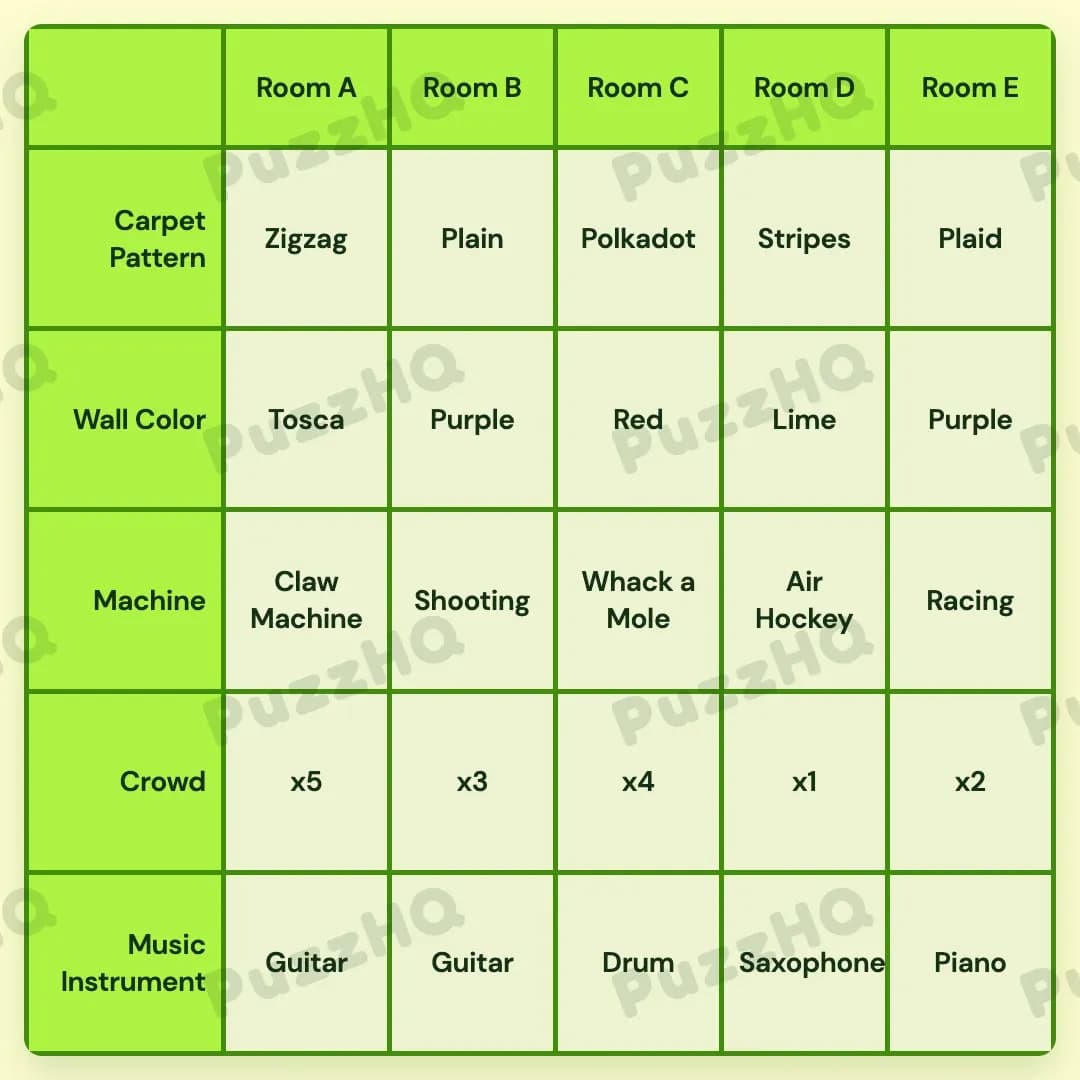
The arcade layout resolves by matching the eggplant purple rooms first, which sets up the positions for the instruments, the crowd counts, and the carpet styles across all five rooms.
| Trait | Room A | Room B | Room C | Room D | Room E |
|---|---|---|---|---|---|
| Carpet Pattern | Zigzag | Plain | Polkadot | Stripes | Plaid |
| Wall Color | Tosca | Purple | Red | Lime | Purple |
| Machine | Claw Machine | Shooting | Whack a Mole | Air Hockey | Racing |
| Crowd | x5 | x3 | x4 | x1 | x2 |
| Music Instrument | Guitar | Guitar | Drum | Saxophone | Piano |
How I Solved Profile Perfect Level 526
Looking over the clues for this arcade floor plan, the first thing I noticed was the mention of room colors and instrument sizes. A couple of direct anchors stood out immediately, particularly around Room E and the repeated wall color. Once those anchored the outer edges of the board, tracking the crowd numbers and carpet patterns became a clean chain of deductions.
Room E And The Piano Gave Me The First Footing
I started with the clue stating that music from the biggest instrument is played in Room E. Among the musical instruments available, the piano is unmistakably the largest, which gave me an immediate assignment of Piano to Room E.
Right away, another clue connected to this: the classical piano piece is played in the Racing room. Because Room E already held the Piano, it had to host the Racing machine as well.
Next came the wall color clue about duplicate wallpapers. It told me that the two rooms sharing the same wallpaper use an eggplant color, meaning Purple. Looking at the five rooms, one clue specifically mentioned the purple room on the left, while another mentioned that the most crowded room is next to the purple room. With two purple rooms on the board, Room B had to be the purple room on the left. That left Room E as the second purple room on the right side of the floor.
Crowd Numbers Began Locking Into Place
With Room B confirmed as purple, I looked closely at the clue stating that the most crowded room is next to the purple room. The middle room, Room C, had its own restriction: it was very popular, but definitely not number 1.
Since Room C could not be the top crowd of x5, Room C had to take the second highest crowd, which was x4. That meant the most crowded room (x5) could not be Room C. Because x5 had to sit next to the purple room on the left (Room B), Room A was the only remaining neighbor. That placed crowd x5 squarely into Room A.
Meanwhile, nobody was interested in playing Air Hockey, identifying Air Hockey as the room with the absolute lowest crowd level, x1. Another clue pointed out that an odd number of people is in the room with the stripes carpet. The available crowd values were x1, x2, x3, x4, and x5. With x5 in Room A and x4 in Room C, the odd options left for stripes were x1 and x3.
The purple room on the left (Room B) was filled with players, holding a moderate crowd of x3. With x5, x4, and x3 accounted for, only x1 and x2 remained for Room D and Room E. Air Hockey had to be x1, and Room E took x2. Since Room D had the odd crowd of x1, Room D also claimed the Stripes carpet, and Air Hockey belonged in Room D.
Connecting Wall Colors And Instruments Across The Middle
With crowds settled and Room D holding Air Hockey, I turned back to the remaining wall colors. Tosca, Red, and Lime were still unassigned to Rooms A, C, and D.
One clue stated that next to the light green wall room, an upbeat drum sound can be heard. Light green clearly pointed to Lime. If Lime was next to the drum room, I had to see where Drum could fit. Room E already had the Piano. Room B was already established as purple, and Room A could not be Lime because it had to accommodate the jagged carpet inside the Tosca room.
That left Room A with the Tosca wall and Room D with the Lime wall. Because the upbeat drum sound is heard next to the light green room (Room D), and Room E had the Piano, the Drum had to be in Room C. By simple elimination of remaining wall colors, Room C was painted Red.
With Drum in Room C and Piano in Room E, the wind instrument clue narrowed down the rest of the audio. The jazz music from the wind instrument corresponds to the Saxophone. With Room C and Room E filled, and guitars filling the standard arcade floor, the Saxophone naturally landed in Room D. Rooms A and B then took the remaining Guitars.
Carpets And Arcade Cabinets Finished The Layout
At this stage, the grid was mostly complete, leaving carpet styles and a couple of arcade machines to settle.
I looked at the clue linking carpets to games: the carpet with little circles is next to the Shooting game. Little circles clearly described the Polkadot pattern. If Polkadot was next to the Shooting game, I needed to check where both could fit.
Room D already had the Stripes carpet, and Room E was already established with the Racing machine. Furthermore, a separate clue warned that the Plaid carpet is not in the room next to the Polkadot carpet. If Polkadot was in Room C, Plaid could not be in Room B or Room D. That meant Plaid had to be in Room E.
With Room A already set to Tosca, the earlier clue about the jagged carpet inside the Tosca room confirmed that Zigzag belonged in Room A. That left Polkadot for Room C, which meant the Plain carpet went to Room B.
Because the Polkadot room (Room C) had to sit next to the Shooting game, and Room D already had Air Hockey, the Shooting machine had to be located in Room B. That left only two open machine slots: Claw Machine and Whack a Mole. Room A took the Claw Machine, and Room C took Whack a Mole.
The final assignments matched every condition without a single conflict across the entire row of rooms.
The Point Where I Nearly Went Wrong
The phrasing around the two purple rooms caused a brief pause early on. The clue referred to an eggplant color rather than explicitly naming purple, and it mentioned the purple room on the left. It was tempting at first to assume that Room A might be purple because it is the leftmost room overall.
However, paying close attention to the requirement that the most crowded room had to sit next to a purple room prevented that error. If Room A had been purple, there would have been no room to its left to act as its neighbor, forcing awkward assumptions. Recognizing eggplant as purple and pairing it with Room B and Room E kept the geometry of the neighbors consistent.
Looking Back At The Solution
The turning point of this solve was definitely deducing that Room E held both the Piano and the Racing machine right away. Locking down that corner room early stopped the instrument clues from floating around and immediately restricted where the drum sounds and lime walls could interact. Once the middle columns were anchored by the Drum in Room C, the remaining carpets and machines fell into place smoothly.
Comments