
Profile Perfect Level 577 Answer
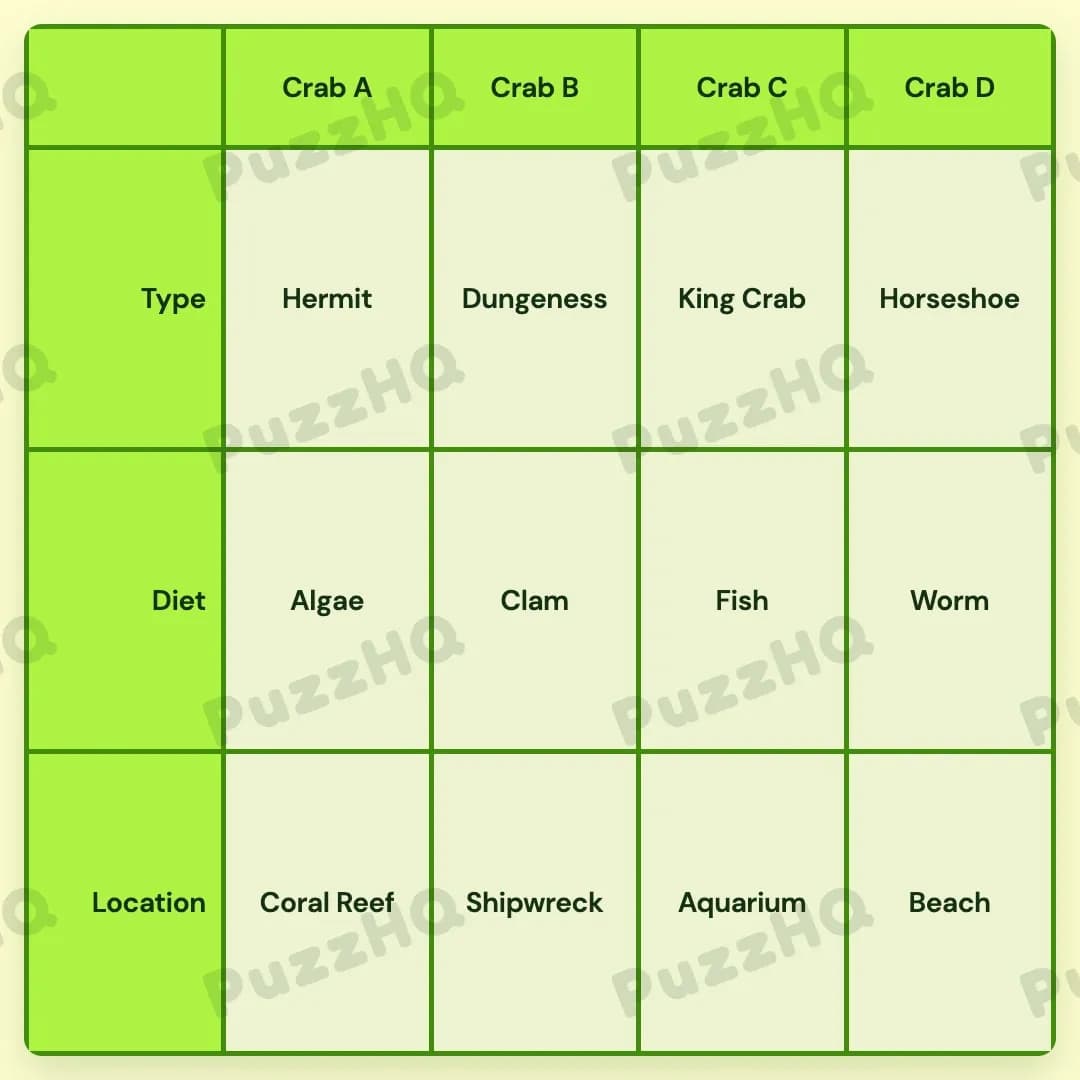
Every crustacean finds its proper place once you follow how feeding habits dictate types and their ocean surroundings.
| Trait | Crab A | Crab B | Crab C | Crab D |
|---|---|---|---|---|
| Type | Hermit | Dungeness | King Crab | Horseshoe |
| Diet | Algae | Clam | Fish | Worm |
| Location | Coral Reef | Shipwreck | Aquarium | Beach |
Building The Grid By Trait
The easiest way to unravel this puzzle is by starting with the Diet row, which offers immediate factual placement alongside precise relational boundaries. Once food preferences establish which creatures sit where, those dietary assignments build a bridge directly into the Location and Type rows.
Diet Anchors The Starting Setup
The Diet row begins with a direct certainty: Crab A eats Algae. This single statement fixes the leftmost subject with an absolute value, providing a firm base for the remaining food items.
Next, we look at the relationship between the Worm diet and its neighbors. The clues specify that either Fish or Algae must sit right next to the Worm diet. Because Crab A eats Algae, you might wonder whether Crab B could eat Worms. However, another clue notes that the creature eating Worms looks similar to prehistoric trilobites, pointing to the Horseshoe crab, while the Clam eater lives around a broken manmade structure.
If Crab B ate Worms, its neighbors would be Crab A (Algae) and Crab C. That arrangement would force either Fish or Clams into the remaining spaces, but subsequent positional requirements push Worm further down the line. Specifically, the Fish diet pairs beside the Worm diet, placing Fish at Crab C and Worm at Crab D. This leaves Clam as the only available diet for Crab B. With that sequence established, the entire Diet row falls into order from left to right: Algae, Clam, Fish, and Worm.
Location Builds From Environmental Cues And Diet Links
With diets assigned, the Location row begins to materialize through a mix of ecological characteristics and feeding grounds. A key clue tells us that the crabs on both ends of the grid live in their natural habitat. In this environment, the natural settings are the Coral Reef and the Beach, while the Shipwreck and Aquarium represent artificial or human-influenced environments. Therefore, Crab A and Crab D must share Coral Reef and Beach between them.
To decide which crab claims which shoreline, we look to the landward distance clue. Crab D is closer to land than Crab A. Because a beach sits right on the edge of the land while a coral reef lies submerged offshore, Crab D must take the Beach, leaving the Coral Reef to Crab A at the far left.
The two central slots belong to the remaining locations: Shipwreck and Aquarium. The puzzle tells us that the Clam eater lives around a broken manmade object. A sunken shipwreck fits the description of a broken manmade structure perfectly. Because Crab B was previously determined to be the Clam eater, Crab B settles at the Shipwreck. By process of elimination, Crab C can only reside in the Aquarium, fully locking down every subject in the Location row.
Type Resolves Through Anatomical Descriptions And Positional Limits
The Type row now clicks together by pairing anatomical observations with remaining open spots. We know that the Worm eater looks similar to prehistoric trilobites. The Horseshoe crab is well known for its ancient, trilobite-like appearance and shell structure. Since Crab D is established as the Worm eater, Crab D is unmistakably the Horseshoe crab.
Next, consider the clue stating that the leftmost crab scavenges dead sea snails. Hermit crabs are famous for scavenging snail shells to use as protective mobile housing. Because Crab A sits on the far left, Crab A takes the Hermit crab designation.
Only two crab varieties remain to be placed: King Crab and Dungeness. A clear positional rule states that the King Crab is not in the left half of the grid. The left half consists of Crab A and Crab B, meaning King Crab cannot belong to Crab B. With Crab D already occupied by the Horseshoe crab, Crab C is the only valid subject in the right half that can take King Crab. This leaves Crab B to take the final open classification, Dungeness crab. The entire Type row is now completely resolved.
Where The Trait Rows Intersect
Logic puzzles become much simpler when you recognize that individual clues do not operate inside a single category vacuum. They act as bridges that tie multiple rows together at key junction points.
Diet Feeds Directly Into Prehistoric Shells
The clue connecting the Worm diet to an animal resembling trilobites bridges Diet and Type seamlessly. Without this biological cross reference, you would merely have an abstract dietary preference with no clear creature to assign it to. By recognizing that the Horseshoe crab possesses that distinct trilobite anatomy, the puzzle locks the identity of the Worm eater in place before you even need to evaluate the other crab types.
Marine Habitats Reveal Feeding Grounds
Another crucial intersection occurs between the Clam diet and the broken manmade object. Knowing that a crab consumes clams means very little on its own until you connect it to an artificial marine structure. Identifying the Shipwreck as that exact manmade habitat immediately pins Crab B to both its meal and its environment simultaneously, preventing unnecessary guessing across the interior columns.
Coastal Geography Locks The Grid Ends
The clue pairing natural habitats at both ends of the display intersects with the geographical clue about land proximity. Identifying Coral Reef and Beach as natural marine settings restricts both outer boundaries. Applying the geographic condition that Crab D sits closer to land than Crab A instantly anchors both outer columns, creating solid endpoints that guide all subsequent deductions.
Final Grid Check
Every row in the completed solution directly reinforces the others without a single contradiction. The Hermit crab at the Coral Reef feeds on Algae, the Dungeness crab scavenges Clams amid the Shipwreck, the King Crab resides safely in the Aquarium eating Fish, and the ancient Horseshoe crab frequents the Beach to hunt for Worms. Every dietary habit matches its environmental setting, and all positional limits fit cleanly into place.
Comments