
Profile Perfect Level 587 Answer
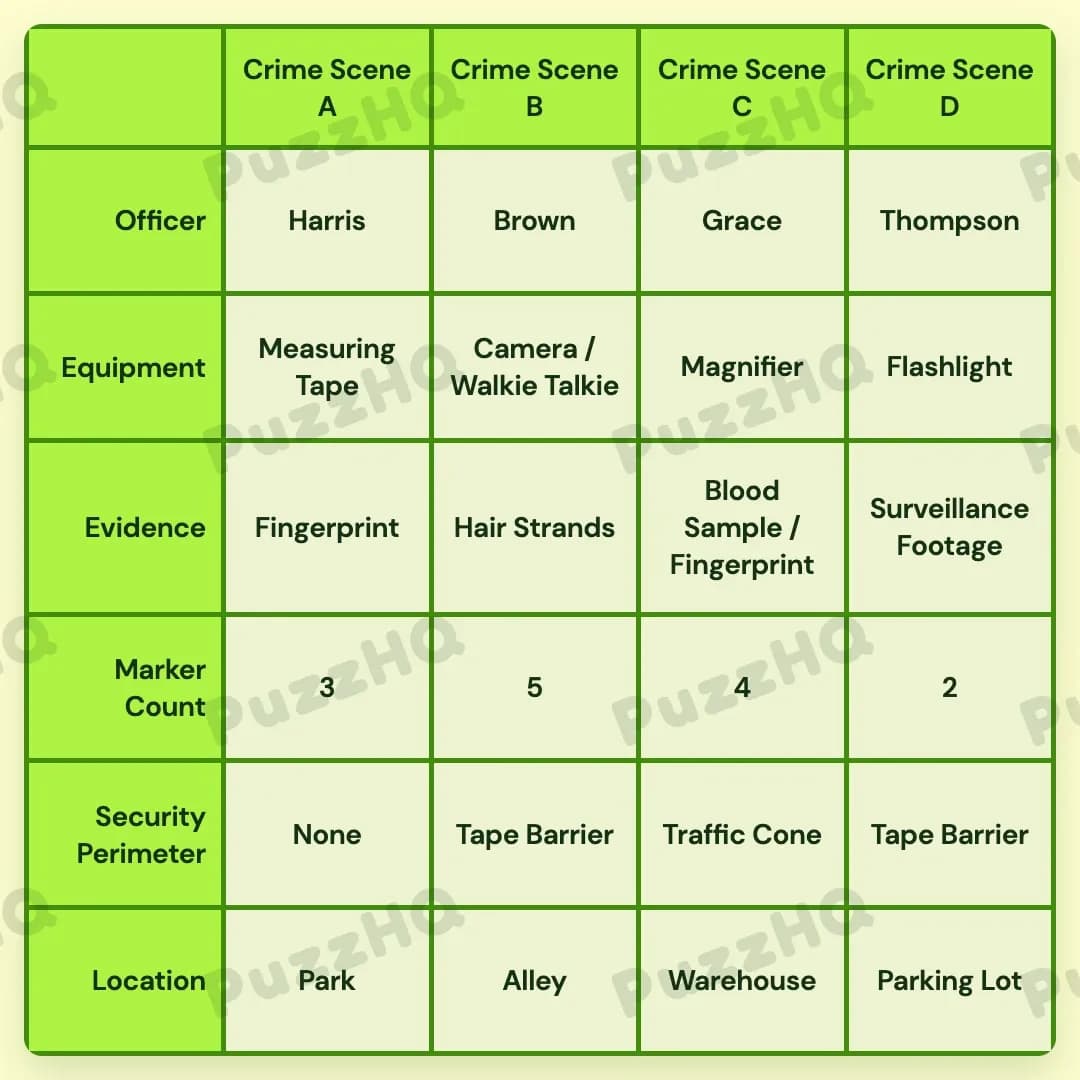
The investigation reveals Harris at the unsealed Park scene with three markers, while Thompson secures the Parking Lot on the far right.
| Trait | Crime Scene A | Crime Scene B | Crime Scene C | Crime Scene D |
|---|---|---|---|---|
| Officer | Harris | Brown | Grace | Thompson |
| Equipment | Measuring Tape | Camera / Walkie Talkie | Magnifier | Flashlight |
| Evidence | Fingerprint | Hair Strands | Blood Sample / Fingerprint | Surveillance Footage |
| Marker Count | 3 | 5 | 4 | 2 |
| Security Perimeter | None | Tape Barrier | Traffic Cone | Tape Barrier |
| Location | Park | Alley | Warehouse | Parking Lot |
How I Solved Profile Perfect Level 587
Looking at the board initially, what stood out right away was how several statements tied spatial positions directly to specific personnel. With four crime scenes lined up from Crime Scene A to Crime Scene D, any clue mentioning an exact side or half gave me an immediate structure to build around.
Pinning Down The Officers On The Right
The very first clear anchor came from the note that Thompson handles the crime on the rightmost edge. That immediately assigned Thompson to Crime Scene D. Knowing that, I looked at the mention of Grace using a Magnifier to search a scene in the right half. Because the right half only includes Crime Scene C and Crime Scene D, and Thompson already claimed Crime Scene D, Grace had to be at Crime Scene C. That single pairing also locked the Magnifier onto Crime Scene C.
With Grace and Thompson accounted for on the right, only Crime Scene A and Crime Scene B were left for the remaining two officers. A curious clue mentioned that the officer at the Alley has a hair color that does not match his name. Looking at the roster of Harris and Brown, the name Brown directly represents a hair color. That meant Brown could not have brown hair, but more importantly, it placed Brown squarely at the Alley.
Marker Counts Fell In Place From The Camera Clue
The next breakthrough came when I examined how equipment and marker numbers interacted. One clue mentioned that multiple tools were brought in because of the absence of security footage, pointing directly to the scene equipped with both a Camera and a Walkie Talkie. Another clue confirmed that many photos were taken to document the 5 markers on the scene. Because photos require a Camera, the 5 markers belonged to the exact scene holding the Camera.
At this point, I needed to know which column had those 5 markers. I knew that the scene with the most evidence had the second most markers. Looking at the evidence combinations, a spot with two findings represents the most evidence, which corresponds to the second highest marker count of 4. Since Grace at Crime Scene C held two pieces of evidence, Crime Scene C received 4 markers.
That left marker counts of 2, 3, and 5 to distribute across Crime Scene A, Crime Scene B, and Crime Scene D. The rules noted that the scene with the least markers could not sit beside the scene with the most markers. Furthermore, another statement reminded me that Harris had exactly 1 more marker than the least marked crime scene. If the least count was 2, Harris had to have 3 markers.
If Crime Scene B had 5 markers, Crime Scene D had to hold the minimum of 2 markers, because putting 2 markers at Crime Scene A would place it directly beside Crime Scene B. That separation worked out cleanly. Crime Scene D held 2 markers, Crime Scene B held 5 markers along with the Camera and Walkie Talkie, and Crime Scene A held 3 markers. Since Harris held 3 markers, Harris went to Crime Scene A. That naturally slotted Brown into Crime Scene B, which confirmed Crime Scene B as the Alley.
Mapping Out The Crime Scene Locations
With Crime Scene B fixed as the Alley, the other locations quickly narrowed. A clue stated that the Camera records the scene next to the Park. Since the Camera was located at Crime Scene B, the Park had to be adjacent to it. Crime Scene C was already known to be a different location based on other details, which left Crime Scene A as the Park.
Meanwhile, an officer next to the Warehouse was reviewing security recordings. Security footage naturally fit Crime Scene D, as Thompson's station had not registered any fingerprints. The only crime scene adjacent to Crime Scene D is Crime Scene C, which confirmed that Crime Scene C was the Warehouse. With the Park at Crime Scene A, the Alley at Crime Scene B, and the Warehouse at Crime Scene C, the only remaining location for Crime Scene D was the Parking Lot.
Perimeter Status And Tool Distribution
From there, I turned my attention to how each scene was secured. The clue discussing the Walkie Talkie noted that it was being used next to the unsealed scene. The Walkie Talkie was situated at Crime Scene B, meaning either Crime Scene A or Crime Scene C had to be unsealed. However, another clue stated that even with the fewest markers, that scene still had to be sealed. Because Crime Scene D had the fewest markers, it was definitely secured, while Crime Scene C at the Warehouse was also explicitly described in relation to barriers. That left Crime Scene A as the completely unsealed scene, marked with None.
This matched the detail that a Measuring Tape was used to determine how the scene would eventually be sealed off, placing the Measuring Tape at Crime Scene A. Thompson at Crime Scene D then received the Flashlight, which fit the note that the Flashlight is never used where fingerprints are found.
For the barriers themselves, the Warehouse at Crime Scene C could not use tape barriers, so it received a Traffic Cone. Thompson at Crime Scene D was not allowed cones, which assigned a Tape Barrier there. Crime Scene B also received a Tape Barrier to complete the row.
Identifying The Final Pieces Of Evidence
With locations, officers, equipment, and perimeters locked in, the evidence category was all that remained. Grace at Crime Scene C had the most evidence, receiving both the Blood Sample and the Fingerprint.
The security footage had already been linked to Crime Scene D next to the Warehouse. That left hair strands and a single fingerprint to split between Crime Scene A and Crime Scene B. The clue stating that hair is not found together with blood meant hair could not be paired with Grace, but it easily went to Crime Scene B. Crime Scene A took the solitary Fingerprint, completing the entire board.
The Point Where I Nearly Went Wrong
The phrasing around the officer at the Alley was very easy to overthink. Seeing a clue about an officer having hair that does not match his name initially made me wonder if I needed to deduce an actual hair color for everyone on the police force. Only after looking at the names on the roster did I realize it was a wordplay clue pointing directly to Brown. Brown was the only officer whose name was an actual color, which meant he had to be the person assigned to the Alley.
Another spot that required care was identifying the unsealed perimeter. A quick skim might lead someone to assume the scene with the fewest markers was left unsealed because it had less activity. But reading carefully, the text explicitly stated that even the scene with the fewest markers had to be sealed, which prevented me from incorrectly placing the unsealed status at Crime Scene D.
Looking Back At The Solution
The turning point of this puzzle was definitely connecting the Camera to the 5 markers and seeing how that restricted the least marked scene. Once Crime Scene B claimed 5 markers, the rule preventing the minimum count from sitting right next to the maximum count forced the 2 markers all the way to Crime Scene D, unlocking the rest of the board in rapid succession.
Comments