
Profile Perfect Level 584 Answer
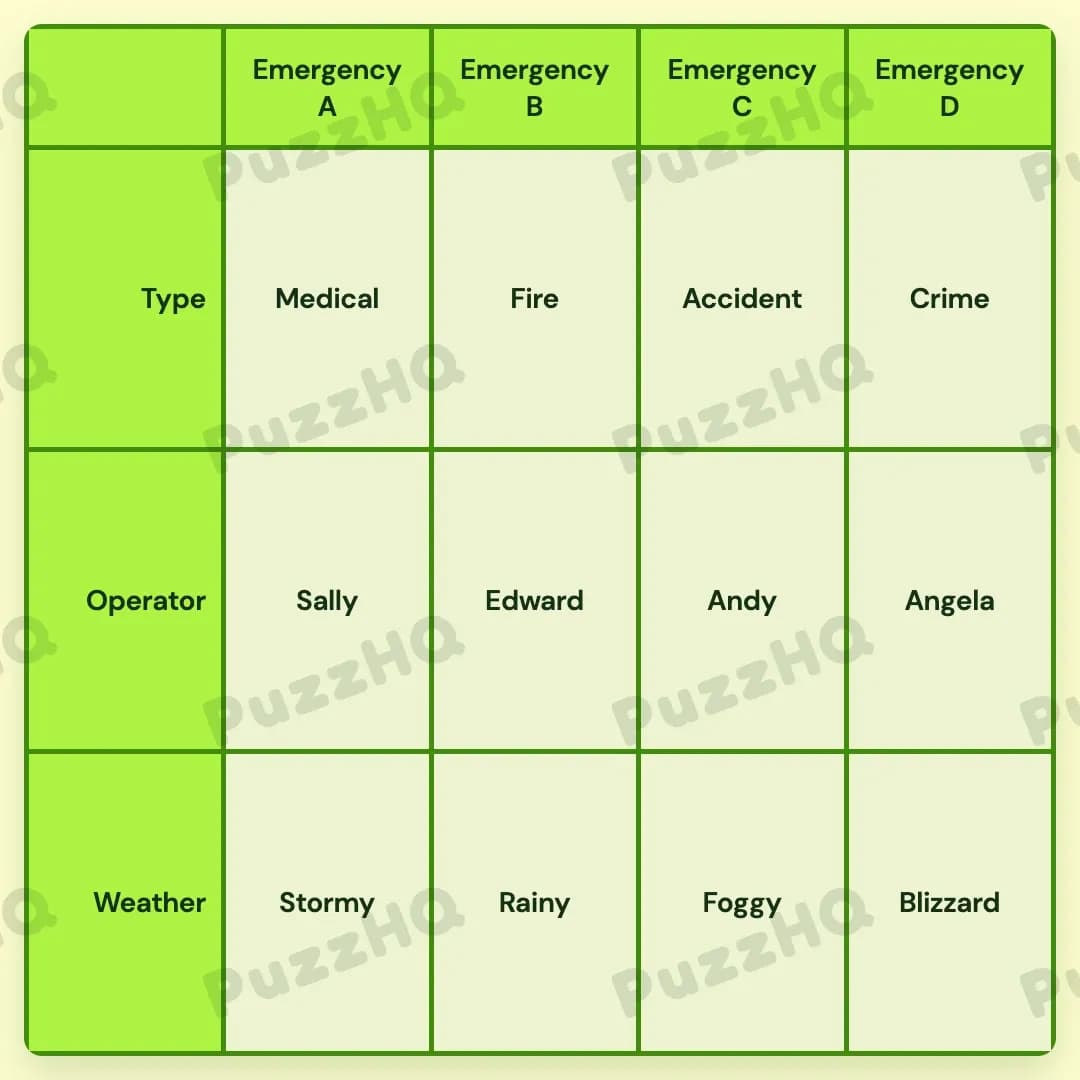
The four dispatch stations resolve by coordinating column spacing for incident types with directional weather clues for the dispatchers.
| Trait | Emergency A | Emergency B | Emergency C | Emergency D |
|---|---|---|---|---|
| Type | Medical | Fire | Accident | Crime |
| Operator | Sally | Edward | Andy | Angela |
| Weather | Stormy | Rainy | Foggy | Blizzard |
How To Think Through Profile Perfect Level 584
The most productive solving habit for this puzzle is treating rigid spatial relationships as anchors before attempting to place individual names. When a grid gives you four sequential positions like Emergency A through Emergency D, clues that specify column distances or immediate neighbors quickly reduce the board. By locking down fixed coordinates early, you turn loose descriptions into certain placements without guessing.
Start With Direct Matching: Secure Emergency C Immediately
A direct statement that pairs a specific column with a specific trait is the strongest possible opening move. The clue states that Emergency C handles a report about an Accident.
Because this directly names Emergency C, you do not have to calculate possibilities across multiple columns. You can fill in Accident under Emergency C right away. This early entry does more than give you one confirmed cell. It changes how you evaluate every other clue mentioning an incident type, because Emergency C is no longer an available option for any other event.
Use Positional Spacing To Isolate The Incident Types
Once Emergency C is locked with Accident, look for clues that mention relative board distances. The clue stating that the call about a robbery is two columns away from the Fire provides an immediate breakthrough.
In a four column lineup, an interval of two columns can only connect two possible pairs:
- Emergency A and Emergency C
- Emergency B and Emergency D
Because Emergency C is already occupied by the Accident, the pair cannot sit in Emergency A and Emergency C. That leaves only Emergency B and Emergency D to share Fire and Crime.
This deduction provides an immediate secondary reward through simple elimination. With three columns spoken for across Fire, Accident, and Crime, Emergency A must take the fourth incident type. You can confidently assign Medical to Emergency A, even though no clue explicitly mentions medical calls.
Bundle Multi Trait Associations Before Assigning Columns
When clues connect two categories together without naming a specific column, treat those traits as joined puzzle pieces.
Two separate clues provide these compound units:
- Edward receives his report during the Rain.
- Sally cannot hear well due to thunder, which ties her directly to Stormy weather.
Do not try to force Edward or Sally into a column yet. Instead, keep them mentally linked: Edward always travels with Rain, and Sally always travels with Stormy conditions. Keeping these trait pairs bound together simplifies positional deductions, because whenever you place the weather, the operator automatically follows.
Use Positional Direction And Weather Comparisons As An Anchor
Now bring in the directional clue: the weather of the office to the left of Edward is worse than his.
This clue gives you both a positional boundary and a qualitative condition. First, Edward cannot be in Emergency A, because there is no office to the left of column A. Second, the office immediately to his left must experience more severe weather than Edward's own shift.
Since Edward is paired with Rainy weather, look at the weather types in play. Stormy weather is noticeably worse than Rain. Sally is already linked to Stormy conditions. If you place Edward at Emergency B, the office to his immediate left is Emergency A. Placing Sally and Stormy weather at Emergency A satisfies both parts of the rule: Sally is directly to the left of Edward, and a storm is worse than rain.
This step locks down two full columns:
- Emergency A has Sally and Stormy weather.
- Emergency B has Edward and Rainy weather.
Apply Negative Neighbor Constraints To Place The Blizzard
At this stage, two weather conditions remain unassigned: Blizzard and Foggy. The clue addressing snow tells you that the call received during heavy snow is not next to the Rainy one.
Edward is at Emergency B with Rainy weather. That means neither of his neighbors, Emergency A or Emergency C, can hold the heavy snow. Emergency A is already filled with Stormy weather anyway, but this rule explicitly bans the Blizzard from Emergency C.
With columns A, B, and C unavailable for heavy snow, Blizzard must belong to Emergency D. By process of elimination, the remaining weather category, Foggy, must belong to Emergency C.
Resolve The Final Names Through Positive Neighbor Clues And Thematic Matching
With the weather row completely solved, you can quickly place the final operators and incident types.
The clue stating that Angela is next to the Foggy place becomes trivial to resolve. Foggy weather sits at Emergency C. The two neighbors of Emergency C are Emergency B and Emergency D. Because Emergency B is already occupied by Edward, Angela must be assigned to Emergency D. That leaves Andy as the only unassigned operator, placing him directly into Emergency C.
Finally, you must separate Fire and Crime across Emergency B and Emergency D. The clue describing the bank robber who was covered completely in white provides the link. The white coverage refers to the heavy snow of the Blizzard at Emergency D. This establishes that the robbery occurred at Emergency D, giving that office the Crime type. Following the earlier two column interval rule, Fire takes its rightful place at Emergency B. The entire dispatch roster is now complete.
What This Level Teaches You
Fixed Coordinates Rule Out Potential Interval Pairs
When a clue establishes a strict distance between two traits, such as two columns apart, check which spaces are already occupied by direct assignments. Because Emergency C was claimed early by the Accident, it immediately invalidated one of the only two possible pairings for the robbery and fire clue. Establishing fixed markers early turns distance clues into exact placements.
Directional Clues Serve As Immediate Edge Eliminators
A clue that references an office to the left of a character does double duty. In addition to setting up a comparison, it instantly prevents that character from occupying the far left column. Recognizing that Edward could not occupy Emergency A kept the search space confined to the remaining positions and made the weather comparison straightforward to test.
Final Thoughts
The key to mastering this puzzle is recognizing how column geometry works alongside descriptive traits. Rather than guessing where the dispatchers sit, using the fixed distance between the robbery and the fire allowed the rest of the board to fall into place systematically.
Comments