
Profile Perfect Level 627 Answer
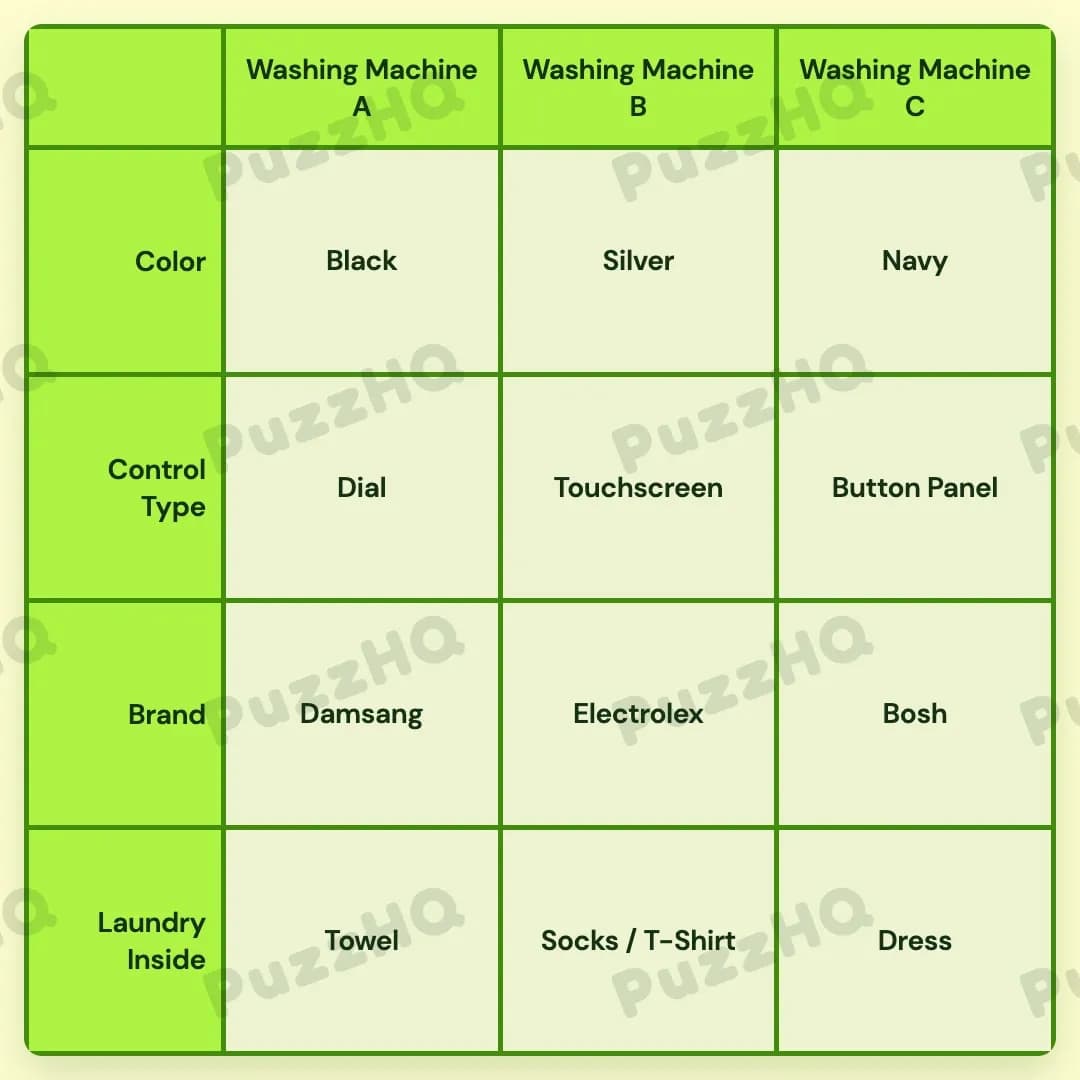
Every washing machine is fully identified by establishing the outer color positions first and linking each relative brand and control clue across the three positions.
| Trait | Washing Machine A | Washing Machine B | Washing Machine C |
|---|---|---|---|
| Color | Black | Silver | Navy |
| Control Type | Dial | Touchscreen | Button Panel |
| Brand | Damsang | Electrolex | Bosh |
| Laundry Inside | Towel | Socks / T-Shirt | Dress |
How To Think Through Profile Perfect Level 627
The most useful solving habit for this puzzle is using extreme positions to narrow down placement possibilities before tackling complex descriptions. When a puzzle provides only three positions, negative neighbor clues carry immense structural weight. Instead of trying to guess which machine owns which feature right away, look for clues that restrict where items cannot sit. Once the outer edges and center are established, directional clues and descriptive traits snap into place naturally.
Establish Spatial Anchors: Separating The Darkest Colors
The first step in solving a compact horizontal puzzle is finding which items are forced to the ends. You are given three washing machines arranged side by side: Washing Machine A on the far left, Washing Machine B in the middle, and Washing Machine C on the far right.
The clue stating that the two darkest washing machines are not neighbors immediately limits your color layout. Among Black, Silver, and Navy, the two darkest colors are clearly Black and Navy. In a three-slot line, there is only one way two items can avoid being neighbors: one must be in the first slot and the other must be in the third slot. This single deduction establishes that Washing Machine B cannot be Black or Navy.
Because Silver is the only remaining color, Washing Machine B must be Silver. While you do not yet know whether Black is on the left or Navy is on the left, you have permanently anchored Silver to the center position. Always look for non-adjacent clues in small groups because they instantly define the center slot.
Build Connected Chains: Linking Control Panels To Position
Once an anchor point is established, search for clues that mention the value you just placed. You know Washing Machine B is Silver. The clue stating that the Silver machine's control panel uses a big LCD directly matches Silver to a specific control type. A control panel with a large LCD screen corresponds to the Touchscreen. You can now confirm that Washing Machine B features the Touchscreen.
Now you can bring in the directional clue: the Black washing machine is to the left of the Touchscreen. Because the Touchscreen is locked into the center at Washing Machine B, the machine to its left can only be Washing Machine A.
This single realization unlocks the rest of the Color row. Washing Machine A must be Black. Because Black and Navy occupy the outer ends, Washing Machine C must be Navy. By chaining the center color to its control type and then using that control type as a directional reference, you have solved the entire Color row without any guessing.
Directional Logic: Placing Brands Along The Line
With the positions of all three machines secured, look at the brand relationships. You have two clues governing brand placement:
- Damsang is next to Electrolex, but not Bosh.
- The brand to the right of Electrolex has a one-letter logo.
Notice how Electrolex acts as the bridge between both statements. If Electrolex were on an outer edge, it could have only one neighbor. But the first brand clue states that Damsang is next to Electrolex while avoiding Bosh, and the second clue explicitly mentions a brand situated to the right of Electrolex.
For a brand to have another brand to its right, it cannot be Washing Machine C. Furthermore, if Electrolex is in the middle slot at Washing Machine B, it has neighbors on both sides. The brand to the right of Washing Machine B is Washing Machine C. Between Bosh and Damsang, Bosh features a one-letter logo (the letter B). Therefore, Washing Machine C must be Bosh.
Returning to the condition that Damsang is next to Electrolex but not Bosh, placing Damsang at Washing Machine A satisfies everything completely. Damsang sits adjacent to Electrolex in the center, while staying completely separated from Bosh on the right end. Washing Machine B is confirmed as Electrolex.
Attribute Definitions And Elimination: Completing The Controls And Laundry
All that remains is assigning the control types and laundry contents using descriptive clues and simple elimination.
Start with the controls. You already know Washing Machine B has the Touchscreen. The clue regarding the remaining controllers says that the rightmost machine's controller requires no rotation. The rightmost position is Washing Machine C. The available controls are Dial and Button Panel. A dial requires turning or rotation, whereas a button panel does not. Consequently, Washing Machine C has the Button Panel. That leaves Dial as the only remaining control type, which must belong to Washing Machine A.
Next, examine the laundry clues:
- The Towel spins inside the Black machine.
- The laundry in the Navy machine is a one-piece garment.
- The lower-body clothing is next to the Navy machine.
Washing Machine A is Black, so by direct match, Washing Machine A contains the Towel.
Washing Machine C is Navy, and the clue states it contains a one-piece garment. Between Dress and Socks / T-Shirt, a dress is a classic one-piece garment. Therefore, Washing Machine C contains the Dress.
Finally, the clue stating that lower-body clothing is next to the Navy machine confirms the remaining laundry item. Socks cover the lower body and are located in Washing Machine B, right next to Navy at Washing Machine C. Socks / T-Shirt completes Washing Machine B, finishing the entire puzzle.
What This Level Teaches You
Non-Neighbor Constraints Define Middle Slots
When solving a line of three subjects, any clue stating that two items are not neighbors guarantees those two items occupy the outer ends. This automatically solves the identity of the middle position by elimination. Look for negative neighbor conditions early to narrow down symmetrical options.
Use Direct Matches As Relational Stepping Stones
A clue that pairs two traits together, such as the Silver machine having a big LCD, is often not just an isolated fact. It serves as a connector. Once Silver was placed in the center, identifying its control panel allowed the relative clue about what sits to the left of the Touchscreen to resolve an entire row. Always ask how a newly placed trait can activate relative clues.
Decode Descriptive Vocabulary Carefully
Logic puzzles frequently substitute specific names with category descriptions. In this puzzle, a one-letter logo referred to Bosh, non-rotating controls pointed to buttons over a dial, and a one-piece garment described a dress. When you encounter general descriptions, compare them against the unused options on your board to find the only fitting match.
Final Thoughts
The key habit that simplified this puzzle was using non-adjacency to secure the center position before testing directional clues. Once Washing Machine B became an anchored reference point, every left, right, and neighboring clue could be evaluated with absolute certainty.
Comments