
Profile Perfect Level 631 Answer
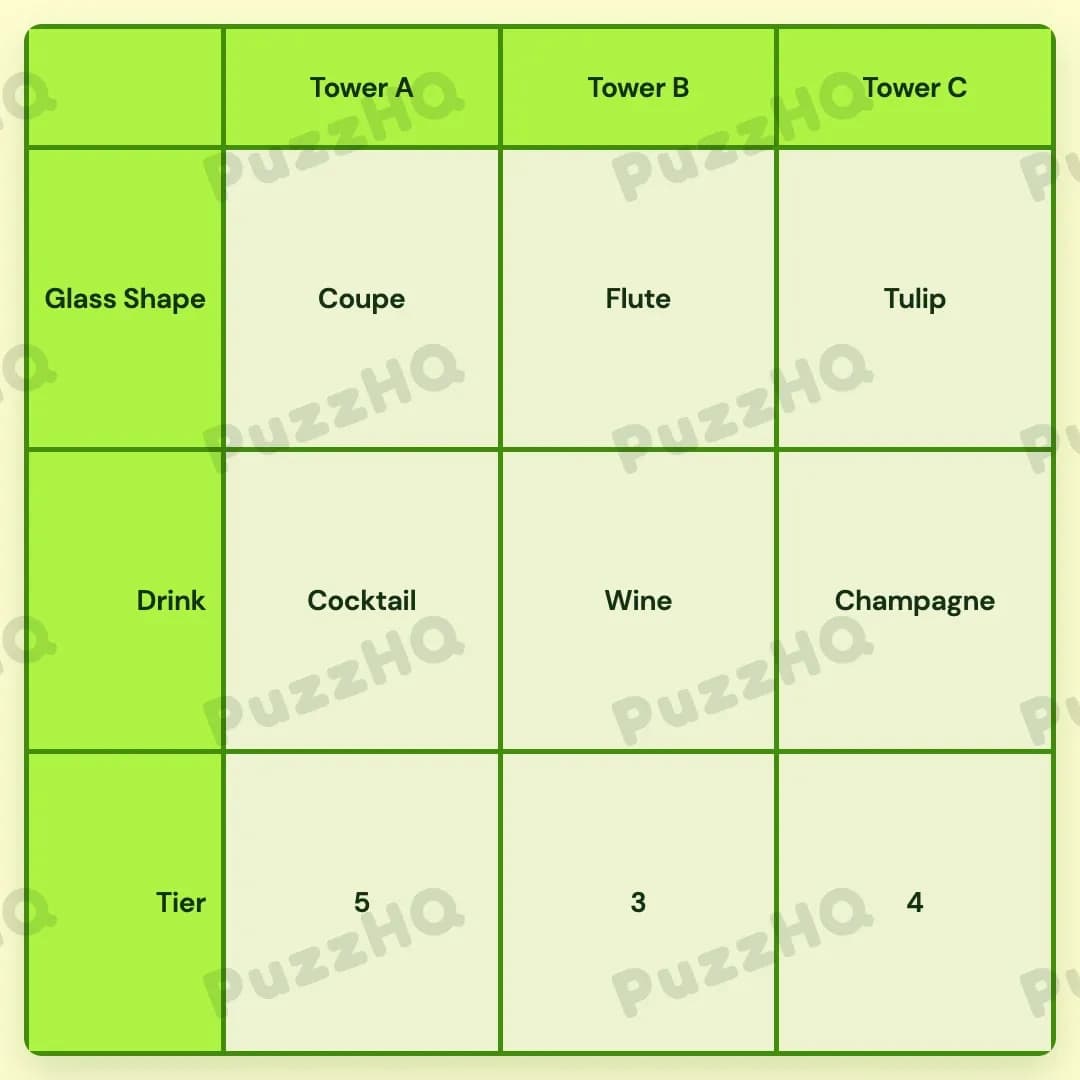
Every tower finds its place by pairing positional clues with glass shapes, tier counts, and beverage types.
| Trait | Tower A | Tower B | Tower C |
|---|---|---|---|
| Glass Shape | Coupe | Flute | Tulip |
| Drink | Cocktail | Wine | Champagne |
| Tier | 5 | 3 | 4 |
Building The Grid By Trait
Starting with positional cues across the Glass Shape and Drink categories provides the cleanest foothold. Because the puzzle spreads three towers across a physical line from left to right, locking down the left and right extremes immediately restricts where the remaining shapes and drinks can go. Once those anchor traits settle in, the Tier values quickly fall into order through direct physical comparisons.
Glass Shape And Drink Establish The Outer Anchors
The puzzle opens with two direct statements about the edges of the display. We learn that Coupe glasses are stacked to make the left tower, while the traditional Champagne tower stands on the right. In our three-column lineup, Tower A occupies the far left and Tower C occupies the far right. This immediately secures Coupe for Tower A's glass shape and Champagne for Tower C's drink.
Securing Champagne on Tower C does not merely fill a single spot. It immediately restricts the Glass Shape row for that same tower. A dedicated clue tells us that the Flute glass is never used to pour Champagne. Because Tower C holds Champagne, Tower C cannot use Flute glasses. Furthermore, Coupe glasses are already claimed by Tower A on the left. With Coupe and Flute both ruled out for Tower C, the only remaining possibility for Tower C's glass shape is Tulip.
With Tulip locked to Tower C and Coupe assigned to Tower A, only one unassigned glass shape remains in that row. Flute must belong to the middle structure, Tower B. Through these early clues, the entire Glass Shape row resolves before we have even assigned tier numbers or identified the remaining drinks.
Tier Heights Align With Glass Profiles
Now that every tower possesses a definitive glass shape, we can use those shapes to decipher the Tier row. The available tier numbers are 3, 4, and 5. We are told that the tallest tower is built using Coupe glasses. Because Tower A is our Coupe tower, Tower A must be the tallest structure in the room, giving it exactly 5 tiers.
That leaves two tier heights, 3 and 4, split between Tower B and Tower C. To resolve them, we look at the constraints placed on the Flute glass. The clues state that the Flute glass is not stacked into 4 tiers. We already established that Tower B is built entirely from Flute glasses. Because Tower B cannot have 4 tiers, and 5 tiers is already taken by Tower A, Tower B must have 3 tiers.
With Tower A claiming 5 tiers and Tower B taking 3 tiers, the middle height of 4 tiers naturally falls to Tower C. This locks down the entire Tier row, giving us a complete vertical profile: Tower A has 5 tiers, Tower B has 3 tiers, and Tower C has 4 tiers.
Drink Assignments Lock Into Tier Heights
With the Glass Shape and Tier categories completely mapped out, we only need to finish the Drink row. Tower C already holds Champagne from the opening clue. That leaves Cocktail and Wine to distribute between Tower A and Tower B.
The final drink clue tells us that Wine is poured into the shortest tower. Our tier calculations proved that Tower B is the shortest structure, standing at only 3 tiers high. Consequently, Tower B must be the tower serving Wine.
With Wine given to Tower B and Champagne already poured at Tower C, only one beverage remains unassigned. Cocktail must fill Tower A. This completes the entire arrangement without relying on guesswork or backtracking.
Where The Trait Rows Intersect
Solving this puzzle smoothly depends on recognizing how clues bridge distinct categories rather than treating each trait as an isolated list.
Glass Shape Bridges Directly To Beverage Selection
The rule stating that Flute glasses are not used to pour Champagne creates a vital bridge between Glass Shape and Drink. Rather than waiting until the end of the puzzle to guess which tower receives which beverage, this restriction acts immediately upon the layout. Because Tower C is already fixed as the Champagne tower, this single negative rule eliminates Flute from Tower C. That elimination forces Tulip into Tower C and pushes Flute into Tower B, effectively solving the entire Glass Shape row in one move.
Height Rankings Translate Glass Profiles Into Numerical Tiers
The clue specifying that the tallest tower uses Coupe glasses binds Glass Shape directly to Tier. Instead of giving a raw number, the clue uses a comparative ranking. Because Coupe is already fixed to Tower A on the far left, Tower A inherits the maximum tier value of 5. This cross trait connection anchors the top end of the tier scale, allowing the subsequent negative rule about Flute glasses not having 4 tiers to isolate the bottom tier count of 3 onto Tower B.
Tier Counts Dictate The Final Beverage Placements
The instruction that Wine belongs in the shortest tower ties the Tier row back into the Drink row. Without first working out the exact tier heights through glass shapes, this clue would remain ambiguous. But once Tower B is identified as having 3 tiers, the shortest designation points directly at Tower B. This connection leaves Cocktail as the only possible match for Tower A, snapping the last piece of the grid into place.
Final Grid Check
Every row and column neatly corroborates the clues. Tower A stands on the left with 5 tiers of Coupe glasses holding Cocktails, fitting the requirement for the tallest tower using Coupes. Tower B rests in the center with 3 tiers of Flute glasses holding Wine, matching the condition that Flutes avoid 4 tiers while Wine claims the shortest tower. Tower C completes the right side with 4 tiers of Tulip glasses holding Champagne, satisfying both the traditional placement and the prohibition against pouring Champagne into Flutes. Every trait interlocks seamlessly.
Comments