
Profile Perfect Level 638 Answer
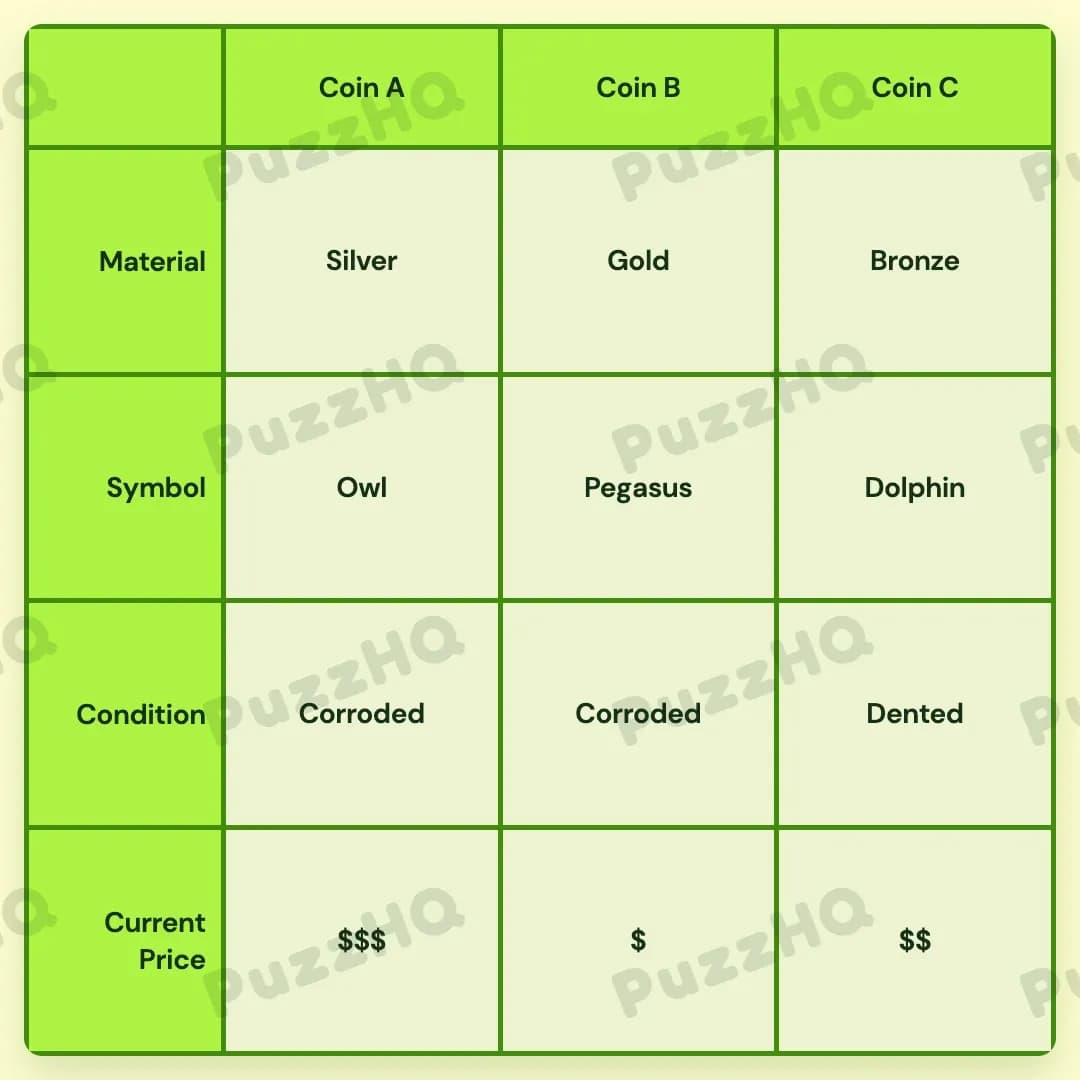
The three coins from left to right are an Owl Silver coin priced at $$$ with a Corroded finish, a Pegasus Gold coin priced at $ with a Corroded finish, and a Dented Dolphin Bronze coin priced at $$.
| Trait | Coin A | Coin B | Coin C |
|---|---|---|---|
| Material | Silver | Gold | Bronze |
| Symbol | Owl | Pegasus | Dolphin |
| Condition | Corroded | Corroded | Dented |
| Current Price | $$$ | $ | $$ |
How To Think Through Profile Perfect Level 638
The most productive solving habit for this puzzle is using structural geometry to anchor your subjects before attempting to resolve values that depend on them. In a row of three items, words such as rightmost and between do not merely describe relationships. They pinpoint exact grid columns immediately. Once those physical anchors are in place, trait pairs and relative directional clues lock into position with very little resistance.
Lock Down Fixed Columns: The Rightmost Clue Anchors Coin C
Positional clues that name an edge are the safest starting point in any linear deduction puzzle. They remove ambiguity without requiring any cross-referencing. When a clue specifies an extreme edge, check the grid layout immediately to claim that spot.
In this level, one clue states that the rightmost Dolphin coin is slightly Dented. Because there are three coins positioned side by side from Coin A to Coin C, the rightmost subject can only be Coin C. This single statement secures three separate pieces of knowledge at the very start of the solve:
- Coin C is the rightmost subject.
- Coin C bears the Dolphin symbol.
- Coin C is in Dented condition.
By addressing this clue first, you establish a firm anchor on the right flank. You also remove the Dolphin symbol and the Dented condition from consideration for Coin A and Coin B. Starting with absolute positions prevents you from having to test hypothetical layouts later.
Exploit Three-Item Geometry: The Middle Coin Must Be Between
Whenever a three-item layout features a clue describing something between two other items, that clue can only refer to the single middle slot. Recognizing this spatial fact lets you turn what seems like a complex multi-subject comparison into a direct assignment.
The clue stating that the cheapest coin is between two non-mythical symbols applies exclusively to Coin B. In a line of three coins, only the center coin sits between two neighbors. Therefore, Coin B must be the cheapest coin. Looking at the available price values of $, $$, and $$$, the lowest price point is $. Coin B is instantly confirmed as having a Current Price of $.
Notice how this step builds directly upon the previous deduction. You now know that Coin B sits between Coin A and Coin C, and that Coin A and Coin C must both display non-mythical symbols. Because you already placed the Dolphin on Coin C, that side of the requirement is satisfied, confirming that the Dolphin counts as one of the two non-mythical creatures. Coin A must therefore hold the other non-mythical symbol when you sort the symbols later.
Combine Value Links With Directional Order: Silver And Gold Fall Into Place
Direct identity clues that bind two traits together become twice as potent when paired with relative directional clues. When one clue matches two categories and another clue restricts their horizontal order, treat them as a combined unit.
You are given two clues about materials and prices:
- The Silver coin is the priciest due to the hype.
- The Gold coin is to the right of the Silver one.
The first statement tells you that Silver corresponds to the top price tier, which is $$$. The second statement establishes that Gold must sit in a column to the right of Silver.
Now compare these rules against your existing grid progress. You already know that Coin B costs $, so Coin B cannot be Silver. That leaves only Coin A and Coin C as candidates for the $$$ price tag. However, if Coin C were Silver, you could not place Gold to the right of it, because Coin C is already the rightmost column in the puzzle.
Therefore, Silver cannot be Coin C. Silver must belong to Coin A, giving Coin A a Current Price of $$$. Because Gold must sit to the right of Silver, and Coin A is Silver, Gold can occupy either Coin B or Coin C.
Look at what remains for the prices. Coin A is $$$, and Coin B is $. This leaves the mid-tier price of $$ for Coin C.
Resolve By Elimination: Filling The Final Materials And Conditions
Once high-priority clues establish the main framework, simple elimination clears out the remaining trait pools. You do not need dedicated clues for every single property when only one valid position remains.
At this stage, you need to determine the materials for Coin B and Coin C between Gold and Bronze. One clue notes that Gold sits to the right of Silver, which is consistent with either Coin B or Coin C. Another clue notes that a certain priced coin has a material not found on the periodic table. Even without relying on incomplete phrasing, standard material facts resolve this cleanly: bronze is an alloy rather than a chemical element, while gold and silver are basic elements. Coin C, holding the $$ price tag, takes Bronze. This leaves Gold for Coin B, satisfying the rule that Gold sits to the right of Silver.
Next, look at the Condition row. You already assigned Dented to Coin C during your very first step. The remaining available condition values are Corroded and Corroded. Because both remaining subjects share this identical state, Coin A and Coin B both become Corroded. The Condition trait is now fully solved across all three profiles.
Filter Remaining Traits Using Neighbor Requirements: Owl And Pegasus
The final task is assigning the remaining symbols, Owl and Pegasus, to Coin A and Coin B. To resolve this last pair, return to the requirement established during your second deduction: the cheapest coin, Coin B, sits between two non-mythical symbols.
A pegasus is a legendary winged horse from mythology, whereas an owl is a real, non-mythical bird. Because Coin B must be flanked on both sides by non-mythical symbols, Coin A cannot be Pegasus. Coin A must be the non-mythical Owl, joining the Dolphin on Coin C to flank Coin B.
Pegasus is left as the only possible symbol for Coin B. Every trait across Material, Symbol, Condition, and Current Price now matches every clue perfectly.
What This Level Teaches You
Recognize Absolute Geometry In Small Layouts
In a three-column puzzle, structural descriptions are far more definitive than they appear at first glance. A clue mentioning the rightmost subject points to exactly one column, just as a clue describing an item between two others can only ever refer to the center. Before reading deep into complex conditions, identify structural words that immediately lock a subject to an exact column.
Pair Relative Rules With Grid Boundaries
Relative statements such as one item being to the right of another are easiest to resolve by testing them against the boundaries of the grid. If an item must have another subject to its right, that first item can never occupy the far right column. Testing edge boundaries eliminates hypothetical placements quickly without requiring trial and error.
Final Thoughts
The key to mastering Profile Perfect Level 638 is recognizing that spatial clues provide instant anchors in three-subject layouts. By converting positional terms like rightmost and between into specific column assignments right away, you build a sturdy foundation that makes all subsequent price, material, and symbol deductions simple and orderly.
Comments