
Profile Perfect Level 636 Answer
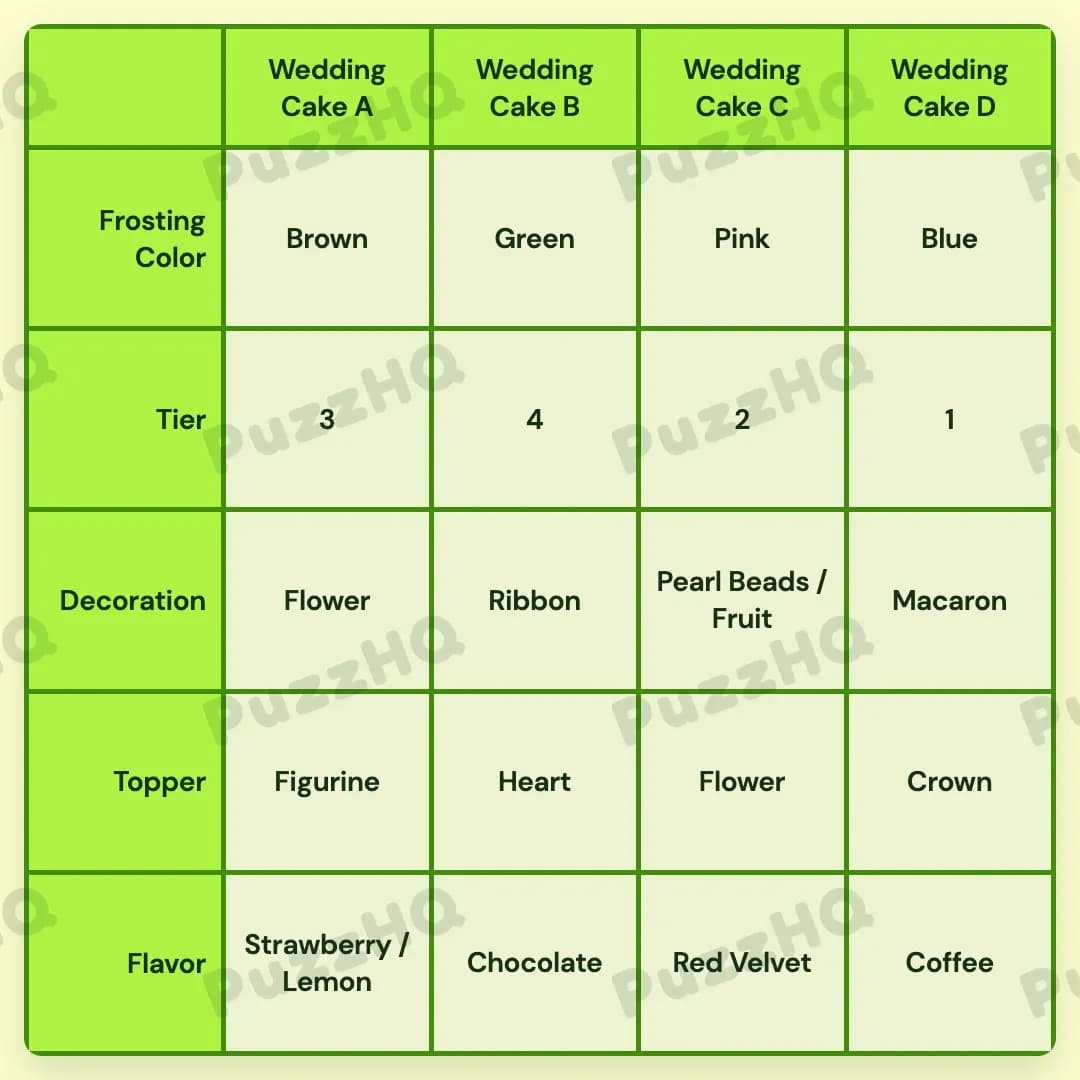
Here is the complete layout for every cake in the display, from their foundational frosting to the toppers resting on their highest tiers.
| Trait | Wedding Cake A | Wedding Cake B | Wedding Cake C | Wedding Cake D |
|---|---|---|---|---|
| Frosting Color | Brown | Green | Pink | Blue |
| Tier | 3 | 4 | 2 | 1 |
| Decoration | Flower | Ribbon | Pearl Beads / Fruit | Macaron |
| Topper | Figurine | Heart | Flower | Crown |
| Flavor | Strawberry / Lemon | Chocolate | Red Velvet | Coffee |
The Logic Behind Profile Perfect Level 636
Every good bakery window relies on a sense of balance, and this solve behaves much like setting up a formal confectionery showcase. The central idea holding the puzzle together is spatial geometry: the four cakes sit in a strict horizontal lineup from left to right, and their physical arrangement governs almost every early deduction. Rather than tumbling into a confusing assortment of tiers and frostings right away, the puzzle asks you to identify how the outer edges anchor the scene before you ever worry about which dessert rises highest.
Framing the Outer Edges by Color
The quickest path into the puzzle comes from looking straight at the lineup ends. We are told right away that Wedding Cake D is coated in either blue or green frosting, while brown frosting sits at the opposite end of the arrangement. That puts brown squarely on Cake A at the far left edge.
Once brown claims Cake A, the rest of the palette falls into place through simple positional boundaries. We learn that no cake on the left half of the display uses pink frosting. With Cake A and Cake B making up that entire left half, pink has to land somewhere on the right side. Cake D cannot take pink because it is already reserved for blue or green, which leaves Cake C as the only possible candidate for pink.
That leaves Cake B and Cake D to divide blue and green between them. A glance at the toppers settles the question: a figurine of the wedding couple stands over the cake positioned farthest from the blue frosting. If blue were assigned to Cake B, neither end would offer a completely unambiguous opposite pole in a four-cake row. Placing blue on Cake D creates an unambiguous span across the entire table, putting the couple directly on Cake A at the opposite end. As a result, Cake D takes the blue frosting, Cake B takes the green frosting, and the color palette is completely resolved across all four pedestals.
Height and Flavor Build the Center
With the frostings settled, the architecture of the cakes comes into focus. We learn that the brown cake is the only one featuring a citrus taste, which directly gives Cake A its combined Strawberry and Lemon profile.
The middle of the table then begins to organize around height. The clue noting that the ribbon cake stands taller than all the others means that whichever cake features a ribbon must hold the maximum height of four tiers. We also know that the cake sitting immediately to the left of the one with multiple decorations uses ribbon. Looking across the remaining decoration options, Cake C is defined as having multiple elements (pearl beads and fruit). Therefore, the cake immediately to its left, Cake B, must carry the ribbon. This firmly assigns four tiers and the ribbon decoration to Cake B.
From there, flavors and tier counts interact cleanly. Chocolate sits to the right of the second tallest cake. Since Cake B occupies the tallest spot at four tiers, the second tallest must be three tiers high, which can only belong to Cake A. Cake B sits directly to the right of Cake A, so Cake B takes the chocolate flavor.
Meanwhile, coffee flavor needs a home. The clue specifying that the ribbon cake and its immediate neighbors cannot taste like coffee immediately excludes Cake B along with Cake A and Cake C. Cake D is the only cake left untouched by that exclusion, making it the coffee cake. That leaves red velvet with only one open spot on the flavor sheet, sending it straight to Cake C.
Accents and Royal Themes Finish the Lineup
With the main flavors and color profiles accounted for, the remaining decorations and toppers quickly lock together. Cake C is established as carrying multiple decorations, one of which is an edible accent described as tasting sweet and sour, matching the pearl beads and fruit combination.
Another spatial rule states that edible decorations sit beside one another. Cake C already carries an edible element, so its neighbor must provide the companion piece. Looking at the remaining options, macarons qualify as an edible garnish, whereas ribbons and simple floral ornaments do not. Cake B is already fixed with a ribbon, which means Cake D must take the macaron decoration. Cake A takes the flower decoration by elimination.
Finally, the toppers and remaining tier levels fall into line. We know a royal theme appears on the right half of the table, and a cake sits to the left of the crown topper. Cake D, sitting at the far right end, fits the crown topper neatly, which also honors the clue that another cake sits to its left.
That leaves the heart and flower toppers to be divided between Cake B and Cake C. The clue guiding red velvet indicates its topper must be either a heart or a flower. Cake C is the red velvet cake. Because Cake B is left to take the heart topper, Cake C receives the flower topper. Cake C claims two tiers while Cake D takes a single tier to complete the descending scale, leaving the display fully assembled.
The Clue I Would Read Twice
The clue stating that "the couple stands above the one farthest from Blue frosting" is easily the most vital turning point in the entire puzzle. At first glance, it feels like a clue simply describing where a topper goes. In practice, it does double duty by resolving the color debate between Cake B and Cake D.
If you read it strictly as a topper hint, you might wait around hoping to stumble on the blue frosting through another trait. But because Cake D is constrained to either blue or green, testing Cake D as blue creates a clear maximum distance: Cake A sits three steps away. If Cake B had been blue, neither outer boundary would feel like the definitive farthest point. Recognizing that distance in a four-item sequence requires using the endpoints makes this clue the subtle linchpin for both the palette and the toppers.
Final Thoughts
What makes 636 enjoyable is how tactile the deductions feel. Rather than relying on heavy arithmetic or abstract comparison chains, the solution unfolds by treating the four cakes like physical showpieces on a counter. Once the outer edges take their colors, the tiers and edible garnishes settle into place with satisfying, orderly precision.
Comments