
Profile Perfect Level 666 Answer
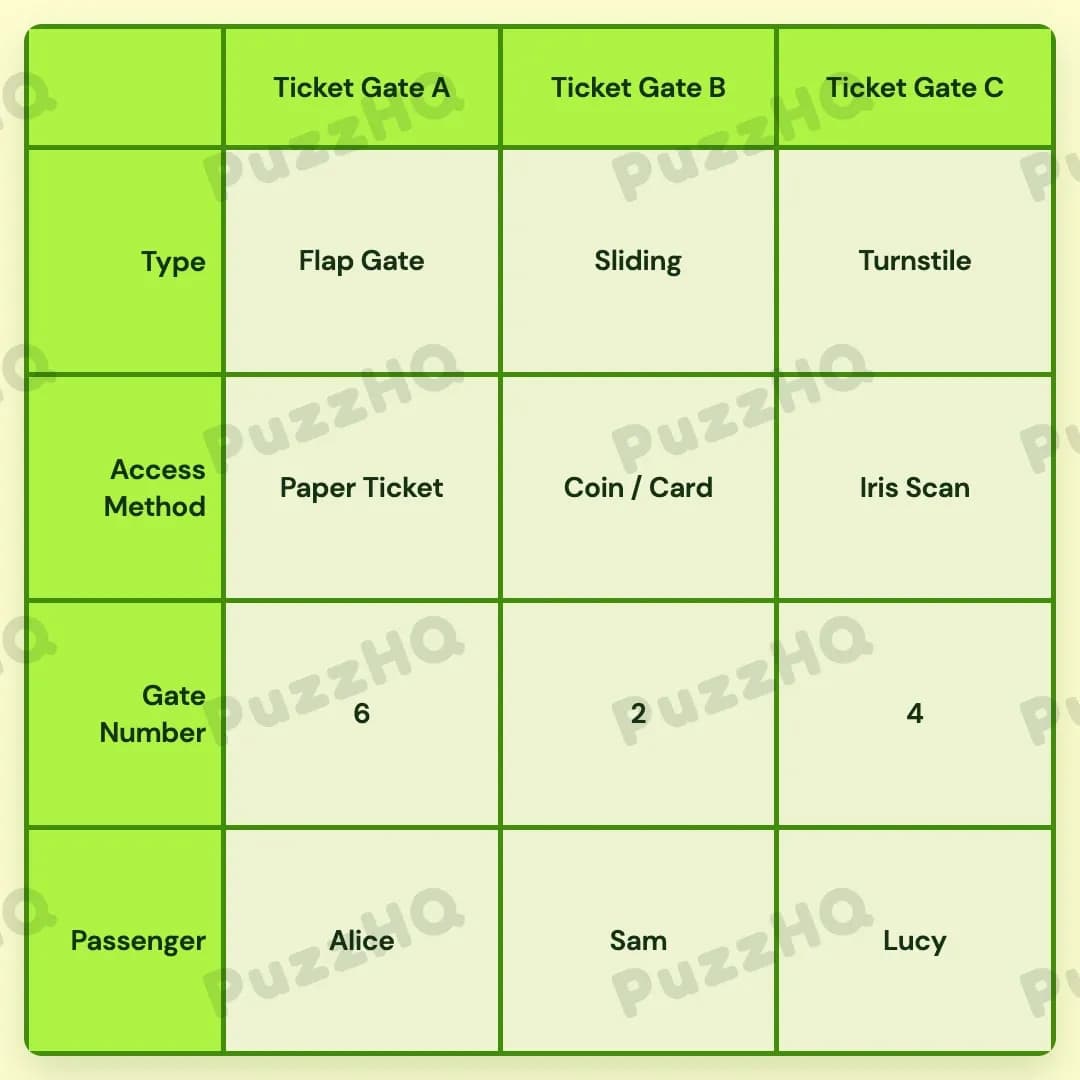
Before stepping into the station concourse, you can cross-check your completed transit log against the fully resolved board below.
| Trait | Ticket Gate A | Ticket Gate B | Ticket Gate C |
|---|---|---|---|
| Type | Flap Gate | Sliding | Turnstile |
| Access Method | Paper Ticket | Coin / Card | Iris Scan |
| Gate Number | 6 | 2 | 4 |
| Passenger | Alice | Sam | Lucy |
The Logic Behind Profile Perfect Level 666
The architectural spine of this puzzle is anchored entirely in physical space. Rather than forcing you to juggle commuter names and fares right out of the gate, the grid asks you to step back and look at the physical turnstile bank from left to right. Once the barrier hardware and the gate numerals find their fixed positions along the concourse, the passengers and their respective boarding passes slip neatly into line behind them.
Spatial Clues Lock The Gate Types In Place
Everything begins with the three lanes stretching across the station floor. Because we have three distinct positions lined up from left to right, directional statements carry an enormous amount of weight before any passenger even taps a card.
The critical interaction happens between the physical descriptions and the numbering rules. We know from the outset that the leftmost terminal holds the highest gate number. A quick survey of the clues reveals that gate number 6 is the largest digit mentioned, while gate number 6 also explicitly forbids a sliding gate mechanism. That simple restriction immediately protects the leftmost lane, Ticket Gate A, from receiving sliding doors.
At the same time, the rules require the turnstile gate to stand somewhere to the right of the sliding barrier. With only three positions on the board, that relative positioning leaves the sliding mechanism with nowhere to go except the center spot at Ticket Gate B. If you attempted to push the sliding doors all the way to the right, there would be no room left for a turnstile beyond it. If you tried placing the sliding gate on the far left, you would directly contradict the restriction on gate number 6.
With Ticket Gate B locked in as the sliding gate, the turnstile automatically claims the far right position at Ticket Gate C. That leaves only one mechanical style unaccounted for, which means the flap gate naturally settles into Ticket Gate A on the left.
Distributing The Numbers Across The Line
Once the physical hardware is fixed in place, the numbering of the terminals unravels without much resistance.
Because the leftmost terminal must hold the largest number of the set, Ticket Gate A takes gate number 6 without debate. That leaves only two numbers floating in reserve across the remaining two lanes, numbers 2 and 4.
The prompt explicitly links Lucy to gate number 4. Since Ticket Gate A is already locked to gate number 6, Lucy cannot be standing at the leftmost lane. Her assignment to gate 4 ties her directly to one of the remaining two spots.
Looking at how the travelers pair with their terminals, Ticket Gate C takes gate number 4, placing Lucy at the turnstile on the far right. That leaves gate number 2 as the sole remaining designation for Ticket Gate B in the middle of the concourse. In just a few clean deductions, the entire spatial skeleton of the puzzle is finished. The physical structures and numerical markers are completely sorted, leaving only the human commuters and their ticketing habits to resolve.
Methods Of Entry Sort The Commuters
With the gates numbered and typed, the final phase shifts attention to how everyone actually pays their way through the barriers. Three passengers are traveling today: Alice, Lucy, and Sam. Alongside them are three distinct ways to clear the barrier: a traditional paper ticket, a biometric iris scan, and an automated terminal that handles both coins and card swipes.
Alice makes her introduction simple. She purchased a paper ticket beforehand from the station booth, binding her directly to that specific fare medium. Meanwhile, a male commuter manually drops a stack of coins into his gate. Additional details clarify that this same coin-fed machine also features a card reader for modern direct payment. That dual coin and card terminal belongs to Sam, who is the only male passenger in the roster.
By basic elimination, the remaining access method is the iris scan. Since Alice holds the paper ticket and Sam manages the coin and card machine, Lucy must be the passenger glancing into the iris scanner.
Placing these travelers into their lanes is the final formality. Lucy was already designated to gate number 4, which we established at Ticket Gate C alongside the turnstile and the iris scanner. Alice steps into the flap gate at Ticket Gate A with her paper ticket in hand. That leaves Sam to feed his coins and tap his card at Ticket Gate B, walking through the sliding doors of gate number 2. Every single traveler finds their lane without a single contradictory detail.
The Clue I Would Read Twice
The single line that deserves a second glance is the requirement that the turnstile gate sits to the right of the sliding one.
In logic puzzles of this style, solvers often stumble by assuming that a directional clue implies direct, side by side adjacency. It is easy to misread that phrase and immediately glue the two gates together as an inseparable block, wondering whether they sit at lanes A and B or lanes B and C.
Here, the phrasing simply dictates relative orientation along the corridor. However, because the concourse is only three slots wide, that simple directional check exerts immense leverage when combined with the prohibition against sliding doors at gate number 6. It single-handedly forces the sliding gate into the middle lane and keeps the turnstile on the far right. What reads like a casual piece of scenic flavor turns out to be the architectural anchor that stabilizes the entire solve.
Final Thoughts
There is a clean, orderly rhythm to Level 666 that feels very true to actual train travel. The puzzle resists the temptation to get bogged down in complicated credential swapping, choosing instead to let the physical layout of the station do the heavy lifting. Once you let the physical machinery establish the geography of the concourse, the rest of the morning commute falls into place with total ease.
Comments