
Profile Perfect Level 683 Answer
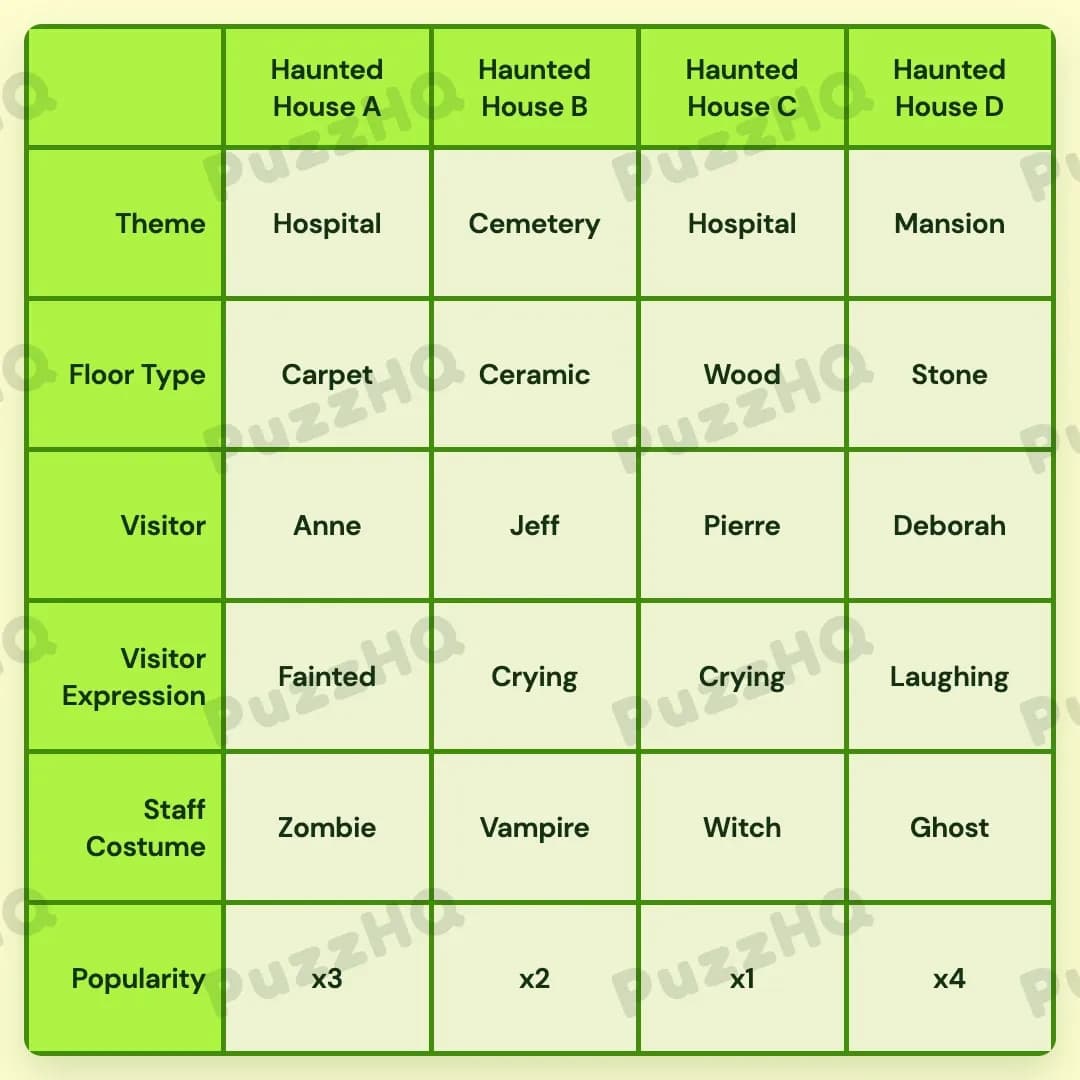
A careful tour through the four haunted attractions reveals exactly who walked into each terrifying corridor, what frightened them, and how each house was received by the crowd.
| Trait | Haunted House A | Haunted House B | Haunted House C | Haunted House D |
|---|---|---|---|---|
| Theme | Hospital | Cemetery | Hospital | Mansion |
| Floor Type | Carpet | Ceramic | Wood | Stone |
| Visitor | Anne | Jeff | Pierre | Deborah |
| Visitor Expression | Fainted | Crying | Crying | Laughing |
| Staff Costume | Zombie | Vampire | Witch | Ghost |
| Popularity | x3 | x2 | x1 | x4 |
The Logic Behind Profile Perfect Level 683
The structural backbone of this puzzle rests almost entirely on physical geography. In a four-house strip, only two locations can ever have two neighbors, and identifying those middle plots early prevents the rest of the board from drifting into guesswork. Once the center holds, relative distance and paired descriptions do the heavy lifting.
The Middle Houses Anchor The Street
Before thinking about visitors or ghouls, look at the architecture of the street. Houses A and D sit at the outer edges of the row, which leaves Houses B and C as the only two spots that have a neighbor on both sides. When we learn that the houses with wooden and ceramic floors each have two neighbors, those two floor textures immediately lock into the middle two slots.
That single spatial constraint simplifies the floor question remarkably quickly. Because the stone floor is situated to the right of the wooden one, stone cannot occupy either of the middle locations or the left edge. It naturally claims Haunted House D on the far right. This forces wood into Haunted House C, ceramic into Haunted House B, and leaves the remaining carpet floor at Haunted House A.
With four quick deductions, the ground beneath every house is settled.
Tracking Guests Across The Ranking Ladder
Once the floor plan is established, the puzzle pivots toward visitor experiences and popularity rankings. Haunted House A is explicitly said to hold second rank even after recent renovations. In a four-tiered hierarchy running from lowest to highest, that second-highest standing translates to a popularity score of x3.
From there, we turn our attention to the physical gaps between guests. We are told that the person who fainted is separated by two full columns from the least popular house on the block. Anne lost consciousness from shock, which places her squarely in the fainted category. Since Haunted House A already sits at x3 popularity, Anne cannot be at the bottom of the rankings. Instead, Anne must be the one who fainted at House A, sitting two columns away from the least popular house, which puts the lowest popularity score of x1 directly into Haunted House C.
The rest of the popularity and visitor traits quickly fall in line. The visitor who finds their venue funny visits the most renowned attraction of all, which is the top-ranked x4 house. Because House A is x3, House C is x1, and House B is an interior house, Haunted House D becomes the undisputed favorite at x4. The visitor there is laughing rather than screaming.
Meanwhile, the house directly to the right of Pierre is styled like an abandoned house. Pierre cannot be standing in House D because there is no house to the right of it. With Anne already situated at House A, Pierre must be visiting House C, leaving the abandoned mansion aesthetic to House D. That places Jeff at House B and Deborah at House D.
Duplicate Themes And Ghostly Sightings Fall Into Place
With the visitors identified and their positions mapped, the monsters and themes begin pairing up naturally. Jeff encounters a vampire rising from a grave, which links both the vampire costume and the cemetery theme directly to House B. Deborah is pursued by a staff member dressed as a ghost who collides with a fireplace, cementing the ghost at House D inside its abandoned mansion.
That leaves two remaining staff costumes to distribute between Houses A and C: the witch and the zombie.
Here, the puzzle offers an intriguing atmospheric link by noting that the witch and the zombie inhabit similar haunted houses. Rather than every venue boasting a completely unique concept, this pair shares the identical theme of an abandoned hospital. Anne encounters the zombie at House A, while Pierre faces the witch at House C.
Visitor reactions wrap up cleanly through simple elimination. Anne has fainted at House A, and Deborah is having a wonderful time laughing at House D. The remaining guests are both reduced to tears, giving crying expressions to both Jeff at House B and Pierre at House C. Jeff and Pierre take their spots, House B takes its x2 popularity mark to finish the ranking sequence, and the spooky boulevard is complete.
The Clue I Would Read Twice
The clue stating that the witch and the zombie are in similar haunted houses is easily the most rewarding line to parse. Most solvers naturally expect each trait row to feature four distinctly named entries. Seeing a clue speak of similar houses might tempt you to look for subtle stylistic synonyms or assume one is a variation of the other.
In truth, the phrase serves as direct justification for duplicating a theme across two separate houses. Once you recognize that both House A and House C share the hospital backdrop, any lingering doubts about leftover thematic assignments vanish. It is a quiet reminder that logic puzzles do not always require every single label to be unique.
Final Thoughts
What makes this visit so memorable is how well it mimics an actual walk down an amusement midway. You move from the sterile fright of a hospital corridor on carpet to the echoing stone halls of a mansion, watching the crowd thin and gather as the popularity ratings rise and fall. It proves that tight spatial logic can make even the most chaotic carnival feel orderly.
Comments