
Profile Perfect Level 92 Answer
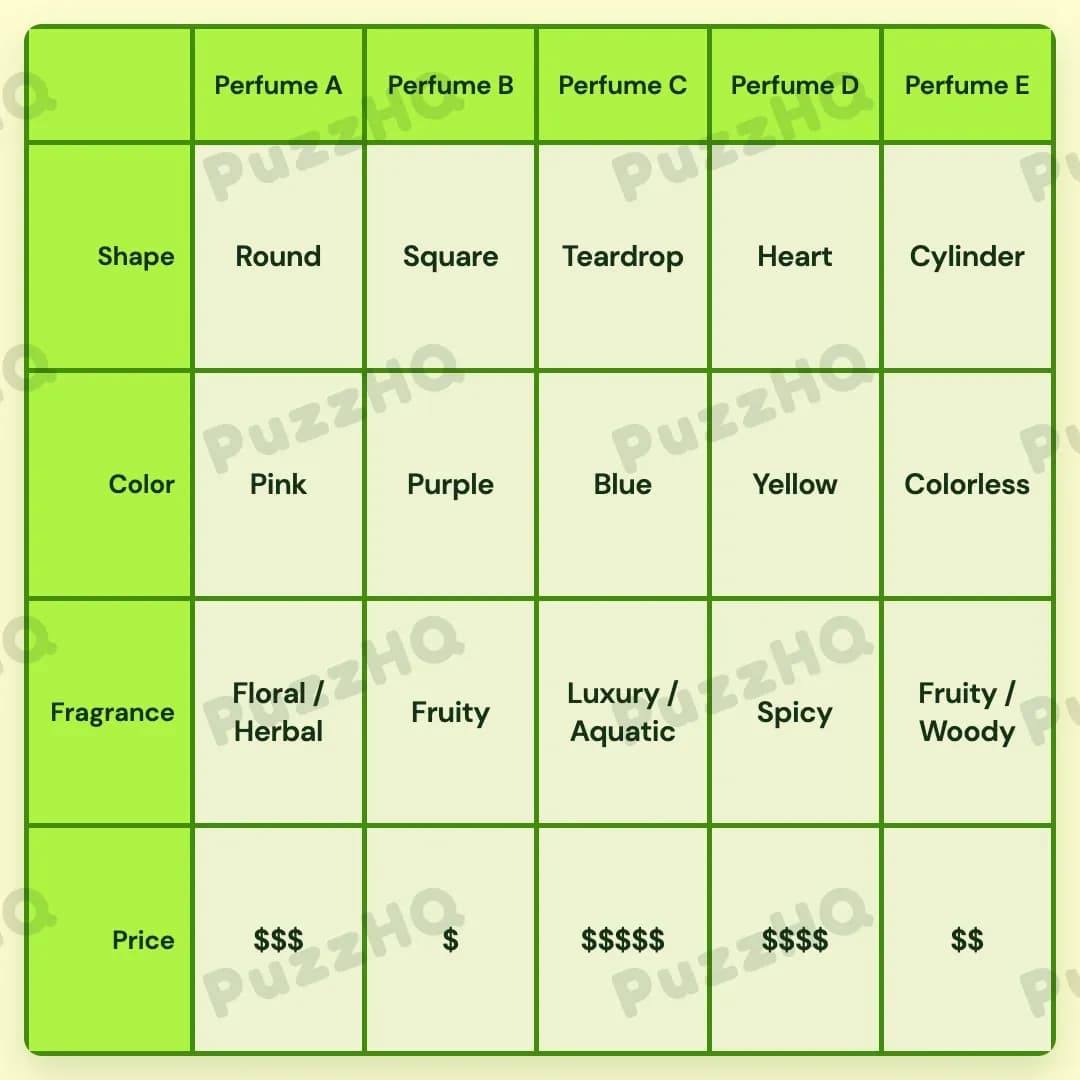
The completed table reveals the exact shapes, colors, fragrance notes, and price tiers for all five perfumes from Perfume A to Perfume E.
| Trait | Perfume A | Perfume B | Perfume C | Perfume D | Perfume E |
|---|---|---|---|---|---|
| Shape | Round | Square | Teardrop | Heart | Cylinder |
| Color | Pink | Purple | Blue | Yellow | Colorless |
| Fragrance | Floral / Herbal | Fruity | Luxury / Aquatic | Spicy | Fruity / Woody |
| Price | $$$ | $ | $$$$$ | $$$$ | $$ |
How To Think Through Profile Perfect Level 92
Solving this puzzle efficiently requires starting with anchor traits that fix specific values to specific subjects, then using price hierarchies and positional neighbor clues to lock down the rest of the board. Rather than testing random configurations, focus on clues that restrict items to extreme values or exact columns.
Lock In Fixed Anchors: Establish The Base Traits
Direct assignment clues provide an immediate foundation. Start by reading the clues that point directly to named perfumes.
- Clue 1 states that Perfume B costs less than all the others. This means Perfume B gets the lowest price tier of $.
- Clue 2 states that Perfume A has the roundest shape. This gives Perfume A the Round shape immediately.
These two facts give you reliable anchor points. Perfume A now has its shape locked in, and Perfume B has its exact price established.
Follow Value Hierarchies: Rank The Prices
Price clues often link traits across columns without naming the subject directly. When multiple clues describe price ranks, you can assemble the entire price row quickly.
- Clue 8 tells you that the priciest perfume is Blue. Since there are five tiers from $ to $$$$$, the top price of $$$$$ belongs to the Blue perfume.
- Clue 11 states that the perfume with the Spicy smell is the second most pricey, which fixes Spicy at $$$$.
- Clue 5 notes that next to the cheapest one are Floral, Herbal, and Luxury fragrances. Perfume B is the cheapest at $, positioned in column 2. Its neighbors are Perfume A on the left and Perfume C on the right. This means Perfume A and Perfume C hold the neighbor fragrances, leaving Perfume D or E for Spicy.
- Looking at Perfume C, it sits next to Perfume B. Clue 9 mentions that the perfume to the left of the Blue one does not have the Spicy smell. If Perfume C were anything other than Blue, the layout would conflict. Perfume C is the priciest bottle at $$$$$, colored Blue.
- Because Perfume C is $$$$$, the second most expensive bottle at $$$$ must be Perfume D, giving Perfume D the Spicy fragrance.
- Clue 7 states that the Cylinder perfume is cheaper than the Round one. Perfume A is Round. The only remaining open price tiers are $$ and $$$. Therefore, the Round perfume (Perfume A) must be $$$, and the Cylinder perfume must take the lower remaining price of $$. This assigns $$ to Perfume E, leaving Perfume E with the Cylinder shape.
Now all five price levels are completely solved: Perfume B is $, Perfume E is $$, Perfume A is $$$, Perfume D is $$$$, and Perfume C is $$$$$.
Connect Multi Trait Clues: Pair Colors And Fragrances
Once prices and positions are clear, use clues that tie two traits together to fill in the color and fragrance rows.
- Clue 10 states that the Pink perfume comes in the Herbal fragrance. Perfume A is already adjacent to Perfume B and carries Herbal notes from Clue 5. This places Pink on Perfume A, along with the combined Floral / Herbal fragrance blend.
- Clue 8 mentions that the priciest bottle (Perfume C, Blue) is not available in Floral fragrance. Perfume C takes the Luxury fragrance from Clue 5 along with Aquatic.
- Clue 4 states that Aquatic and Woody fragrance perfumes are 2 columns apart. Perfume C has Aquatic in column 3. Counting two columns over leads to column 5, which is Perfume E. Perfume E therefore contains the Woody note in its Fruity / Woody blend.
- Clue 3 notes that the Square and Heart perfumes are only available in 1 fragrance. Perfume D has only the Spicy fragrance, which means Perfume D is a candidate for Heart. Perfume B has only the Fruity fragrance, making it a candidate for Square.
Resolve Spatial Relationships: Neighbor Clues Lock Shapes And Colors
Neighbor clues help determine the exact distribution of the remaining shapes and colors.
- Clue 12 states that the Colorless perfume is next to the Heart-shaped one. Perfume E is at the end of the row. Assigning Colorless to Perfume E places it directly next to Perfume D in column 4. This confirms Perfume D has the Heart shape.
- With Perfume D confirmed as Heart, Clue 3 dictates that Perfume B must be the Square shape.
- The only remaining shape for Perfume C is Teardrop.
- Clue 13 states that the Fruity fragrance perfume is not colored Yellow. Perfume B has the single Fruity fragrance, so Perfume B cannot be Yellow. Perfume B takes Purple instead.
- This leaves Yellow as the final remaining color, which naturally belongs to Perfume D.
Every cell in the grid is now fully accounted for without making a single unforced assumption.
What This Level Teaches You
Price Hierarchies Can Fill An Entire Trait Row Early
When a puzzle includes clues defining the cheapest, second most pricey, priciest, and relative costs, you can solve the entire price row before knowing all the subject names. Building an ordered chain of values narrows down subject assignments much faster than treating each clue in isolation.
Neighbor Clues Depend On Fixed Positions
Clues that describe items next to each other, such as the Colorless perfume sitting beside the Heart shape, are most effective when one of the subjects already has an established column. Trying to evaluate neighbor relationships before establishing anchor columns creates unnecessary branching. Wait until a column is anchored, then apply the adjacency.
Multi Trait Exclusions Narrow Down Single Value Cells
When a clue specifies that certain shapes only hold one fragrance note, you can immediately filter out complex multi note blends from those subjects. Combining positive traits with negative restrictions, like confirming a single note bottle is not Yellow, quickly isolates the correct colors for the remaining columns.
Final Thoughts
The key to mastering this puzzle is sequencing your deductions around value rankings first. By resolving the price hierarchy from lowest to highest, you create stable anchors across every column. Once those columns are settled, the neighbor restrictions and multi trait pairings resolve naturally without any need for guesswork.
Comments