
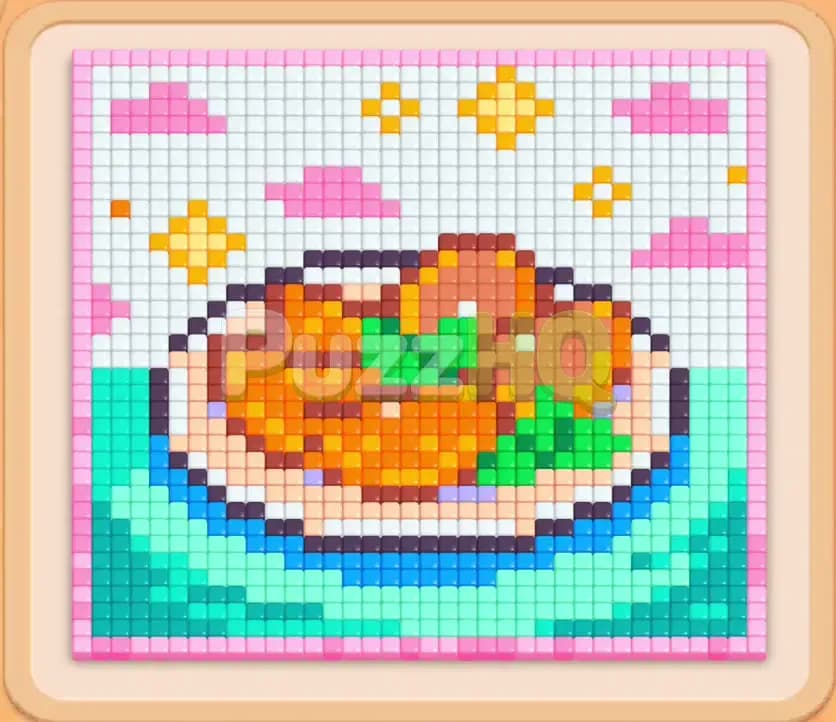
Colony Flow Level 2507 presents an intricate food plate illustration that demands strict discipline with your tray choices. Between the massive outer border of teal and white tiles and the densely packed core of the dish, you must peel away external layers cleanly to expose the center. The key to this puzzle lies in pacing your picks so that high count blocks never choke your waiting area before their paths open up.
Colony Flow Level 2507 Starting Setup
Reading the Board
The main puzzle board depicts a delicious plate of golden brown food resting on a bed of green garnish inside a rounded white and orange dish. Underneath the dish sits a wide teal and cyan cloth that occupies the entire lower third of the canvas. Surrounding the dish is a pale white background topped with soft pink clouds and glowing yellow stars.
Down below the nest hole, your tray starts with five open waiting slots and a stacked lineup of numbered blocks. Right along the top row of the tray, you have access to dark green nine, terracotta brown twelve, teal fourteen, deep red thirteen, and salmon peach eleven. Beneath these visible choices rest multiple layers of colored blocks, including several sets of Connected Boxes linked together by colored tubes. These connected pairs mean that whenever you pull one block from the pair, its partner will follow along into your waiting area.
What You Need to Watch Out For
Your primary threat on this stage is slot suffocation caused by premature color commitments. The center of the plate contains massive clusters of orange, brown, and green, but none of those delicious central tiles can be reached from the nest until the teal cloth and white outer borders disappear. If you grab dark red or brown blocks too early because their numbers look tempting, those ants will run out of exposed targets almost immediately.
Because you only have five waiting slots, parking even two dead blocks in your tray cuts your working space in half. Furthermore, the presence of Connected Boxes in the lower stacks means you must always reserve at least two empty slots before tapping a linked set. Pulling a connected pair when you only have one open slot will instantly fail the stage.
Colony Flow Level 2507 Step by Step Walkthrough
Step 1: Opening the Outer Teal Border and Base
Your first priority is clearing out the bottom border so ants have room to fan out toward the sides of the dish. Begin by tapping the teal fourteen from the front row. A steady stream of teal ants will pour from the nest and march straight into the bottom right corner of the cyan tablecloth. As those tiles crumble, tap the dark green nine and the deep red thirteen to start chipping away at the dark accent tiles framing the lower edge.
Watch the numbers tick down rapidly as the teal block drops to one and the dark red block shrinks to eight. You will also see a white block and a black block enter the waiting lineup to keep the ants chewing through the base layer. By clearing the lower right section of the teal cloth, you create an open avenue that lets ants travel up the right flank of the board toward the plate rim.
Step 2: Releasing White Ants to Clear the Lower Corners
With the lower edges beginning to loosen, select the white twenty seven block that surfaced in your options. A large swarm of white ants will rush into the bottom right and bottom left perimeter, devouring the clean background tiles flanking the plate. While the white ants are busy working on the corners, bring in the teal eleven and the salmon eleven to clear the remaining patches of table runner.
The board now shows significant cutouts along both bottom corners. The teal cloth has been carved into separate chunks, exposing the bottom curve of the orange plate rim. Your waiting slots will temporarily hold dark green nine, deep red seven, mint teal five, and white twenty five. Keep your eyes on the white counter as it steadily declines while clearing room around the outer frame.
Step 3: Targeting the Pink Clouds and Upper Edges
Now that the lower paths are wide open, your ants can easily wrap around the sides toward the top of the canvas. Tap the pink twenty block from the tray. Pink ants will march along the newly cleared outer paths directly toward the pink clouds floating at the top right and top left corners.
As the pink clouds get chewed away, the white ceiling of the illustration becomes exposed. Use this moment to clear the black sixteen and brown seven blocks that have open paths along the plate shadow. Your waiting tray should remain healthy with two or three slots cycling active colors like pink and dark green while the rest remain open. Do not touch any central dish colors yet because the outer rim still shields them.
Step 4: Activating Connected Boxes to Breach the Plate Outline
At this stage you will uncover Connected Boxes in your tray, specifically the linked blue and orange pairs. Ensure you have at least two completely empty waiting slots before touching them. Once you tap the linked set, both blocks slide into your active slots simultaneously.
Blue ants immediately swarm the remaining blue trim below the dish, while the orange ants begin gnawing on the outer edge of the plate rim. The dark green block finally counts down from nine to six as its ants clear the remaining leaves around the base. With the rim cracked open, the inner clusters of food become accessible from both the left and right sides.
Step 5: Stripping Away the Yellow Stars and Sky Tiles
Before plunging completely into the meat of the dish, you must finish stripping the background to avoid getting stalled later. Select the yellow block with count one and the pink thirteen to wipe out the small stars and leftover cloud wisps across the top. At the same time, drop white seventeen into the tray so white ants can clear out the remaining ceiling tiles.
This coordinated push clears out the upper half of the board entirely, leaving only floating fragments of the food platter. Because the yellow and pink counts are relatively low, they vacate your waiting slots almost immediately, granting you fresh room to handle the dense colors remaining in the center.
Step 6: Dissolving the Green Garnish and Plate Rim
With the background completely gone, all your ant traffic can focus directly on the plate. Deploy the green twenty one block alongside the blue thirteen. Green ants will flood into the garnish underneath the nuggets, chewing through the leafy base and disconnecting the food clusters into smaller, manageable islands.
As the green and blue tiles vanish, the remaining orange and brown sections of the food become entirely exposed on all sides. Your tray will now cycle through low count utility blocks like black two, light blue, and brown four, smoothly dropping each block count to zero without filling the five waiting slots.
Step 7: Consuming the Center Dish and Emptying the Board
You have reached the final stretch of the puzzle. The only tiles left on the board are the fried food nuggets in the center, consisting of orange, green accents, and rich terracotta brown. Tap the orange block, the salmon eleven, and the green three.
Streams of multicolored ants will converge on the center from every direction. Because every single remaining tile has open perimeter access, all active blocks count down simultaneously. The final green tiles disappear first, followed closely by the orange clusters and the last few brown crumbs. Once the final tile is consumed, the board clears completely and you win the level.
Colony Flow Level 2507 Winning Strategy
The Most Important Moves
The defining decision in this level is holding back on the orange and brown food blocks until the teal tablecloth and white edges are completely dismantled. Players frequently fail here because orange and brown appear heavily in the lower tray stacks, tempting you to pull them before their paths exist. Doing so traps those high count blocks in your waiting area where they sit uselessly for minutes.
Another crucial junction occurs when handling the Connected Boxes. Because these blocks arrive in pairs, you must deliberately pace your single block selections right before unlocking them. You need two clean slots available at the exact moment you tap a connected pair. Treating linked blocks with that level of respect ensures you never accidentally trigger a game over from a full tray.
Keeping the Ants Moving
To maintain continuous movement without jamming your waiting area, always pair high count blocks with low count blocks. When you place a block with twenty or more ants into your tray, accompany it with quick finishes like yellow one or black two. The rapid completion of smaller blocks keeps your waiting slots rotating, giving you the flexibility to adapt whenever a new color path opens on the board.
Always watch which side of the food platter is losing tiles faster. In this layout, the right side opens up much earlier than the left. Directing your block choices to exploit the right hand opening allows your ants to sneak behind the main dish and clear background tiles while the front entrance remains partially congested.
Colony Flow Level 2507 Final Tips
Pay close attention to the visual connections between blocks in your lower tray stacks. Colored tubes indicate linked boxes that must travel together, so take a second to scan the tray before committing your next tap. If you see a connected pair approaching the top of a stack, stop pulling single blocks until you have created sufficient breathing room in your waiting row.
Remember that ants can only eat tiles that have at least one exposed edge. Tiles buried deep inside the chicken nuggets cannot be targeted until the outer rim and green garnish are peeled away. Trust the outside in methodology, keep your slots clean, and let the outer layers fall before attempting to digest the core.
If you find yourself stuck on any specific block transition or want to see the exact ant routes in motion, watching the companion video walkthrough linked above will provide full visual clarity for every tap.
Comments