
Profile Perfect Level 107 Answer
Spoiler warning: The solution grid below contains the complete answer for Level 107. If you only need a hint to get unstuck on a specific clue, consider reading through the question sections before looking at the table.
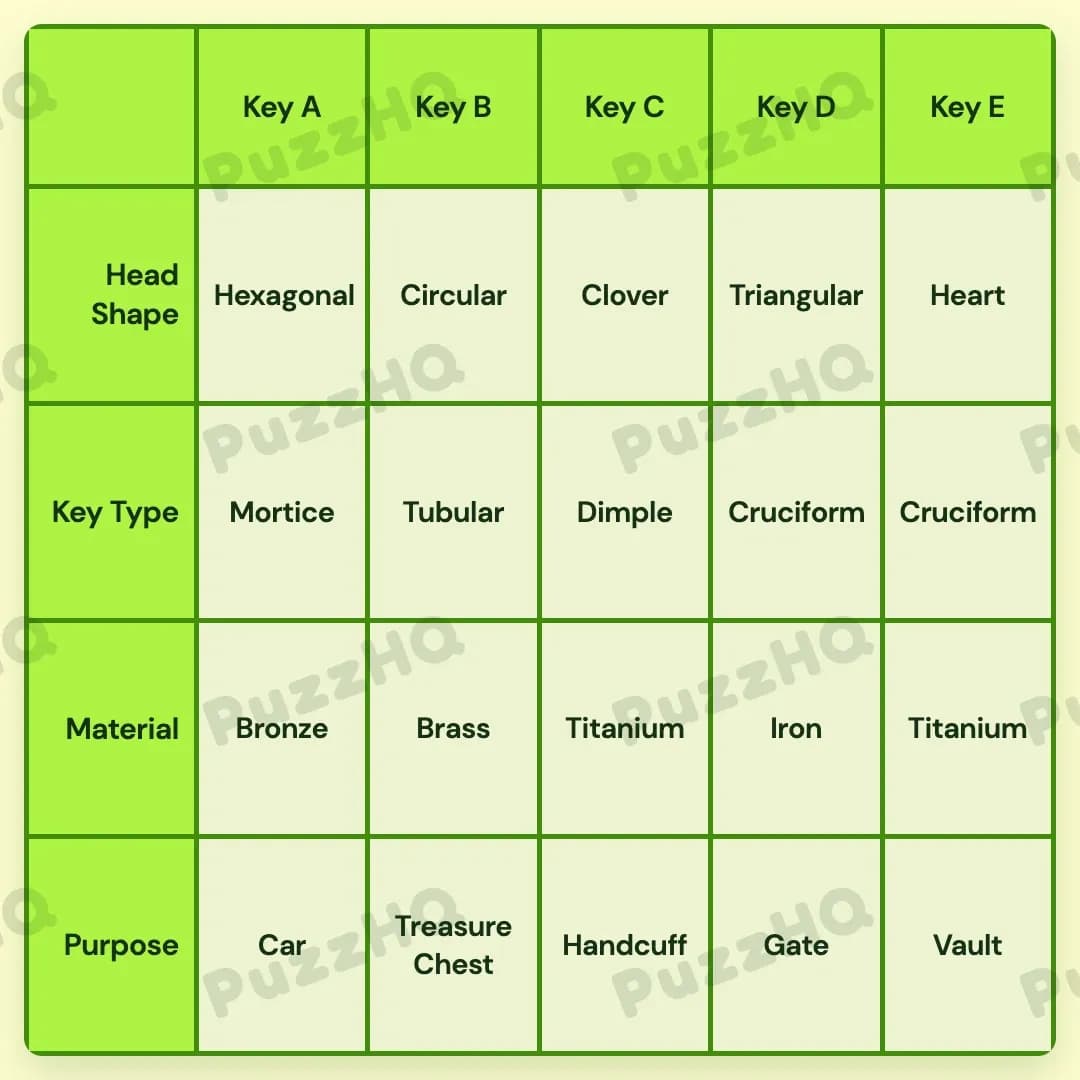
| Trait | Key A | Key B | Key C | Key D | Key E |
|---|---|---|---|---|---|
| Head Shape | Hexagonal | Circular | Clover | Triangular | Heart |
| Key Type | Mortice | Tubular | Dimple | Cruciform | Cruciform |
| Material | Bronze | Brass | Titanium | Iron | Titanium |
| Purpose | Car | Treasure Chest | Handcuff | Gate | Vault |
Stuck On Profile Perfect Level 107?
Many players get held up when trying to connect the spatial clues on the left side of the board with the specific locks each key opens. The puzzle becomes much easier once you link the Treasure Chest and Handcuff positions, which then locks in the material and shape assignments across the middle keys.
Where Do The Circular Head And Treasure Chest Belong?
You can establish the first direct matches right away by combining two early details:
- One clue confirms that Key A has a Hexagonal head and is made of Bronze.
- Another clue states that the Circular head key opens the Treasure Chest.
- You are also told that the Mortice key is to the left of the Circular head key.
Because Key A is already Hexagonal, it cannot be the Circular head key. Key A sits on the far left of the row, so placing the Circular head on Key B allows Key A to serve as the Mortice key immediately to its left. This firmly assigns the Circular head and the Treasure Chest purpose to Key B, while locking the Mortice key type onto Key A.
Why Must Key C Open The Handcuff?
Once you know Key B opens the Treasure Chest, you can solve the Handcuff clue:
- The clue specifies that the key for the Handcuff is next to the Treasure Chest.
- Since Key B is the Treasure Chest, the Handcuff key must be either Key A or Key C.
- However, a separate clue tells you that the Bronze key does not open the Gate or the Handcuff.
Because Key A is made of Bronze, it cannot open the Handcuff. That leaves Key C as the only valid neighbor for the Handcuff purpose.
How Do You Find The Clover Head And The Brass Material?
With Key C identified as the Handcuff key, you can narrow down the materials and head shapes:
- The Handcuff key is not made from Brass, which means Key C cannot be Brass.
- The clue regarding the Clover head states that it is next to the key made of Brass.
- Key A is Bronze, so Key B must be the Brass key.
- With Key B being Brass, the adjacent Clover head must be on Key C, because Key A is already established as Hexagonal.
This completes the head shape for Key C (Clover) and the material for Key B (Brass).
How Do You Assign The Gate, Vault, And Car Purposes?
At this stage, you have two purposes placed: Key B is the Treasure Chest and Key C is the Handcuff. You have three purposes left to place: Car, Gate, and Vault.
- You already know the Bronze key (Key A) cannot open the Gate or the Handcuff.
- Key A is not the Vault either, because opening the Vault requires a Cruciform key type, and Key A is a Mortice key.
- Therefore, Key A must open the Car.
This leaves the Gate and Vault for Key D and Key E:
- The Gate key is not made from Titanium.
- The Vault requires a Cruciform key type.
- The remaining materials for the puzzle are Titanium (which appears twice) and Iron.
- Because the Gate cannot be Titanium, Key D must be made of Iron and open the Gate.
- That leaves Key E to open the Vault, which takes the Cruciform type and the remaining Titanium material. Key C also receives the second Titanium slot.
How Do The Remaining Key Types And Head Shapes Fall Into Place?
You are left with a few empty slots in Key Type and Head Shape for the middle and right keys:
- For Head Shapes, only Triangular and Heart remain for Key D and Key E. The clue states that Key D has sharp corners. A triangle has sharp corners, so Key D is Triangular and Key E is Heart.
- For Key Types, the remaining options are Tubular, Dimple, and Cruciform.
- You know that Titanium keys do not have the Tubular type. Because Key C and Key E are both Titanium, neither can be Tubular.
- This means Key B must be the Tubular key type.
- The Vault key (Key E) takes one Cruciform type as required by its clue, and Key D takes the remaining Cruciform type.
- Finally, Key C takes the Dimple key type, completing the entire board.
One Clue You Should Not Overthink
The clue stating that Key D has sharp corners might sound like a riddle with multiple interpretations, but when you look at the remaining head shapes (Triangular and Heart), the deduction is straightforward. A triangle is the only shape left that has sharp geometric corners, giving you an immediate placement for Key D.
Quick Answer Check
To confirm your board is accurate, check that your row of keys alternates materials from left to right as Bronze, Brass, Titanium, Iron, and Titanium. Key A should be your Mortice Car key, while Key E serves as the Cruciform Vault key.
Comments