
Profile Perfect Level 109 Answer
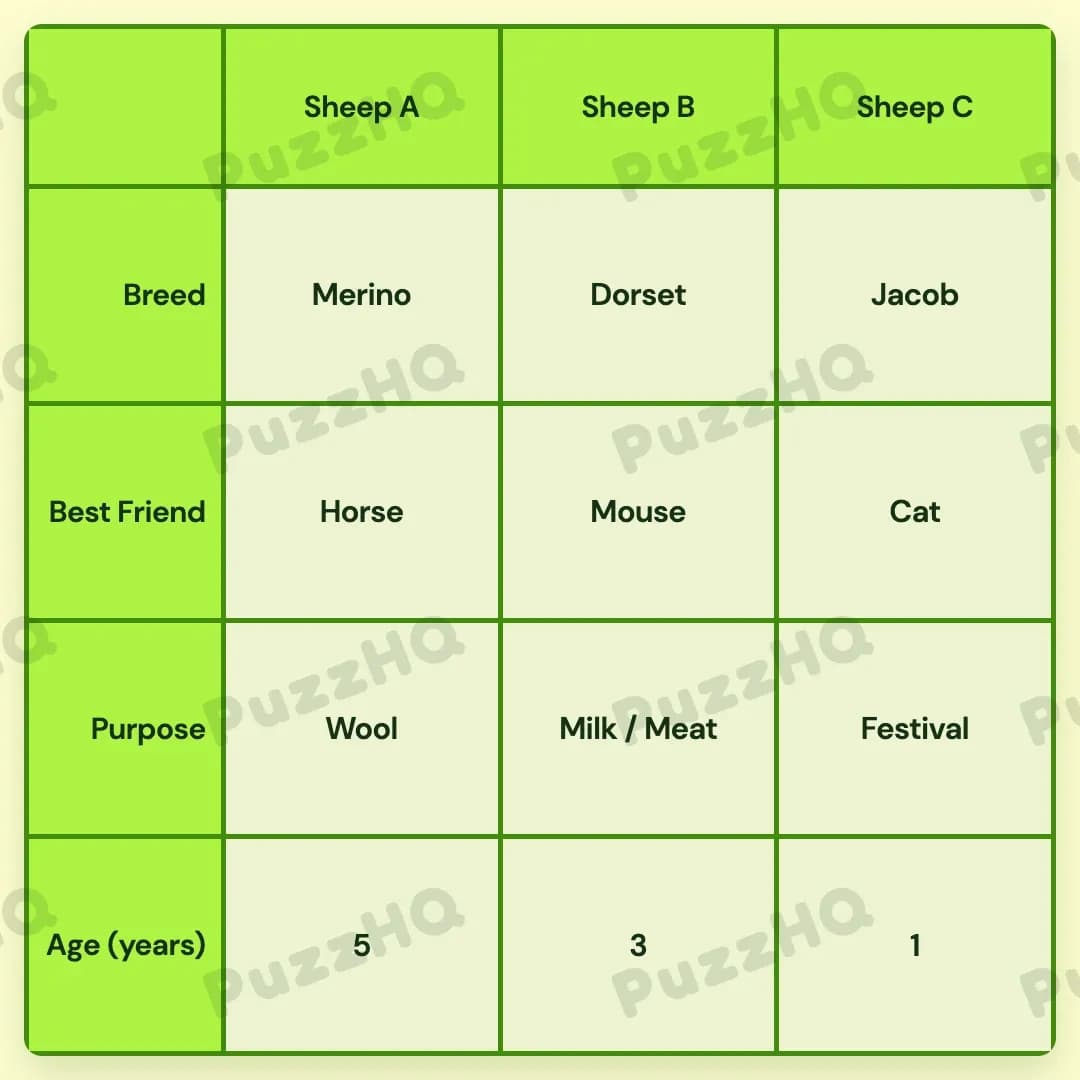
Every sheep finds its exact identity once breed placement unlocks the ages, friendships, and agricultural purposes across the pasture.
| Trait | Sheep A | Sheep B | Sheep C |
|---|---|---|---|
| Breed | Merino | Dorset | Jacob |
| Best Friend | Horse | Mouse | Cat |
| Purpose | Wool | Milk / Meat | Festival |
| Age (years) | 5 | 3 | 1 |
Building The Grid By Trait
Starting with the Breed category gives the clearest path forward because spatial clues immediately lock the sheep into their physical column layout.
Breed Establishes Positional Anchors
The puzzle opens with strong spatial constraints on breeds. We learn that Sheep B stands directly between a Merino sheep and a Jacob sheep. Because Sheep B occupies the center position, Sheep A and Sheep C must take Merino and Jacob in some order. That leaves Dorset as the only remaining breed for Sheep B.
To resolve the outer columns, we look at the clue noting that the sheep on the right possesses four horns. Polycerate, or multi-horned fleece, is the signature hallmark of a Jacob sheep. Because Sheep C is on the far right, Sheep C must be the Jacob sheep. Consequently, Sheep A is the Merino sheep. With all three breeds locked in place from left to right as Merino, Dorset, and Jacob, the breed row acts as a solid anchor for the rest of the deduction process.
Best Friend And Age Form A Direct Pair
Once breeds are set, clues relating animal companions to numerical ages allow both rows to be populated together. We are told that the Cat befriends a yearling, which is defined as a one to two year old sheep. This establishes a strict compound profile linking the Cat companion directly with the youngest age value, 1.
We know from another clue that Sheep A does not have the Cat as a best friend. Therefore, the Cat cannot belong to Sheep A. Furthermore, the Dorset sheep's friend stole cheese from the fridge, an unmistakable mouse trait that pairs the Mouse with Sheep B. With Sheep B paired with the Mouse and Sheep A excluded from having the Cat, Sheep C must be the sheep with the Cat best friend.
Assigning the Cat to Sheep C instantly resolves Sheep C's age as 1 year old, satisfying the yearling requirement. With the Mouse assigned to Sheep B and the Cat assigned to Sheep C, the remaining companion, the Horse, belongs to Sheep A.
For the remaining ages of 3 and 5, we look at production requirements. The oldest sheep is responsible for wool. Because Merino sheep are famous for wool production and Sheep A is the Merino, Sheep A must be the oldest sheep at 5 years old. That leaves the age of 3 years old for Sheep B in the middle. Both the Best Friend and Age rows are now completely filled.
Purpose Locks Down Through Production Constraints
With Breed, Best Friend, and Age solved, the Purpose row falls into place through elimination and known agricultural roles.
First, the clue stating that wool comes from the oldest sheep confirms that Sheep A, aged 5, has the purpose of Wool. This aligns with the clue highlighting the necessity of shearing Merino sheep to keep them cool.
Next, we evaluate the remaining two purposes, which are Milk / Meat and Festival. We are given the rule that the Jacob sheep does not produce milk. Because Sheep C is the Jacob sheep, Sheep C cannot hold the Milk / Meat purpose. Additionally, a sheep producing milk cannot be used for a festival. Therefore, Milk / Meat must belong to Sheep B, the Dorset sheep.
This leaves Festival as the only possible purpose for Sheep C. With that assignment, all four trait rows are fully accounted for across all three subjects.
Where The Trait Rows Intersect
Solving this puzzle relies on recognizing how distinct categories share cross-clue information to eliminate impossible combinations.
Connecting Physical Traits To Positional Order
The intersection of Breed and spatial placement solves the entire horizontal layout right at the start. The clue stating that Sheep B is between a Merino and a Jacob sets up an alternating structure, but it does not specify which end is which. By connecting the clue about four horns to the rightmost column, the Jacob breed is pinned to Sheep C. This single cross connection immediately determines Sheep A as the Merino and Sheep B as the Dorset, providing fixed references for all subsequent clues.
Linking Friends To Age Constraints
The connection between the Best Friend category and the Age category serves as the central bridge for the middle of the puzzle. The definition of a yearling links the Cat directly to an age of 1 year old. Rather than floating as two separate unknowns, they act as a single bundled block. When elimination rules keep the Cat away from Sheep A, and cheese theft ties the Mouse to Sheep B, the combined Cat and 1-year-old block snaps cleanly into Sheep C.
Using Age And Breed To Lock In Purpose
The final step relies on intersecting the Age and Breed rows with the Purpose row. Knowing that the oldest sheep produces wool lets us link the maximum age of 5 directly to the Wool purpose on Sheep A. From there, breed-specific restrictions rule out milk production for the Jacob sheep on Sheep C, neatly directing Milk / Meat to Sheep B and Festival to Sheep C.
Final Grid Check
Every row harmonizes with all puzzle clues without contradiction. Sheep A is a 5-year-old Merino producing wool with a horse companion. Sheep B is a 3-year-old Dorset providing milk and meat alongside a mouse friend. Sheep C is a 1-year-old multi-horned Jacob destined for festival showcase alongside a cat friend. Each category interlocks seamlessly with the next to complete the pasture profile.
Comments