
Profile Perfect Level 108 Answer
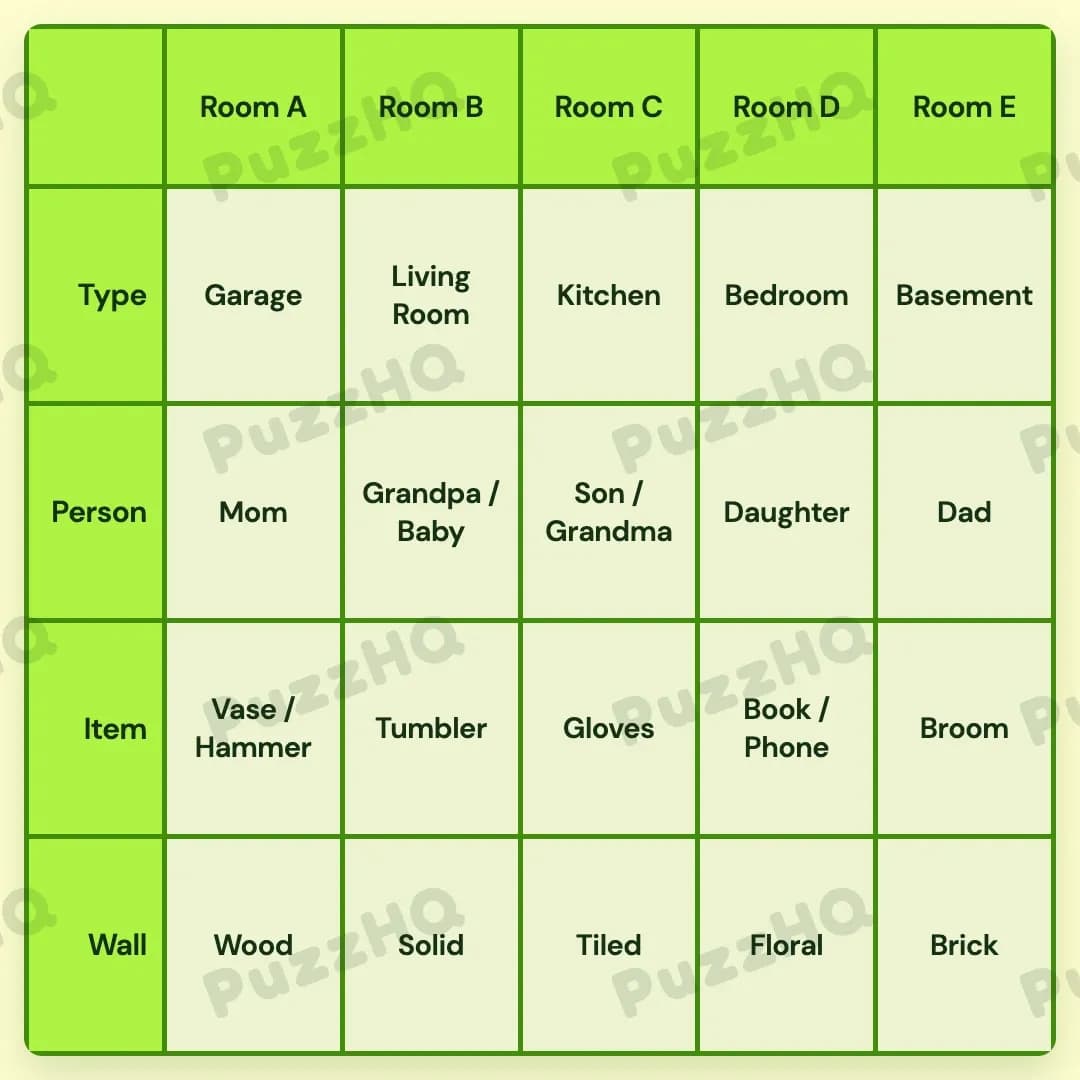
Here is the complete layout of the household, mapping every family member, item, room type, and wall texture to its proper location.
| Trait | Room A | Room B | Room C | Room D | Room E |
|---|---|---|---|---|---|
| Type | Garage | Living Room | Kitchen | Bedroom | Basement |
| Person | Mom | Grandpa / Baby | Son / Grandma | Daughter | Dad |
| Item | Vase / Hammer | Tumbler | Gloves | Book / Phone | Broom |
| Wall | Wood | Solid | Tiled | Floral | Brick |
The Logic Behind Profile Perfect Level 108
Everything in this puzzle flows from the center outward, using spatial spacing as the primary anchor. Once you place the Son right in the middle room, the distances mentioned across the house set up an orderly chain reaction. From that single midpoint, structural features like the basement and garage lock into position, quickly allowing the household items and family routines to fall into place.
The Floor Plan Establishes the Outer Wings
The solve begins in the center. We are told the Son is currently occupying the middle room, which firmly places him in Room C. Right away, this gives us a measuring stick for the rest of the building.
The brick-walled basement is located two columns away from the Son. From Room C, two columns away could technically point toward Room A on the far left or Room E on the far right. However, another observation establishes that Room A is already the Garage. That leaves Room E as the only possible location for the Basement with its brick wall finish.
With Room A settled as the Garage and Room E as the Basement, the family assignments begin to clear up. We know either Mom or Dad is in Room A, but a separate remark mentions Mom calling out to Dad while he is down in the Basement. That places Dad in Room E, which immediately leaves Mom in Room A. Since Dad has spent the morning sweeping, the Broom belongs with him in Room E.
The Item Sequence Resolves from Right to Left
Once the Broom is pinned to Room E, the chain of household items begins to assemble smoothly. We learn that two items and one room sit between the Gloves and the Broom. Working backward from Room E, skipping Room D places the Gloves directly in Room C with the Son.
Next, the Gloves are described as resting between the Tumbler and the Book. With the Gloves in Room C, the Tumbler must sit to the left in Room B, and the Book must sit to the right in Room D.
Because Grandpa is crafting a drink with his Tumbler, he joins Room B. The remaining objects also find their spots through direct association. The Book shares its space with another item, placing the Phone alongside it in Room D. Meanwhile, the room with the wooden wall holds a Vase. The baby sits to the right of the room where the Hammer is kept, placing the Hammer in Room A and the Baby alongside Grandpa in Room B.
Architectural Finishes Settle the Room Identities
With the items and primary residents lined up, the wall styles help reveal the remaining room types. We are told the neighbor of the room containing the Vase is next to the tiled wall. With the Vase and its wooden wall stationed in Room A, its neighbor is Room B, meaning Room C must have the tiled wall.
The tiled wall is adjacent to the floral wall but cannot touch the wooden wall. Room C is already tiled, and since Room A is wood, Room D must take the floral pattern. That leaves the solid wall for Room B, completing the wall textures from left to right.
Finally, we turn to the daily activities to finish identifying the rooms and remaining family members. The Daughter does not accompany the Son in cooking, which tells us the Son is in the Kitchen in Room C while Grandma stays with him. The Daughter occupies Room D. Dad is located to the right of the room where someone is sleeping, which means Room D serves as the Bedroom. That leaves Room B to serve as the Living Room, neatly wrapping up the entire household.
The Clue I Would Read Twice
The most deceptively constructed clue in the puzzle is the spatial condition between the Gloves and the Broom: "2 items and 1 room are between Gloves and Broom."
At first glance, it is easy to misinterpret the phrase as requiring a three-space gap if you mistakenly count the items and rooms as separate consecutive columns. In reality, the phrasing describes the exact same gap from two perspectives. Moving from Room E to Room C skips exactly one room, Room D, which happens to contain two items. Recognizing that the clue was describing the contents of the intervening space rather than an impossible distance keeps the entire item layout aligned.
Final Thoughts
What makes Level 108 particularly satisfying is how neatly it mirrors real-world domestic layout. Instead of relying on isolated guessing, every single piece of information links back to the central axis in Room C. The interplay between physical architectural details and ordinary family routines gives the solve an enjoyable, grounded rhythm from the first deduction to the last.
Comments