
Profile Perfect Level 147 Answer
Every ambulance is identified by pairing vehicle builds with siren colors before routing drivers to their designated locations.
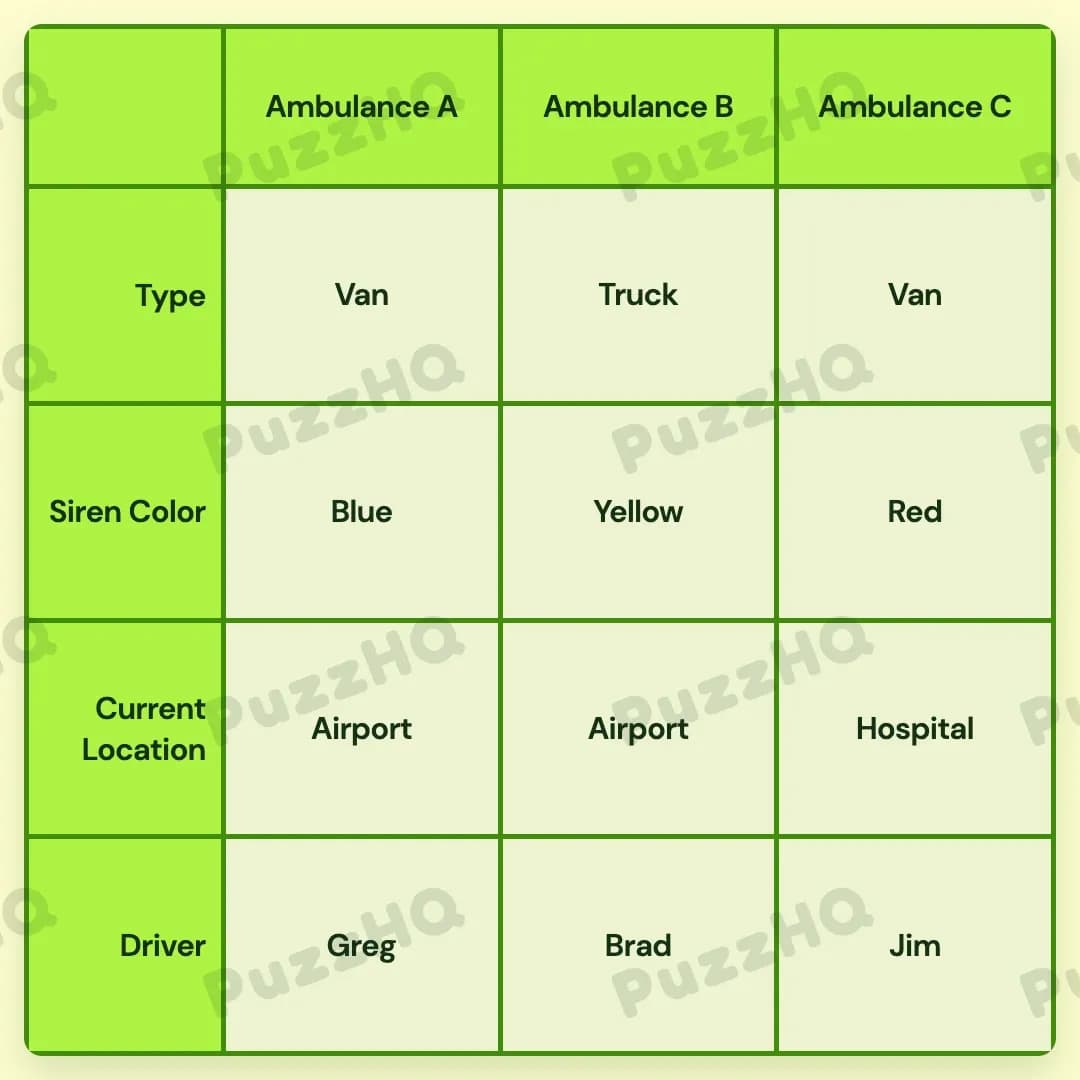
| Trait | Ambulance A | Ambulance B | Ambulance C |
|---|---|---|---|
| Type | Van | Truck | Van |
| Siren Color | Blue | Yellow | Red |
| Current Location | Airport | Airport | Hospital |
| Driver | Greg | Brad | Jim |
Building The Grid By Trait
Starting with the vehicle types and siren colors creates a reliable structural baseline. Because siren colors and physical vehicle models are directly linked by specific clues, sorting out these visual traits first makes placing drivers and their destination locations much more straightforward.
Type And Siren Color Establish Key Anchors
The puzzle provides clear physical details about the vehicles in the fleet. We learn immediately that the truck has a siren that flashes yellow. In addition, we know that the fleet consists of one truck and two vans. This means that whichever ambulance is identified as the truck must also take the yellow siren.
A positional rule specifies that the red siren cannot be to the left of the yellow siren. In a three column layout consisting of Ambulance A, Ambulance B, and Ambulance C from left to right, placing the yellow siren on Ambulance C would leave no legal position to the right for the red siren. Placing the yellow siren on Ambulance A would force the red siren to appear on Ambulance B or Ambulance C, but further clues about drivers and locations demonstrate that Ambulance B holds the central position for the truck.
With the yellow siren assigned to the truck at Ambulance B, the red siren must be situated to its right, locking the red siren onto Ambulance C. This leaves the blue siren as the only remaining choice for Ambulance A. Since the truck is established at Ambulance B with the yellow siren, both Ambulance A and Ambulance C take the van type.
Driver Assignments Distribute Across The Fleet
With the vehicle types settled, the driver roster can be sorted using clues that connect individual names to specific vehicle types and responsibilities. The clues introduce three drivers: Greg, Brad, and Jim.
We are told that Greg drives one of the vans. Since vans occupy Ambulance A and Ambulance C, Greg must be assigned to one of those two columns. Meanwhile, Brad is waiting for a VIP patient, and Jim is actively searching for parking. Because only the truck driver maintains a mustache, and neither Greg nor Jim is connected to the truck, the driver roles start falling into place.
Brad takes the role of the truck driver at Ambulance B. With Brad driving Ambulance B, the remaining two drivers belong to the two vans. Jim is searching for parking at the hospital, while Brad is waiting at the airport. This directly separates the drivers between the available vehicles and lines them up with the location category.
Current Location Completes The Operational Setup
The location trait tracks where each unit is operating, dividing the fleet between the airport and the hospital. The clue statements provide explicit location assignments for two of the drivers.
Brad is waiting at the airport for a VIP patient arrival, which places Ambulance B at the airport. Jim is looking for a parking spot at the hospital, which places his vehicle at the hospital. Since Greg drives the other van and Jim is at the hospital, Jim must be operating Ambulance C at the hospital, while Greg operates Ambulance A at the airport.
This completes the location row by assigning the airport to Ambulance A, the airport to Ambulance B, and the hospital to Ambulance C. Every trait row now matches the designated columns without any contradictory overlaps.
Where The Trait Rows Intersect
Linking Vehicle Type Directly To Siren Color
The rule stating that the truck features a yellow siren is one of the most effective cross trait connections in the puzzle. Instead of attempting to guess driver names or positions independently, this direct pairing collapses two separate categories into a single unit. Knowing that truck and yellow siren must occupy the exact same subject column immediately reduces the possible configurations for both the vehicle type row and the siren color row.
Positional Siren Constraints Guiding Vehicle Type Placement
The siren color constraint stating that the red siren cannot be to the left of the yellow siren acts as a bridge between the physical traits and the column order. Because the yellow siren belongs strictly to the truck, the positional rule for the red siren also dictates where the truck can legally sit relative to the vans. This intersection prevents Ambulance C from being the truck, ensuring that the central slot, Ambulance B, becomes the truck while Ambulance C takes the red siren and the van type.
Pairing Drivers With Locations To Determine Vehicle Assignments
The connection between drivers and locations provides the final alignment across the grid. Jim is tied to the hospital, while Greg drives a van and Brad waits at the airport. Because Ambulance C is established as a van with a red siren at the hospital, Jim perfectly fits Ambulance C. This leaves Greg at Ambulance A in the other van at the airport, and Brad at Ambulance B in the truck at the airport. The cross connection between driver names and active locations neatly settles all remaining subject columns.
Final Grid Check
Every category cleanly reinforces the others across all three vehicles. Ambulance A is a van flashing a blue siren, stationed at the airport with Greg at the wheel. Ambulance B is the lone truck flashing a yellow siren, held at the airport by Brad. Ambulance C serves as the second van, flashing a red siren to the right of the yellow one, with Jim managing parking at the hospital. All clues and positional restrictions are satisfied simultaneously.
Comments