
Profile Perfect Level 226 Answer
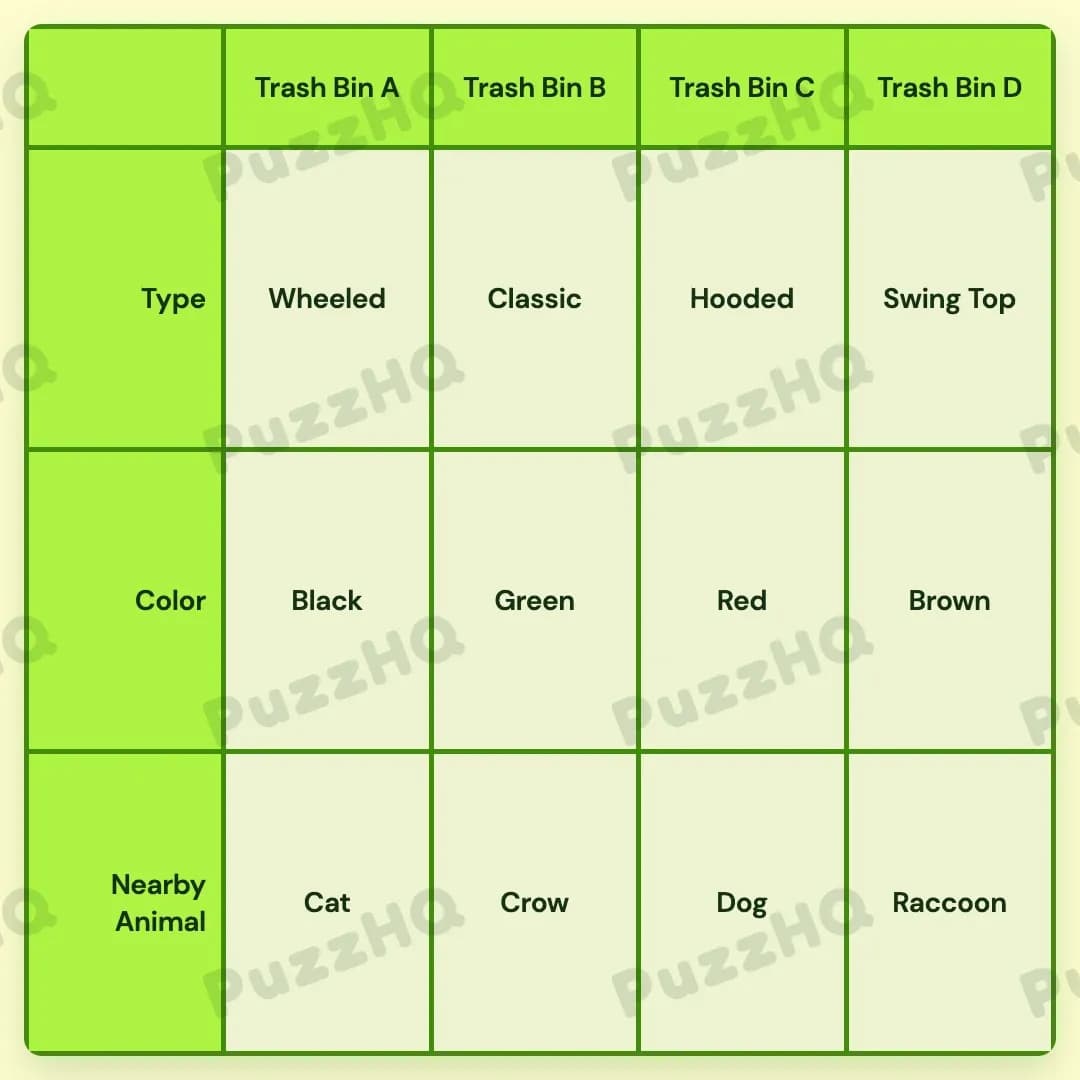
Trash Bin A is a Black Wheeled bin with a Cat, Trash Bin B is a Green Classic bin with a Crow, Trash Bin C is a Red Hooded bin with a Dog, and Trash Bin D is a Brown Swing Top bin with a Raccoon.
| Trait | Trash Bin A | Trash Bin B | Trash Bin C | Trash Bin D |
|---|---|---|---|---|
| Type | Wheeled | Classic | Hooded | Swing Top |
| Color | Black | Green | Red | Brown |
| Nearby Animal | Cat | Crow | Dog | Raccoon |
How To Think Through Profile Perfect Level 226
The most effective habit for this puzzle is using fixed physical positions to anchor multi trait pairs before resolving relative sequences. When a clue defines a specific slot on the board, placing those traits immediately narrows down where paired attributes and adjacent items can fit.
Start With Direct Placement: Anchor Trash Bin A
Direct positional clues give you an immediate foundation. Instead of juggling multiple possible locations, you can lock traits into place right away.
Look at the third clue:
- A Cat is scavenging food near the leftmost Black bin
Because Trash Bin A is the leftmost bin in the lineup, this single clue establishes two traits simultaneously:
- Trash Bin A's color is Black.
- Trash Bin A's nearby animal is Cat.
Locking Trash Bin A gives you a solid boundary on the left side of the grid. Any clue referring to the Black bin now directly refers to Trash Bin A, and the Cat is fully settled.
Combine Linked Traits With Negative Eliminations: Place The Red Hooded Bin
When two traits are tied together, treat them as a single combined block. You can then test which subjects are allowed to hold that entire block.
Consider these two clues together:
- The Red bin is a Hooded trash bin.
- The Hooded type is not Trash Bin A or D.
The fourth clue binds Red and Hooded into one unit. Wherever Hooded goes, Red must go as well.
The second clue explicitly eliminates Trash Bin A and Trash Bin D from being Hooded. Trash Bin A is already known to be Black, which also prevents it from being Red. That leaves only two possible spots for the Red Hooded pair: Trash Bin B or Trash Bin C.
By merging the two clues into a combined requirement, you reduce four possible positions down to just two.
Apply Positional Adjacency: Sequence The Dog And Raccoon
Adjacency clues restrict where pairs of items can sit relative to one another. They become much easier to place once other subjects are occupied.
Look at the sixth clue:
- Dog is near the bin to the left where Raccoon is.
This means Dog and Raccoon must occupy adjacent bins in left to right order. With Cat already placed at Trash Bin A, the remaining available animal positions are Trash Bin B, Trash Bin C, and Trash Bin D.
There is only one valid animal left to fill the remaining open slot: Crow. Placing Crow at Trash Bin B allows Dog to sit at Trash Bin C directly to the left of Raccoon at Trash Bin D:
- Trash Bin B's nearby animal is Crow.
- Trash Bin C's nearby animal is Dog.
- Trash Bin D's nearby animal is Raccoon.
All four nearby animals are now completely solved.
Resolve Color Eliminations: Assign Green, Brown, And Red
Now that animal positions are fixed, you can use negative constraints to sort out the remaining colors.
Review the remaining color rules:
- Raccoon is not looking for food at the Green one.
- The Red bin is a Hooded trash bin.
Raccoon is at Trash Bin D, so Trash Bin D cannot be Green. Trash Bin A is already Black. That leaves only Trash Bin B and Trash Bin C as candidates for Green.
Because Trash Bin C holds the Red Hooded block, Trash Bin C is Red:
- Trash Bin C's color is Red.
- Trash Bin C's type is Hooded.
With Red and Black assigned, and Trash Bin D unable to be Green, Trash Bin B must take Green:
- Trash Bin B's color is Green.
The only remaining unassigned color is Brown, which belongs to the final open slot:
- Trash Bin D's color is Brown.
Fill The Final Types By Elimination: Place Swing Top, Classic, And Wheeled
Once colors and animals are locked, the remaining types resolve through simple elimination and negative clues.
Look at the fifth clue:
- The Swing Top trash bin color is not Black.
Trash Bin A is Black, so Trash Bin A cannot be the Swing Top type. Trash Bin B and Trash Bin C already have established identities or traits that rule them out. That leaves Trash Bin D for Swing Top:
- Trash Bin D's type is Swing Top.
Now review the remaining unassigned types: Wheeled and Classic. With Trash Bin A and Trash Bin B left to complete:
- Trash Bin A's type is Wheeled.
- Trash Bin B's type is Classic.
Every cell across all four subjects is now fully determined without guessing.
What This Level Teaches You
Treat Linked Traits As A Single Combined Unit
When a clue states that the Red bin is a Hooded bin, you should never evaluate Red and Hooded separately. Combining them into one item cuts down the number of open slots across the grid and makes negative clues twice as powerful.
Use Positional Boundaries To Anchor Floating Sequences
The pair consisting of Dog to the left of Raccoon could have fit into several arrangements at the start. Locking the Cat at the leftmost bin immediately eliminated one whole side of the board, forcing the adjacent pair into a clear, manageable position.
Rely On Negative Clues To Break Final Symmetries
Clues telling you where something cannot go are just as useful as positive placements. Knowing that Raccoon was not at the Green bin made it straightforward to separate Green and Brown once the other two colors were placed.
Final Thoughts
The key to solving Level 226 efficiently is anchoring the leftmost bin first and bundling paired traits together. Once you establish a fixed edge and treat linked attributes as single blocks, the neighbor relationships and negative eliminations fall into place naturally.
Comments