
Profile Perfect Level 229 Answer
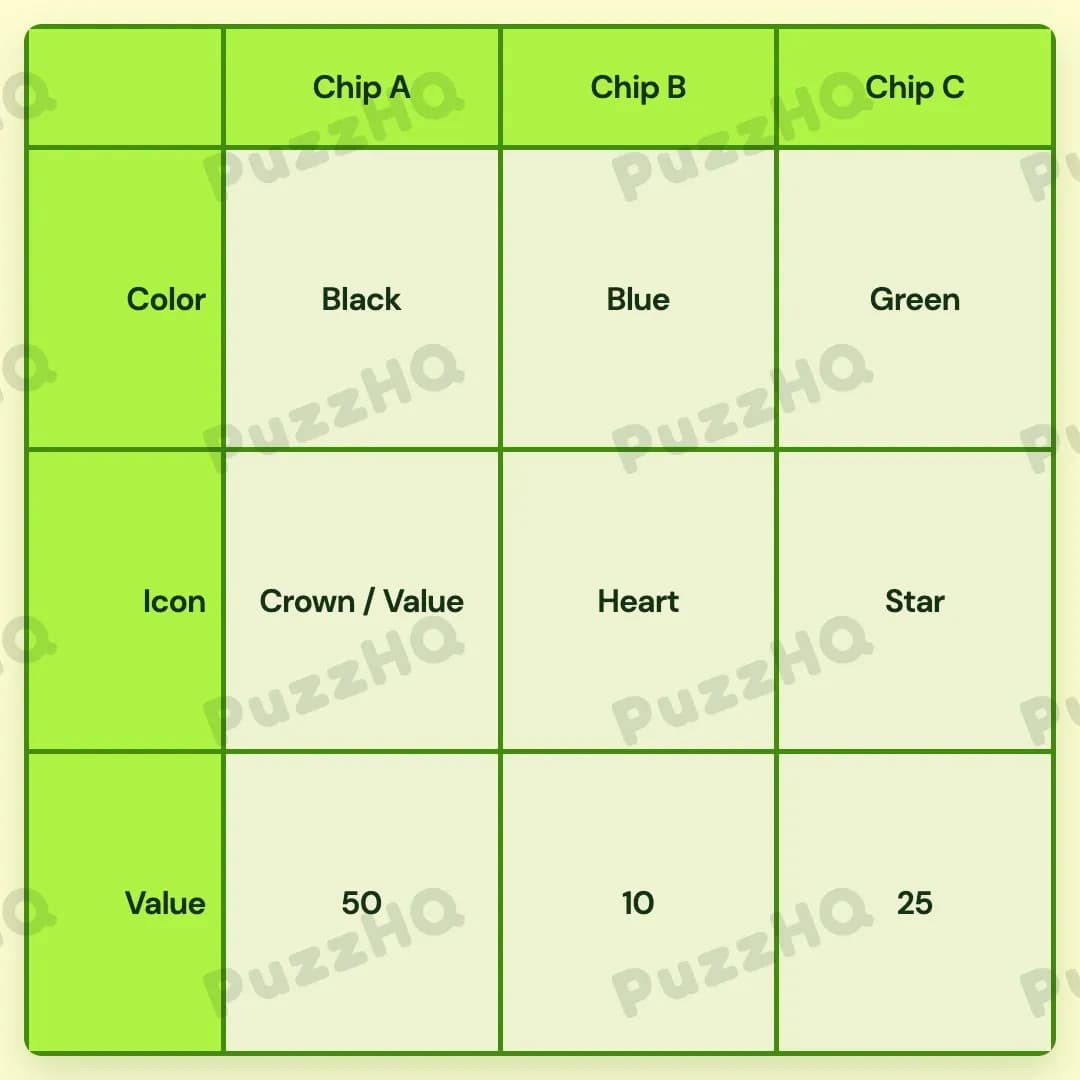
Before diving into the breakdown, here is the complete solution for Level 229.
| Trait | Chip A | Chip B | Chip C |
|---|---|---|---|
| Color | Black | Blue | Green |
| Icon | Crown / Value | Heart | Star |
| Value | 50 | 10 | 25 |
The Logic Behind Profile Perfect Level 229
This grid resolves quickly once you realize that the spatial clues dictate the colors and icons before the numerical values even enter the equation. The entire puzzle anchors itself firmly onto the leftmost position, which immediately forces a chain reaction across the remaining slots.
The Left Edge Sets The Stage
When looking across a row of three items, the ends provide the cleanest points of leverage. Here, we are told right away that the leftmost chip carries both the Crown icon and the specific number designation for the value trait. That immediately gives Chip A its primary identity.
From there, we look at what cannot belong on that first spot. The Crown icon cannot be placed on a green chip. At the same time, we know from another hint that the blue chip is paired directly with the Heart icon. Because Chip A is already locked to the Crown icon, Chip A cannot be the blue chip either.
With green and blue both ruled out for the first spot, only one color remains available for Chip A. The leftmost chip must be Black.
Colors And Icons Fall Into Place
Once Chip A is identified as Black, the color relationships establish the rest of the physical layout. We know that the black and blue chips sit right next to each other. Because Chip A is on the far left, its only possible neighbor is the middle position. Therefore, Chip B must be the blue chip.
That leaves only one slot open for the final color. Chip C takes Green by default.
With the colors settled across all three positions, assigning the remaining icons becomes straightforward. We already know that the blue chip carries the Heart icon, which places the Heart squarely on Chip B. That leaves just one icon unaccounted for across the board. The Star icon moves naturally into the open slot on Chip C.
At this halfway mark, every physical chip has a defined color and icon pairing without any guesswork.
Proportions And Neighbor Comparisons Settle The Numbers
With colors and icons mapped out, the remaining task is sorting out the numerical values across the three chips.
The arithmetic clues work in tandem here. We are told that the chip bearing the Star icon has a value that is exactly half of another chip in the lineup. Looking at the values in the grid, twenty-five is half of fifty. Since the Star icon belongs to Chip C, Chip C must take the value of 25, while the chip it draws its half-value from must be set to 50.
The only chip that can reasonably hold the larger base value of 50 is Chip A. Placing 50 on Chip A also aligns with the condition that the value written on the chip is higher than its neighbor's value. With Chip A at 50, its neighbor Chip B takes the remaining value of 10.
This satisfies every numerical relationship across the board. Chip C at 25 sits comfortably higher than its neighbor Chip B at 10, and Chip A at 50 is higher than Chip B as well, closing out the entire arrangement cleanly.
The Clue I Would Read Twice
The clue stating that the leftmost chip has a Crown icon and the number of the value is easy to skim past as simple setup text, but it does most of the heavy lifting in the early solve.
Because it binds both an icon and a positional trait to Chip A in a single phrase, it immediately restricts how the negative clues can be applied. Knowing that the Crown cannot be green instantly prevents Chip A from taking green, and knowing the blue chip holds a heart prevents Chip A from being blue. Without that single positional anchor holding the Crown in place, the color sequence could easily have drifted across multiple configurations before settling down.
Final Thoughts
What makes Level 229 pleasant to work through is how cleanly it divides into two distinct phases. The visual traits lock down the board through process of elimination, and once the chips are sitting in their proper spots, the values drop into place using simple relative math. It is a tidy, self-contained puzzle that rewards paying close attention to how position influences trait compatibility.
Comments