
Profile Perfect Level 238 Answer
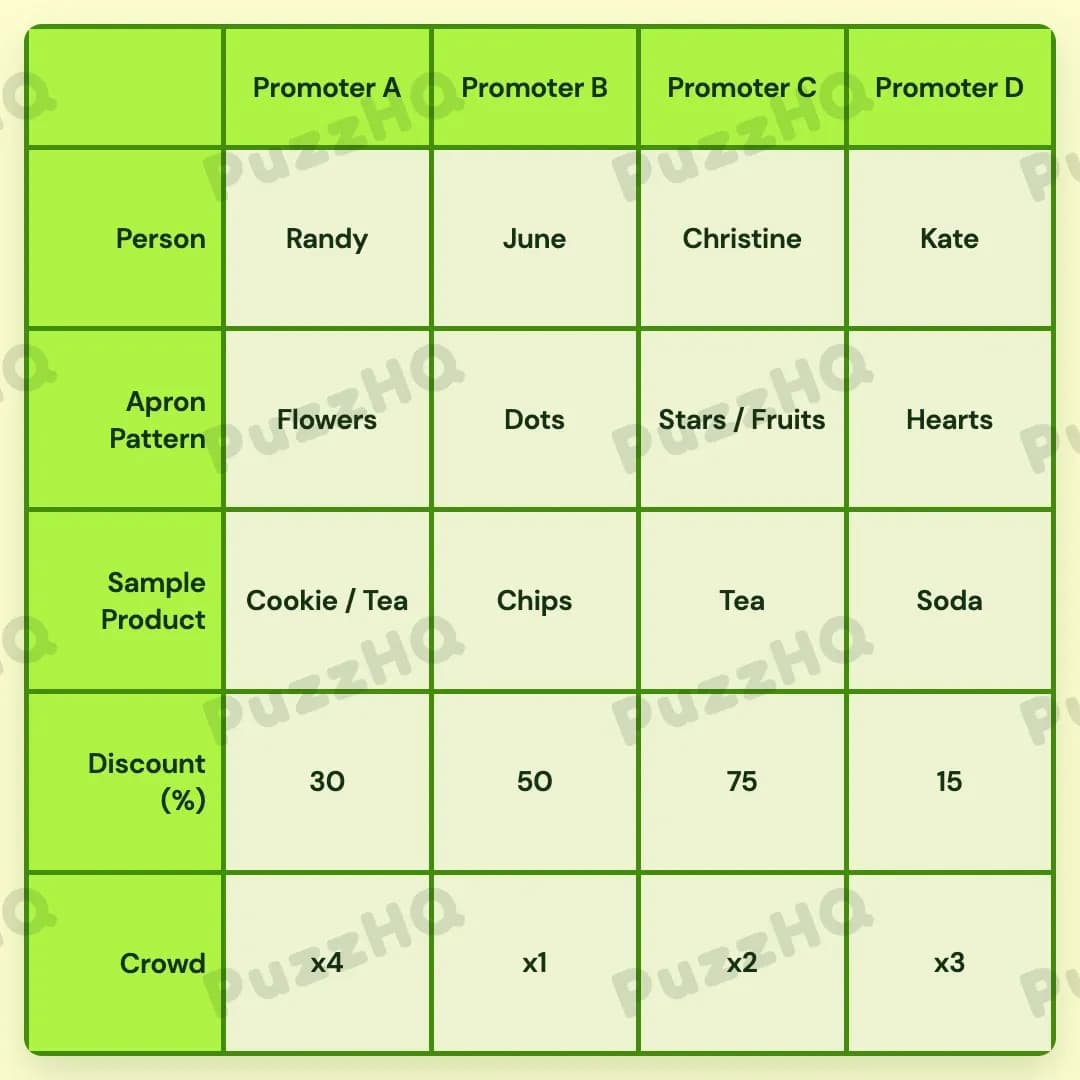
Here is the complete solution for all four promoters, their assigned patterns, sample products, discounts, and crowd multipliers.
| Trait | Promoter A | Promoter B | Promoter C | Promoter D |
|---|---|---|---|---|
| Person | Randy | June | Christine | Kate |
| Apron Pattern | Flowers | Dots | Stars / Fruits | Hearts |
| Sample Product | Cookie / Tea | Chips | Tea | Soda |
| Discount (%) | 30 | 50 | 75 | 15 |
| Crowd | x4 | x1 | x2 | x3 |
How To Think Through Profile Perfect Level 238
The key habit in this puzzle is establishing fixed edge positions first before trying to evaluate relative comparisons. When you lock down the outer columns, clues about middle positions, neighbor relationships, and column distances immediately become much easier to test and confirm.
Anchor The Outer Edges: Kate And The Rose Pattern
Begin by looking for clues that talk about absolute board locations or opposite sides of the layout.
Clue 7 mentions that a beautiful rose pattern is painted on the leftmost apron. Because Promoter A is on the far left, you can immediately assign Flowers to Promoter A.
Next, Clue 6 states that Kate is at the other end of Promoter A. Since Promoter A sits on the left end, the opposite end must be Promoter D on the far right. Place Kate directly into Promoter D.
Starting with edge positions gives you stable anchors on both ends of the row. This immediately eliminates guesswork about where the board begins and ends.
Combine Multi-Trait Details: Kate's Product And Discount
Once you have Kate locked into Promoter D, look for any clues that mention her by name to build out her full column in one step.
Clue 5 explains that the new fizzy drink Kate is promoting has a release sale of 15%. This gives you two traits at once for Promoter D:
- Sample Product: Soda (the fizzy drink)
- Discount (%): 15
Using multi-trait clues on an already fixed person is one of the quickest ways to complete an entire column. Promoter D now has Kate, Soda, and 15% discount filled in.
Use Distance And Sandwich Clues: Placing Products And The Dotted Apron
Now look at Clue 10 and Clue 3, which rely on spacing between columns.
Clue 10 notes that Cookie is 3 columns away from the right side. In a four-promoter layout, a separation of 3 columns can only exist between the first column (Promoter A) and the fourth column (Promoter D). Therefore, Promoter A is offering Cookie / Tea.
Next, examine Clue 3: the dotted apron is between promoters with Tea. For an apron to sit between two promoters giving out Tea, the dotted apron must occupy an interior spot with Tea on both sides. Promoter A offers Cookie / Tea, and Promoter C offers Tea. That leaves Promoter B squarely in the middle with the Dots pattern.
Because Promoter B has Dots and Promoter A has Flowers, look at the remaining apron patterns. Clue 4 mentions the apron with Hearts pattern is next to another spot, placing Hearts in Promoter D. That leaves Stars / Fruits for Promoter C.
Match Linked Person And Trait Clues: Christine's Stars And Top Discount
With patterns mostly mapped out, connect the person clues that reference these patterns.
Clue 9 states that Christine loves the Stars pattern on her apron. Promoter C has the Stars / Fruits pattern, so Christine must be Promoter C.
Now look at Clue 8: the promoter with the Fruits apron has the highest discount. Promoter C carries the Stars / Fruits apron, which means Promoter C must receive the highest discount value among the available options (15, 30, 50, 75). That means Promoter C gets 75%.
With Christine at Promoter C, Kate at Promoter D, and Promoter A needing a name, we turn to the remaining clues to identify the other two people.
Calculate Relative Crowd Sizes: Resolving Randy And June
Crowd sizes require comparative arithmetic across columns rather than direct identity statements.
Clue 1 notes that Promoter C gets very few crowd, but not the least. The available crowd multipliers are x1, x2, x3, and x4. If Promoter C has very few but is not the lowest, Promoter C must have a crowd multiplier of x2. The lowest value (x1) must belong to someone else.
Clue 2 states that Randy has more than twice the crowd of Promoter B.
- If Promoter B had x2, twice that would be x4, requiring Randy to have more than x4 (impossible).
- If Promoter B has x1, twice that is x2. For Randy to have more than twice that, Randy must have either x3 or x4.
- Since Promoter C is already x2 and Kate is at Promoter D, Randy must be Promoter A with a crowd multiplier of x4.
- This leaves Promoter B with a crowd multiplier of x1, and Promoter D with the remaining multiplier of x3.
Since Randy is Promoter A, the only person left without an assigned column is June, who takes Promoter B.
Fill The Final Values By Elimination
At this stage, almost every cell is complete:
- Promoter A: Randy, Flowers, Cookie / Tea, Crowd x4.
- Promoter B: June, Dots, Crowd x1.
- Promoter C: Christine, Stars / Fruits, Tea, Discount 75%, Crowd x2.
- Promoter D: Kate, Hearts, Soda, Discount 15%, Crowd x3.
For the sample products, Chips is the only item left unassigned, so it belongs to Promoter B.
For discounts, we have 15% at Promoter D and 75% at Promoter C. The remaining discounts are 30% and 50%. Looking across the remaining open spaces, 30% goes to Promoter A and 50% goes to Promoter B. The puzzle is now fully solved.
What This Level Teaches You
Positional Clues Outperform Relative Clues In The Opening
When beginning a logic grid, clues referencing ends, corners, or specific columns should be used before clues about comparative values. Placing Flowers at Promoter A and Kate at Promoter D established the entire frame of the board, making sandwich clues and distance clues simple to count.
Multi-Trait Statements Accelerate Single Columns
Clue 5 paired Kate, her product, and her discount percentage together. When you apply a multi-attribute clue to a subject whose seat is already known, you resolve multiple rows at once rather than scattering single notes across the board.
Inequality Clues Rely On Boundary Values
The crowd calculations depended on understanding minimum and maximum thresholds. Knowing Promoter C was not the lowest eliminated x1 for that column, which in turn forced x1 into Promoter B so that Randy could be more than double that amount at x4.
Final Thoughts
The most crucial solving habit in this level was anchoring the extreme ends of the board immediately. By securing Promoter A and Promoter D on the first move, every subsequent neighbor, distance, and sandwich clue fell into place without any need to test multiple branches.
Comments