
Profile Perfect Level 235 Answer
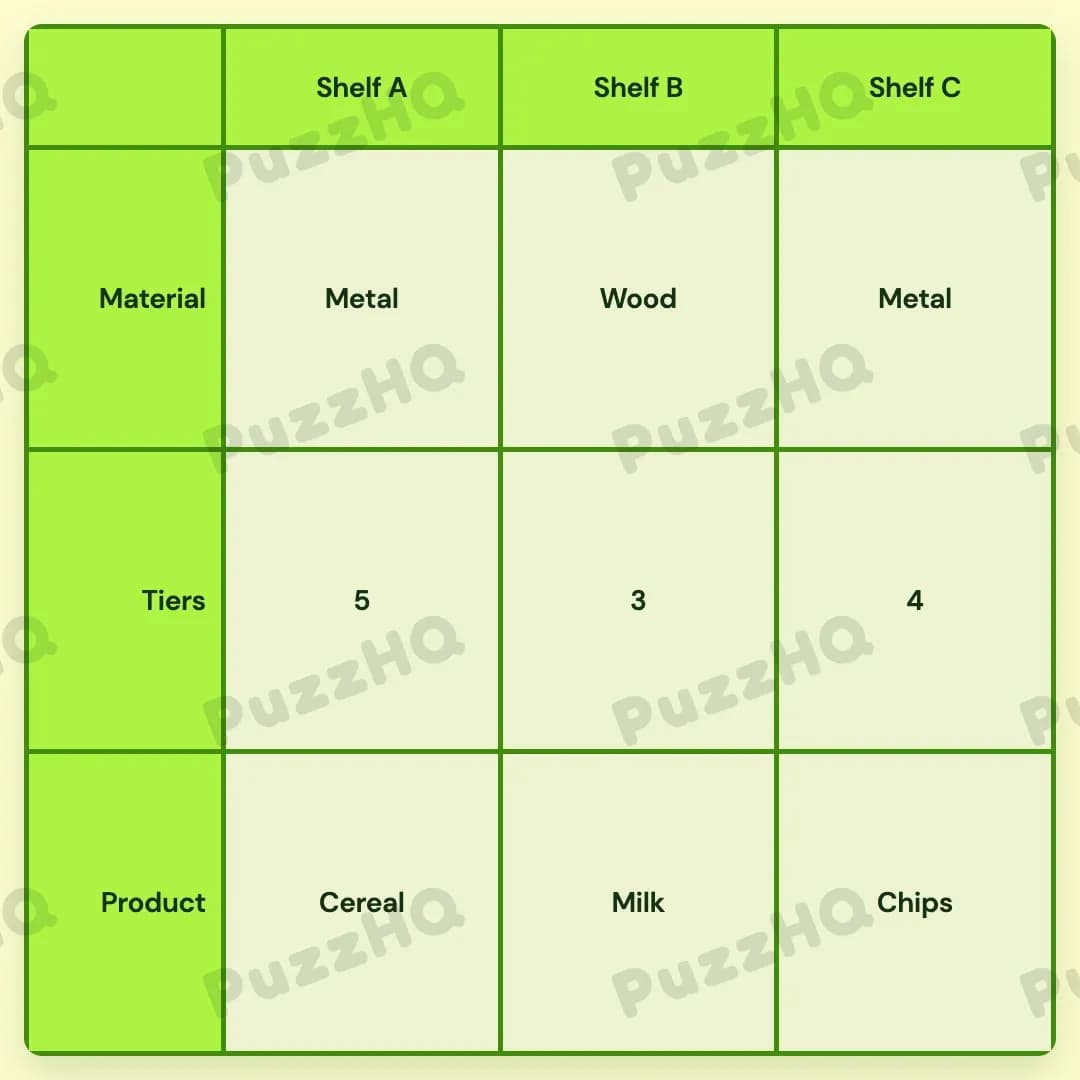
To solve Level 235, determine shelf capacities and positions first to unlock product assignments, then finish by deducing the material types from adjacency rules.
| Trait | Shelf A | Shelf B | Shelf C |
|---|---|---|---|
| Material | Metal | Wood | Metal |
| Tiers | 5 | 3 | 4 |
| Product | Cereal | Milk | Chips |
Building The Grid By Trait
The best starting point in this puzzle is the Tiers category. Because positional clues directly define tier heights and capacities across the physical layout, solving the Tiers row immediately creates a solid framework. Once the tier counts are fixed, product assignments follow quickly through elimination and size constraints, leaving the material assignments to be completed through adjacency logic.
Tiers Establish The Framework For Each Position
The shelf arrangement is laid out horizontally from left to right across Shelf A, Shelf B, and Shelf C. We can determine the exact tier counts by evaluating the comparative capacity statements.
First, we learn that the leftmost shelf has the most tiers. In this three shelf layout, Shelf A occupies the leftmost spot, which means Shelf A must be assigned the maximum tier count of 5.
Next, we are told that Shelf B can fit fewer items than the other two shelves. Since fitting the fewest items corresponds directly to having the smallest overall capacity, Shelf B receives the lowest tier count of 3.
With two positions firmly established, only one tier value remains unassigned. Shelf C takes the middle value of 4 tiers. This completes the entire Tiers row: Shelf A has 5 tiers, Shelf B has 3 tiers, and Shelf C has 4 tiers. Establishing these numbers gives us the necessary references to resolve the other categories.
Product Assignments Fall Into Place Using Capacity And Center Clues
With the physical structure and tier values resolved, we can turn to the Product row. The clues provide two vital negative constraints that narrow down which item belongs on which shelf.
We know from the clues that neither Cereal nor Chips is stored in the center shelf. Looking at our horizontal layout, Shelf B is the shelf in the center. Because both Cereal and Chips are eliminated from this central position, the only product left that can go on Shelf B is Milk.
Now we only have Cereal and Chips left to place between Shelf A and Shelf C. Another clue states that Chips is not found inside the biggest shelf. From our solved Tiers row, we know that Shelf A holds 5 tiers, making it the biggest shelf in the set. Since Chips cannot go into the biggest shelf, Chips cannot be on Shelf A.
This means Chips must be placed on Shelf C, which has 4 tiers. The remaining product, Cereal, must therefore belong to Shelf A. All three products are now fully locked: Cereal on Shelf A, Milk on Shelf B, and Chips on Shelf C.
Material Assignments Complete The Grid Using Tier Relationships
The final trait to resolve is Material, which consists of Metal and Wood. To determine which shelf is made of Wood, we look at the relationship between materials and tier values.
The puzzle states that the shelf with the fewest tiers is not beside the Wood shelf. From our earlier work on the Tiers category, we know that Shelf B is the shelf with the fewest tiers, having only 3 tiers. Shelf B is located in the middle position, meaning it is directly adjacent to both Shelf A on the left and Shelf C on the right.
If either Shelf A or Shelf C were made of Wood, then Shelf B would be directly beside the Wood shelf, violating the clue. The only logical way for the shelf with the fewest tiers not to be beside the Wood shelf is if Shelf B itself is the Wood shelf.
Because Shelf B is Wood, the remaining shelves must take the other available material. Therefore, Shelf A and Shelf C are both made of Metal. This completes the final trait row.
Where The Trait Rows Intersect
Solving logic puzzles efficiently requires understanding how traits interact across categories rather than examining traits in total isolation. In this puzzle, multiple cross category intersections make solving straightforward.
Linking Tier Extremes To Eliminate Food Items
The clue stating that Chips is not found inside the biggest shelf creates a bridge between the Tiers row and the Product row. Without knowing which shelf holds the most tiers, the restriction on Chips cannot be applied to a specific shelf. Once the Tiers category identifies Shelf A as the 5 tier shelf, this restriction instantly rules out Shelf A for Chips, allowing us to place Chips on Shelf C and Cereal on Shelf A without guessing.
Position Rules Isolating The Dairy Product
The clue stating that Cereal and Chips are not inside the center shelf connects spatial layout directly to the Product trait. By identifying Shelf B as the middle subject, two of the three food items are eliminated at once. This single positional clue isolates Milk onto Shelf B early in the solving process, reducing the remaining product choices to a simple binary decision.
Adjacency And Tier Minimums Pinpointing Material
The statement that the shelf with the fewest tiers is not beside the Wood shelf connects Tiers and Material through physical adjacency. Because Shelf B is both the center shelf and the shelf with the minimum number of tiers, it touches every other shelf in the line. Recognizing this connection proves that neither neighbor can be Wood, which forces Wood onto Shelf B and Metal onto Shelf A and Shelf C.
Final Grid Check
Every category now aligns seamlessly with all puzzle clues. Shelf A sits on the left with 5 tiers, holding Cereal in a Metal structure. Shelf B sits in the center with 3 tiers, holding Milk in a Wood structure, fitting fewer items than its neighbors and keeping Wood from being adjacent to the smallest tier count. Shelf C completes the setup on the right with 4 tiers, holding Chips in a Metal build. Every constraint is satisfied, confirming the solution is accurate.
Comments