
Profile Perfect Level 265 Answer
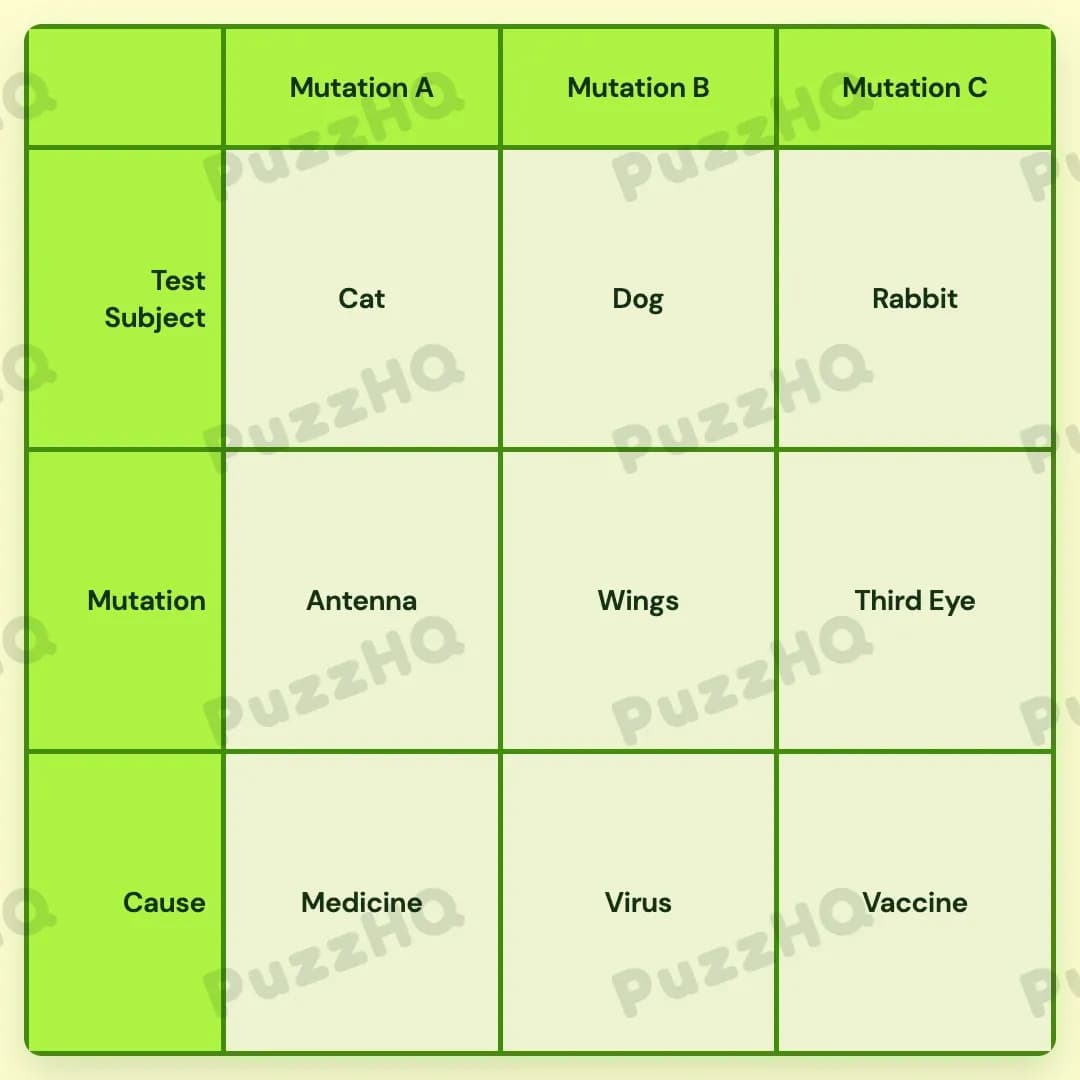
A careful look at medical triggers and physical transformations reveals how each test subject developed its unique trait.
| Trait | Mutation A | Mutation B | Mutation C |
|---|---|---|---|
| Test Subject | Cat | Dog | Rabbit |
| Mutation | Antenna | Wings | Third Eye |
| Cause | Medicine | Virus | Vaccine |
The Logic Behind Profile Perfect Level 265
Solving this puzzle comes down to an early positional anchor that quickly binds an animal to its treatment, leaving the remaining two subjects to be separated through clean negative deductions. Once the physical positions and causes settle, the resulting anatomical changes fall into place almost on their own.
Anchoring The Left Column With The First Subject
The solve begins cleanly on the left side of the board. We are told directly that the leftmost mutation accidentally happened to the feline. That gives Mutation A its test subject immediately: the Cat.
With the Cat secured in the first column, another piece of its background quickly connects. The sick feline had been taking a prescription prior to changing. In our list of underlying triggers, a prescription points straight to Medicine. Just like that, Mutation A possesses both its animal and its cause.
This early pair gives the rest of the board stability. We do not have to wonder where the Cat belongs or whether Medicine might drift into the middle or right columns. Everything about Mutation A is half-finished right at the opening bell, allowing us to evaluate the remaining two subjects against a much smaller field of possibilities.
Negative Clues Untangle The Remaining Animals
With the Cat fixed in Mutation A, the Dog and the Rabbit are left competing for Mutation B and Mutation C. Here, the process shifts from direct placement to careful elimination.
We learn that the Vaccine was not administered into the Dog. Since Medicine is already locked to the Cat in column A, the Vaccine can only belong to Mutation B or Mutation C. Knowing the Dog cannot have received the Vaccine means the Dog cannot inhabit whichever column holds the Vaccine.
At the same time, we have a clear hint regarding Animal C, noting that it can now spot danger much more easily than others of its kind. Enhanced sensory awareness points directly to the Third Eye. We also know that the Dog does not gain a Third Eye. That single negative rule keeps the Dog out of Mutation C.
Because the Dog cannot take the Third Eye in Mutation C, the Dog must belong in Mutation B. That leaves Mutation C to the Rabbit.
Following the thread back to the causes, the Vaccine cannot belong to the Dog in Mutation B, which forces the Vaccine into Mutation C alongside the Rabbit. That leaves only one remaining trigger for Mutation B: the Virus. The subject row and the cause row are now completely filled across all three columns.
The Transformations Fall In Line
The final stage is matching the specific physical mutations to the animals that developed them.
We already deduced from the danger spotting clue that Mutation C involves the Third Eye, perfectly matching the Rabbit that took the Vaccine.
From there, we turn to the viral trigger sitting in Mutation B. We are told that a new Virus makes its subject rival the Pegasus. A Pegasus is legendary for flight, pointing directly to Wings. Placing Wings under Mutation B matches the Dog with its viral transformation.
Only one physical mutation remains unassigned. With Wings belonging to the Dog and the Third Eye belonging to the Rabbit, the Antenna must belong to the Cat under Mutation A. The entire grid resolves without a single contradiction.
The Clue I Would Read Twice
The clue stating that Animal C can now spot danger more easily than others of its kind deserves a second look because it serves two distinct purposes at once. On the surface, it describes an anatomical transformation, pointing clearly toward the Third Eye rather than Wings or an Antenna. Beneath that, it specifically names Animal C, immediately tying that visual trait to the third column.
When paired with the restriction that the Dog never receives a Third Eye, this single sentence does double duty. It establishes the physical change for the rightmost column while simultaneously steering the Dog straight into Mutation B. It is the hinge upon which the entire second half of the puzzle turns.
Final Thoughts
What makes this level fun is how briskly the deductions chain together once the first column is solved. The puzzle never demands wild leaps of intuition. Instead, it rewards players who take a direct clue about a feline, lock down the leftmost column, and let simple process of elimination do the heavy lifting across the rest of the board.
Comments