
Profile Perfect Level 319 Answer
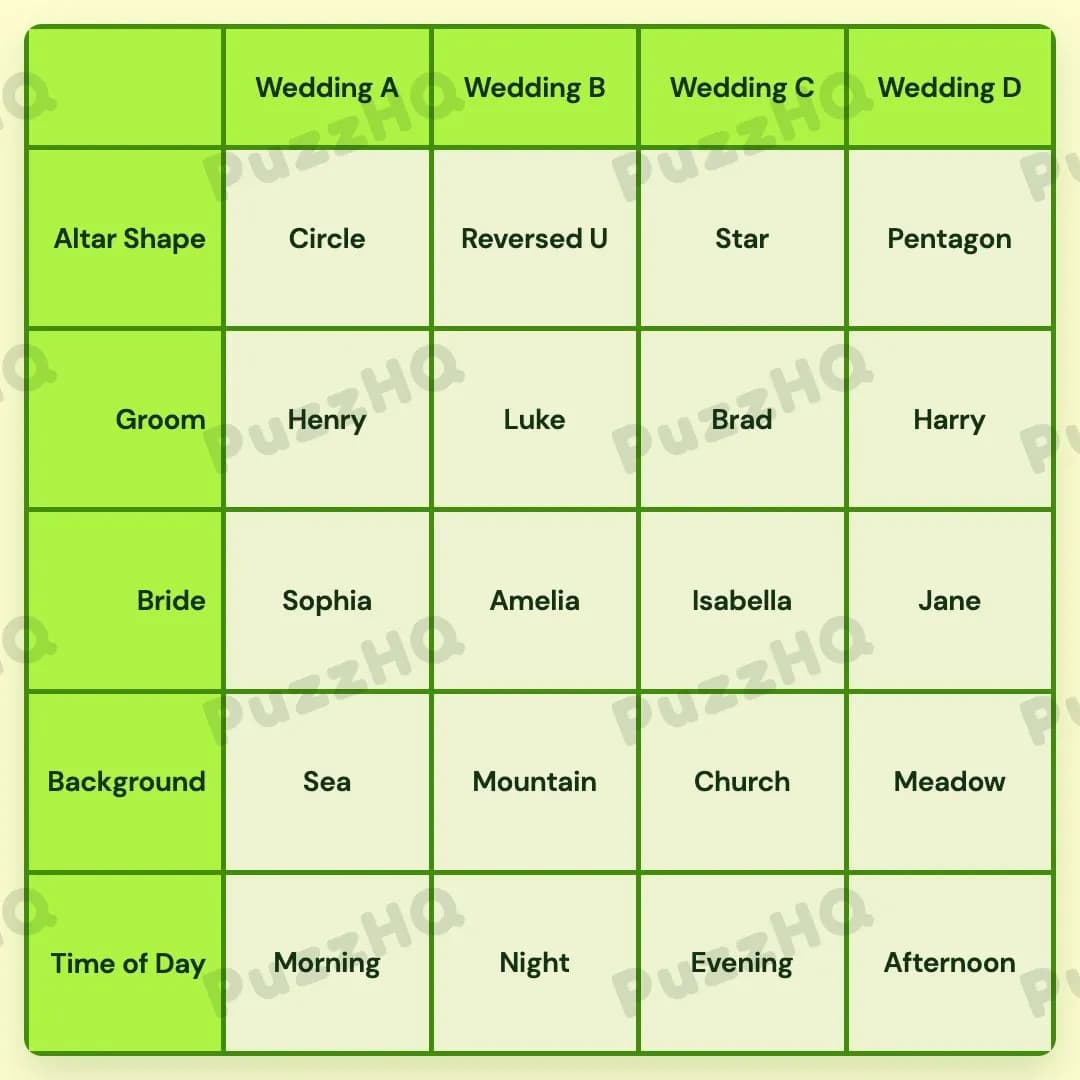
By establishing the boundary positions for the altar shapes and backgrounds first, you can quickly align the ceremony times, grooms, and brides across all four weddings.
| Trait | Wedding A | Wedding B | Wedding C | Wedding D |
|---|---|---|---|---|
| Altar Shape | Circle | Reversed U | Star | Pentagon |
| Groom | Henry | Luke | Brad | Harry |
| Bride | Sophia | Amelia | Isabella | Jane |
| Background | Sea | Mountain | Church | Meadow |
| Time of Day | Morning | Night | Evening | Afternoon |
Building The Grid By Trait
The clearest way to unlock this puzzle is to focus on physical settings first. Altar Shape and Background share direct geographical clues that establish the outer edges of the line, creating fixed reference points for the remaining categories.
Altar Shape And Background Establish The Grid Anchors
The puzzle establishes immediate polarity along the layout through the shape of each altar and its surrounding scenery. We learn that the circle-shaped altar is positioned farthest away from the Pentagon altar. This immediately places the Circle and the Pentagon at the two outer ends of the sequence: Wedding A and Wedding D.
Several clues tie these altar shapes directly to background landscapes:
- The Circle altar faces the Sea. Because the Circle sits at Wedding A, the Sea background belongs to Wedding A.
- The Pentagon altar is described with a lush Meadow backdrop, placing the Meadow at Wedding D alongside the Pentagon altar.
- Wedding B is directly identified as taking place in the Himalayan mountain range, assigning the Mountain background to Wedding B.
- The Star-shaped altar is used for a religious ceremony, linking it to the Church background. With Wedding A, Wedding B, and Wedding D already holding their backgrounds, the Church must be placed at Wedding C, which simultaneously assigns the Star altar to Wedding C.
With Circle, Star, and Pentagon assigned to weddings A, C, and D, the remaining altar shape, Reversed U, slots naturally into Wedding B.
Time Of Day Locks The Remaining Settings
Once the backgrounds and altars are anchored, the ceremony schedules line up cleanly against them:
- The Circle altar by the Sea aligns with the rising sun in the Morning, locking the Morning time slot into Wedding A.
- The ceremony at the Pentagon altar takes place right before lunch, placing the Afternoon time slot at Wedding D.
- Brad desires his wedding kiss during the sunset, which designates Evening as his ceremony time. Since the religious ceremony at Wedding C is paired with an Evening sunset backdrop, Wedding C receives Evening.
- The sole remaining time slot is Night, which fits into Wedding B under the mountain skies.
Groom Placements Follow Distance And Timing
With times and locations fixed, the grooms can be positioned using distance clues and schedule preferences:
- Harry is identified as the groom farthest from the pelicans, which reside by the Sea at Wedding A. Being farthest from Wedding A means Harry belongs at Wedding D.
- Brad insists on a sunset kiss, matching the Evening time slot established at Wedding C.
- The remaining two grooms are Henry and Luke. With weddings C and D claimed by Brad and Harry, weddings A and B remain open.
- Clues referencing groom spacing and neighborhood arrangements confirm Henry at Wedding A by the Sea and Luke at Wedding B in the mountains.
Bride Assignments Complete The Rows
The brides are determined by their relationships to the established grooms, backgrounds, and positions:
- Isabella is separated from the Sea at Wedding A by exactly one groom. Counting one spot past Wedding A places Isabella at Wedding C.
- Sophia cannot be a neighbor of Brad, who is located at Wedding C. Brad's immediate neighbors are Wedding B and Wedding D. This rules Sophia out of Wedding B and Wedding D, placing her at Wedding A.
- Amelia is placed at Wedding B, leaving Jane to take the final open bride position at Wedding D.
Where The Trait Rows Intersect
The Circle Altar Connects Dawn And The Coastline
A pivotal multi-trait connection occurs when a single clue links the Circle altar, the Sea, and the Morning sunrise. Instead of treating the altar layout, background environment, and schedule as isolated tracks, this relationship locks all three traits into Wedding A at once. Establishing Wedding A as the coastal morning ceremony immediately provides the necessary reference point to calculate distances for grooms and brides further down the line.
The Meadow Behind The Pentagon Solidifies The Opposite End
Just as the Circle defines the beginning of the sequence, the Pentagon altar anchors the far end at Wedding D. Connecting the Pentagon to the lush Meadow and an early afternoon schedule gives Wedding D three complete attributes early in the deduction process. Knowing that Wedding D is the furthest point from the coastal setting allows distance clues, like locating the groom farthest from the pelicans, to resolve instantly without guesswork.
Separation Constraints Pinpoint The Wedding Couples
The bride placements rely heavily on the cross-connections between groom locations and spatial intervals. Because the Sea was fixed to Wedding A, the rule stating that Isabella sits one groom away from the Sea immediately pinpoints her at Wedding C. That placement, combined with Brad's sunset preference at Wedding C, reveals Brad and Isabella as a couple and creates the neighborhood restriction that isolates Sophia to Wedding A.
Final Grid Check
Every row in the completed grid harmonizes across all five categories. The geographic progression runs smoothly from the morning ceremony by the sea at Wedding A to the afternoon gathering in the meadow at Wedding D. The intermediate ceremonies at the mountain range and the church balance the timeline through night and evening. All spacing rules, altar shapes, and partner assignments agree with the clues without any internal contradictions.
Comments