
Profile Perfect Level 313 Answer
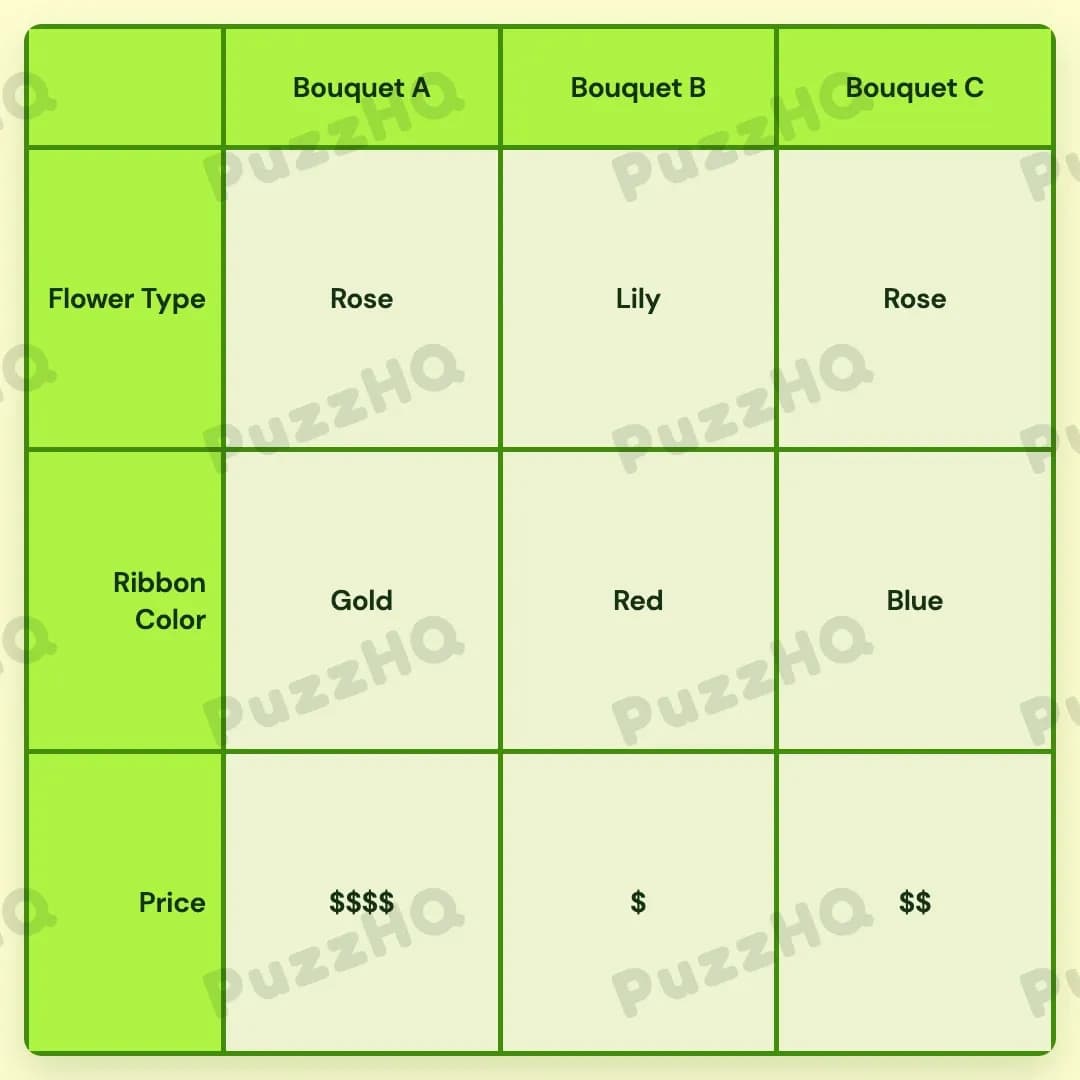
Bouquet A combines roses with a gold ribbon at the top price tier, Bouquet B pairs lilies with a red ribbon at the lowest price tier, and Bouquet C matches roses with a blue ribbon at the mid price tier.
| Trait | Bouquet A | Bouquet B | Bouquet C |
|---|---|---|---|
| Flower Type | Rose | Lily | Rose |
| Ribbon Color | Gold | Red | Blue |
| Price | $$$$ | $ | $$ |
Building The Grid By Trait
When approaching this layout, positional cues give us direct access to the price points and ribbon colors before we even need to touch the flower arrangements. Working through the traits in an order that builds from absolute spatial facts to relative color and price eliminations makes the entire puzzle snap together effortlessly.
Price Establishes The High And Low Ends
The price row serves as a reliable anchor because positional and relational clues narrow down the costs right away. We are told directly that the bouquet on the far left, Bouquet A, is the most expensive of the group. This instantly assigns the maximum price tier of four dollar signs to Bouquet A.
With Bouquet A locked into the highest cost, only the lowest price tier and the middle price tier remain to be placed. We learn from the clues that the cheapest bouquet cannot be sitting next to the one featuring lilies. Since Bouquet B occupies the middle position, it sits directly adjacent to both Bouquet A on its left and Bouquet C on its right.
If either Bouquet A or Bouquet C were the cheapest bouquet, it would be positioned directly beside the bouquet with lilies in the center. Consequently, neither Bouquet A nor Bouquet C can hold the lowest price tier. Bouquet A already has the highest price anyway, but this rule specifically prevents Bouquet C from being the cheapest.
Because neither outside position can be the cheapest option, Bouquet B must be the cheapest bouquet, receiving the single dollar sign tier. That leaves the remaining mid-range cost of two dollar signs to fill the only open spot in the price row, which belongs to Bouquet C. With just a few deductions, the entire price row is settled from left to right as four dollar signs, one dollar sign, and two dollar signs.
Ribbon Color Resolves Through Middle And Premium Constraints
Once the price row is established, the ribbon colors can be distributed by looking at position restrictions and value associations.
We know from the clue rules that the bouquet in the middle position does not use a gold ribbon or a blue ribbon. Because Bouquet B is in the middle, gold and blue are completely off the table for it. With gold and blue eliminated, Bouquet B has only one possible ribbon color left, which is red.
That leaves gold and blue to be split between Bouquet A on the left and Bouquet C on the right. Another clue clarifies that the blue ribbon is never used for the most premium bouquet. Because we already determined during the price analysis that Bouquet A is the most premium bouquet at four dollar signs, Bouquet A cannot have the blue ribbon.
With blue ruled out for Bouquet A, Bouquet A must receive the gold ribbon. That leaves the blue ribbon for Bouquet C. Just like that, the ribbon row is completely solved, giving us gold for Bouquet A, red for Bouquet B, and blue for Bouquet C.
Flower Type Finishes The Visual Profile
With price and ribbon choices locked across all three subjects, the flower type row becomes simple to resolve. The clue states that Bouquet B is the only bouquet without red flowers.
Lilies are the non-red option in the list, while roses represent the traditional red bloom. Because Bouquet B is specifically identified as the solitary bouquet lacking red flowers, Bouquet B must contain lilies.
Since Bouquet B is the only one without red flowers, every other bouquet must feature red flowers. This means that Bouquet A and Bouquet C both take roses as their flower type. The flower row is therefore complete with roses for Bouquet A, lilies for Bouquet B, and roses for Bouquet C.
Where The Trait Rows Intersect
Solving logic puzzles becomes much smoother when we notice how two separate traits rely on each other to eliminate possibilities. Here are the key cross-category junctions that made this layout click.
Premium Price And Ribbon Exclusion Determine Bouquet A
The relationship between the price row and the ribbon row provides the decisive clue needed to separate the remaining two ribbon colors. Once Bouquet A was established as the most expensive bouquet through the positional left-side clue, it inherited the title of the most premium bouquet.
The clue barring the blue ribbon from the most premium bouquet did not mention Bouquet A by name. Instead, it connected a ribbon trait to a price trait. Because we had already solved the price row, that connection translated directly into an elimination for Bouquet A. Without knowing which bouquet held the top price, the ribbon clue would have stayed ambiguous. Resolving price first gave the ribbon clue an exact target.
Flower Identity And Adjacency Direct The Cheapest Price
The price placement for the remaining two bouquets depended entirely on the relationship between flower types and spatial neighbors. The clue stated that the cheapest bouquet could not sit beside the bouquet with lilies.
Because Bouquet B was established as the non-red flower selection, it was guaranteed to hold the lilies. Since Bouquet B occupies the middle spot in a three-item row, every neighboring spot is beside it. If the cheapest price had been placed on Bouquet C, it would have violated the adjacency restriction by sitting right next to the lilies in Bouquet B.
Recognizing that the flower identity of the center bouquet blocked both neighboring slots from being the cheapest forced the single dollar sign into Bouquet B itself. This neat cross-trait interaction between flower identity and price tier made guessing completely unnecessary.
Final Grid Check
Every row in the final grid validates the surrounding clues seamlessly. Bouquet A sits on the left as the most expensive item with a gold ribbon and classic roses. Bouquet B occupies the center with lilies, a red ribbon, and the lowest price, perfectly matching its non-red flower status while avoiding gold or blue ribbons. Bouquet C rests on the right with roses, a blue ribbon, and a mid-tier price, safely avoiding any forbidden pairings with premium tags or neighboring restrictions. The traits support each other across every column to create a completely balanced solution.
Comments