
Profile Perfect Level 353 Answer
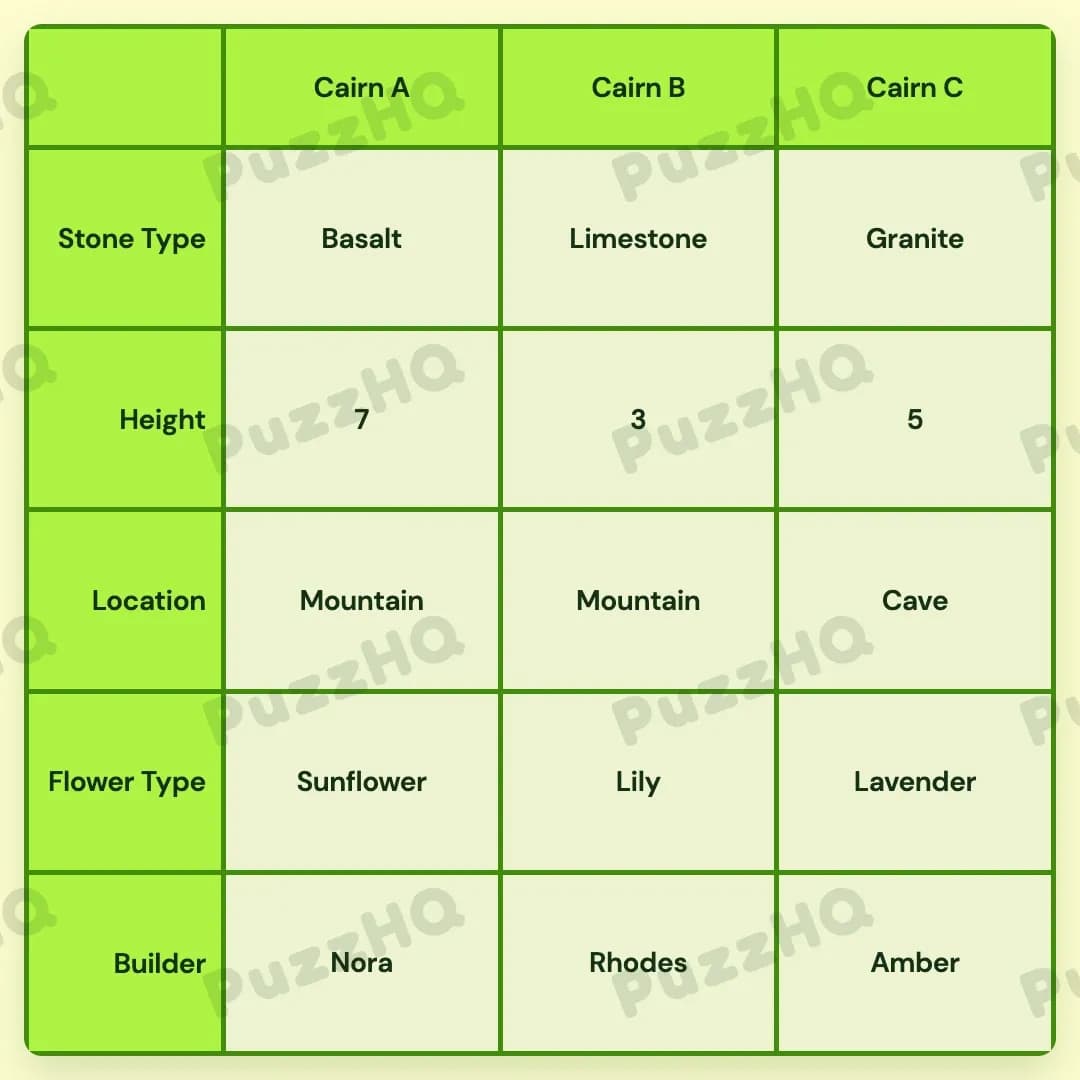
Before reading through the step-by-step breakdown below, take a look at the completed ledger to see where every stone and flower belongs.
| Trait | Cairn A | Cairn B | Cairn C |
|---|---|---|---|
| Stone Type | Basalt | Limestone | Granite |
| Height | 7 | 3 | 5 |
| Location | Mountain | Mountain | Cave |
| Flower Type | Sunflower | Lily | Lavender |
| Builder | Nora | Rhodes | Amber |
The Logic Behind Profile Perfect Level 353
This grid revolves around how physical positions and builder profiles immediately narrow down an otherwise open field. When dealing with three sequential trail markers across a row, a clue about the middle marker carries far more leverage than it might on a larger board. Once you realize how the middle position interacts with fixed numbers, the rest of the solve falls into place through clean adjacency rules and narrative pairing.
Amber Lays Down The Framework
The most productive place to start is with the details tied to Amber. We are told directly that Amber stacks five stones and decorates them with lavender. That gives us a tight, self-contained bundle of three attributes: builder, height, and flower type.
At the same time, we have a clear structural rule about the layout: the cairn in the middle is the shortest of the three. Because the available stone counts are three, five, and seven, the middle position at Cairn B must take the lowest value of three.
This single realization does a lot of heavy lifting. Amber built a stack of five stones, which means she cannot occupy the middle slot. That leaves Cairn A and Cairn C as her potential spots. When you look at how the remaining traits settle, placing Amber, her five stones, and her lavender at Cairn C leaves the tallest height of seven stones for Cairn A. The stone count across all three positions is solved in minutes: seven at Cairn A, three at Cairn B, and five at Cairn C.
Finding Room On The Mountain
With heights established, the builders and their geographic settings quickly take center stage. The clues tell us that Rhodes lost his way while navigating the mountain, and that Nora, upon seeing the cairn, knows Rhodes was nearby.
The idea of proximity plays an essential role here. For Nora to recognize that Rhodes was close at hand, their markers need to share the mountain terrain and sit alongside each other. Cairn A and Cairn B both belong to the mountain, which neatly accommodates both Rhodes and Nora while leaving the cave location for Amber at Cairn C.
Because Rhodes is tied to the mountain and sits in the center of the story at Cairn B, Nora naturally claims Cairn A. Amber is already established at Cairn C, meaning the entire row of builders from left to right is Nora, Rhodes, and Amber.
Separating Stones And Petals Across The Row
Once the builders and locations are sorted, the remaining traits come down to stone types and floral choices. We learn that a limestone cairn stands on the mountain, and that granite stones and sunflowers are not neighbors.
Look closely at the non-neighbor constraint. On a three-item board, the only way two elements can avoid being neighbors is if they occupy the extreme ends: Cairn A and Cairn C. If granite and sunflower were placed in any adjacent pairing involving Cairn B, the clue would be violated.
With Amber already settled at Cairn C, granite takes the stone slot at Cairn C, which forces sunflower to the far left at Cairn A. This completely avoids Cairn B, satisfying the clue.
From there, filling in the blanks is simple deduction. With granite at Cairn C, the clue about limestone standing on the mountain must apply to Cairn B. That leaves basalt as the only available stone for Cairn A. On the flower side, lavender sits at Cairn C and sunflower at Cairn A, leaving lily to complete Rhodes's marker at Cairn B.
The Clue I Would Read Twice
The clue stating that granite stones and sunflowers are not neighbors is the one worth pausing over. In larger logic puzzles, a negative neighborhood clue often leaves multiple possible arrangements, requiring several cross-checks before it becomes useful.
On a three-column board, however, negative adjacency is remarkably rigid. The only two slots that do not share a border are the first and the third. The moment you read that granite and sunflower cannot touch, you are not merely eliminating an adjacent pair. You are actively locking them into the outer positions of the grid. Recognizing that spatial property early saves considerable time and prevents second-guessing the stone distributions.
Final Thoughts
Level 353 offers a tidy, satisfying exercise in spatial reasoning. By blending physical marker positions with a simple trailside narrative of travelers leaving signs for one another, the puzzle never feels dry. Everything clicks into place through clean, interlocking deductions without requiring complicated trial and error.
Comments